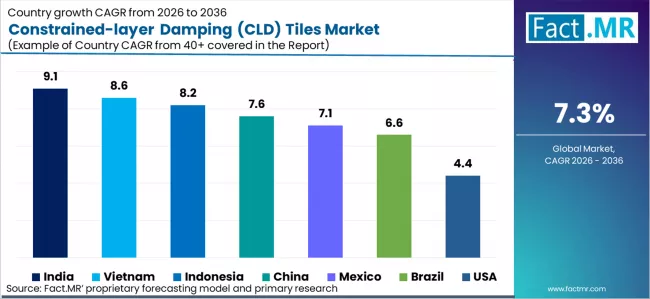
The Mexico Constrained-Layer Damping (CLD) Tiles market is gaining strong momentum, supported by expanding construction activities and growing awareness of noise and vibration control solutions. The market is estimated at USD 120 million in 2026, expected to reach USD 128 million in 2027, and is projected to grow to approximately USD 240 million by 2036, registering a CAGR of 7.1% during the forecast period.
The market is witnessing a shift from traditional soundproofing materials toward engineered CLD systems, particularly in commercial construction, industrial facilities, and transportation infrastructure. Increasing urbanization and stricter building standards are accelerating this transition.
Quick Stats
- Market Size (2026): USD 120 Million
- Market Size (2027): USD 128 Million
- Forecast Value (2036): USD 240 Million
- CAGR (2026–2036): 7.1%
- Incremental Opportunity: USD 120 Million
- Leading Segment: Self-Adhesive CLD Tiles (approx. 58–60% share)
- Leading Application: Construction & Infrastructure
- Key Players: 3M Company, Trelleborg AB, Sika AG, Henkel AG & Co. KGaA, Nitto Denko Corporation
Executive Insight for Decision Makers
- Strategic Shift: Mexico’s market is transitioning toward performance-based acoustic materials, driven by urban density and infrastructure modernization.
- For Manufacturers & OEMs:
- Focus on cost-effective, easy-to-install CLD tiles
- Align products with local building codes and noise standards
- For Investors:
- Mexico presents strong opportunities in construction-led demand clusters
- Risk of Inaction:
- Missing early positioning in a rapidly growing mid-tier market
- Losing competitiveness against imported advanced materials
Market Dynamics
Key Growth Drivers:
- Rapid urban construction and infrastructure projects
- Growing awareness of noise pollution in commercial and residential buildings
- Expansion of industrial and manufacturing facilities
- Increasing demand for cost-efficient acoustic solutions
Key Restraints:
- Price sensitivity among local contractors
- Limited awareness of advanced CLD technologies in smaller projects
- Dependence on imported high-performance materials
Emerging Trends:
- Adoption of self-adhesive CLD tiles for faster installation
- Integration in commercial real estate and office spaces
- Growing use in transport infrastructure (rail, logistics hubs)
- Rising interest in energy-efficient and acoustic-compliant buildings
Segment Analysis
- Leading Segment:
- Self-adhesive CLD tiles dominate due to ease of installation and reduced labor cost
- Material Stack Leader:
- Polymer + Metal layers lead adoption, offering durability and effective vibration damping
- Fastest-Growing Segment:
- CLD tiles in commercial construction and industrial facilities
- Application Breakdown:
- Construction & Infrastructure (dominant)
- Industrial machinery
- Automotive (emerging)
Strategic Importance:
Construction-driven demand makes Mexico a volume-driven market, with growing potential for premium solutions.
Supply Chain Analysis (Critical Insight)
- Raw Material Suppliers:
- Polymer producers, metal sheet manufacturers, adhesive suppliers
- Manufacturers / Producers:
- Global CLD tile producers and regional converters
- Distributors:
- Construction material distributors and industrial suppliers
- End-Users:
- Construction firms, contractors, industrial operators
Who Supplies Whom:
Global raw material suppliers → CLD manufacturers → Local distributors → Construction contractors → Final integration into buildings and infrastructure projects.
Imports play a significant role, especially for high-performance CLD systems, creating opportunities for local manufacturing expansion.
Pricing Trends
- Commodity vs Premium:
- Standard damping solutions dominate lower price segments
- Advanced CLD tiles priced higher due to performance and durability
- Key Influencing Factors:
- Import costs and tariffs
- Raw material price fluctuations
- Project scale and customization
- Margin Insights:
- Higher margins in commercial and industrial large-scale projects
- Competitive pricing pressure in residential construction
Regional Analysis (Mexico Focus)
Mexico stands out in Latin America due to:
- Strong construction and infrastructure investments
- Expanding industrial manufacturing base
- Increasing urban noise control requirements
Compared to developed markets:
- Mexico is growth-driven and cost-sensitive
- Adoption is accelerating as awareness and regulations evolve
Competitive Landscape
- Market Structure: Semi-fragmented with strong presence of global players
Key Players:
- 3M Company
- Trelleborg AB
- Sika AG
- Henkel AG & Co. KGaA
- Nitto Denko Corporation
- Saint-Gobain
- Rogers Corporation
Competitive Strategies:
- Expanding distribution networks in Mexico
- Offering cost-effective product variants
- Partnering with construction firms and OEMs
- Product innovation focused on ease of installation
Strategic Takeaways
For Manufacturers:
- Localize production or distribution to reduce costs
- Develop mid-range performance products suited for Mexico
For Investors:
- Target infrastructure and construction-linked opportunities
For Marketers / Distributors:
- Educate contractors on performance benefits of CLD tiles
- Focus on ease of use and installation savings
Future Outlook
Mexico’s CLD tiles market is expected to evolve into a key Latin American growth hub, supported by infrastructure modernization and rising acoustic standards.
- Increased penetration in urban construction projects
- Gradual shift toward higher-performance solutions
- Potential for local manufacturing expansion
Conclusion
The Mexico Constrained-Layer Damping (CLD) Tiles market is entering a high-growth phase, driven by construction expansion and increasing focus on noise control. As the market matures, the shift toward engineered damping solutions will unlock new opportunities for manufacturers and investors.
Why This Market Matters
With urbanization and infrastructure development accelerating, Mexico’s CLD tiles market represents a strategic opportunity to capitalize on rising demand for efficient, cost-effective acoustic solutions, making it a critical growth frontier in Latin America.