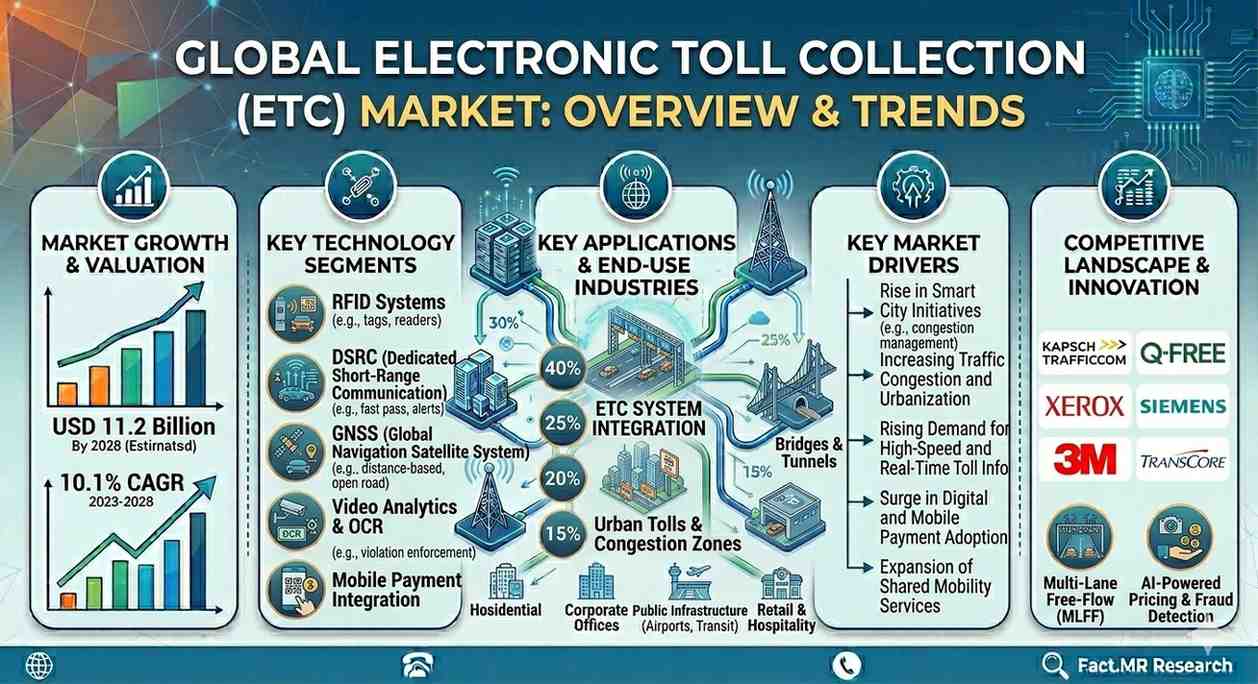
According to Fact.MR’s latest analysis, the global electronic toll collection (ETC) market is witnessing robust expansion driven by infrastructure modernization, smart mobility initiatives, and digital payment integration.
- Market Size (2026): USD 16.9 Billion
- Estimated (2027): USD 18.7 Billion
- Forecast (2036): USD 46.3 Billion
- CAGR (2026–2036): 10.6%
- Incremental Opportunity: USD 29.4 Billion
The market is transitioning from manual toll collection systems to fully automated, interoperable, and account-based tolling ecosystems. Governments worldwide are prioritizing ETC systems to reduce congestion, improve operational efficiency, and enable seamless transportation networks.
Quick Stats
- Market Size (2026): USD 16.9 Billion
- Market Size (2027): USD 18.7 Billion
- Forecast Value (2036): USD 46.3 Billion
- CAGR: 10.6%
- Incremental Opportunity: USD 29.4 Billion
- Leading Segment: RFID Technology (≈35.5% share)
- Leading Region: East Asia (China-led)
- Key Players: Kapsch TrafficCom AG, Conduent Incorporated, Siemens Mobility GmbH, Thales Group, TransCore, LP
Executive Insight for Decision Makers
The ETC market is evolving into a core component of intelligent transportation systems (ITS), shifting from hardware-driven deployments to integrated, software-led mobility platforms.
Strategic Shifts
- Transition toward interoperable, multi-lane free-flow tolling systems
- Integration with digital payments and mobility-as-a-service (MaaS)
- Rise of data-driven traffic management platforms
Action Imperatives
- OEMs must invest in AI-enabled toll analytics and ANPR systems
- Infrastructure players should adopt open-standard interoperable systems
- Investors should focus on high-growth regions with infrastructure expansion
Risk of Inaction
Failure to adopt advanced ETC solutions may result in traffic inefficiencies, revenue leakage, and non-compliance with evolving regulatory frameworks.
Market Dynamics
Key Growth Drivers
- Increasing adoption of cashless tolling systems globally
- Government initiatives for smart cities and highway modernization
- Rising need to reduce congestion and improve traffic flow
- Integration with digital payment ecosystems
Key Restraints
- High initial deployment and infrastructure costs
- Interoperability challenges across regions
- Data privacy and cybersecurity concerns
Emerging Trends
- Adoption of multi-lane free-flow (MLFF) tolling systems
- Growth of GNSS-based and video analytics tolling
- Expansion of account-based tolling platforms
- Integration with connected and autonomous vehicle ecosystems
Segment Analysis
By Technology
- RFID Technology: ~35.5% share (2026)
- Enables high-speed, accurate vehicle identification
By Product Type
- Transponders: ~23.2% share
- Core device enabling seamless toll transactions
By Application
- Highways (dominant), followed by urban roads and bridges
Fastest-Growing Segment
- Video analytics and GNSS-based tolling systems due to scalability and reduced hardware dependency
Strategic Importance
- RFID and transponder systems remain foundational
- Advanced technologies enable scalable, future-ready tolling infrastructure
Supply Chain Analysis (Critical Insight)
The ETC market operates through a complex, technology-driven value chain:
- Raw Material & Component Suppliers
- Semiconductor manufacturers
- Sensor and antenna component providers
- Communication module suppliers
- Technology & System Providers
- Kapsch TrafficCom AG
- Conduent Incorporated
- Siemens Mobility GmbH
- Thales Group
These players develop end-to-end ETC systems including software, hardware, and integration platforms.
- System Integrators & Contractors
- Infrastructure engineering firms
- ITS solution providers
- Government contractors
- Distributors & Service Providers
- Toll system operators
- Managed service providers
- Maintenance and support vendors
- End-Users
- Government transport authorities
- Highway operators
- Infrastructure concessionaires
Who Supplies Whom
- Component suppliers → ETC equipment manufacturers
- Manufacturers → System integrators / governments
- Integrators → Toll operators
- Operators → End-users (vehicle owners via toll services)
This ecosystem ensures long-term revenue through service contracts, upgrades, and transaction-based models.
Pricing Trends
- Commodity Layer: Basic RFID systems with standardized pricing
- Premium Layer: Advanced MLFF, GNSS, and analytics platforms
Key Pricing Drivers
- Technology complexity (RFID vs GNSS vs ANPR)
- Infrastructure scale and deployment size
- Regulatory compliance and certifications
- Integration with payment ecosystems
Margin Insights
- Hardware margins are moderate
- Software, analytics, and service contracts drive higher profitability
Regional Analysis
Top 5 Countries by CAGR (2026–2036)
- China – 10.0%
- South Korea – 7.6%
- United Kingdom – 7.4%
- United States – 6.6%
- Germany – 6.0%
Regional Insights
- East Asia: Dominates due to aggressive smart infrastructure investments
- North America: Mature market with high-value system upgrades
- Europe: Growth driven by regulatory frameworks and congestion pricing
Developed vs Emerging Markets
- Developed markets focus on system upgrades and interoperability
- Emerging markets emphasize new infrastructure deployment and expansion
Competitive Landscape
Market Structure
- Moderately concentrated with global system integrators
Key Players
- Kapsch TrafficCom AG
- Conduent Incorporated
- TransCore, LP
- Thales Group
- Cubic Corporation
- Siemens Mobility GmbH
- Egis Group
- Neology, Inc.
- Raytheon Technologies Corporation
- Verra Mobility Corporation
Competitive Strategies
- Focus on end-to-end integrated solutions
- Investment in AI, analytics, and interoperability
- Long-term government contracts and partnerships
- Expansion into emerging markets
Strategic Takeaways
For Manufacturers
- Invest in AI-driven tolling and MLFF systems
- Enhance interoperability and compliance capabilities
For Investors
- Target high-growth regions such as East Asia
- Focus on platform-based and recurring revenue models
For Marketers & Distributors
- Position solutions as efficiency and compliance enablers
- Build public-private partnership ecosystems
Future Outlook
The ETC market is set to become a cornerstone of smart mobility infrastructure:
- Growth in connected vehicle ecosystems
- Expansion of urban congestion pricing models
- Increasing reliance on data-driven traffic optimization
Technological innovation and sustainability goals will accelerate the shift toward fully automated, barrier-free tolling systems.
Conclusion
The global electronic toll collection market is entering a high-growth phase driven by digital transformation and infrastructure modernization.
Stakeholders that embrace advanced technologies, interoperability, and service-driven models will gain a competitive edge, while laggards risk losing relevance in an increasingly automated mobility ecosystem.
Why This Market Matters
Electronic toll collection is not just a payment system—it is a critical enabler of efficient, sustainable, and intelligent transportation networks, shaping the future of global mobility and infrastructure economics.
Browse Full Report:
https://www.factmr.com/report/electronic-toll-collection-market