Finland is rapidly positioning itself as a global leader in the hemicellulose-derived xylitol intermediates market, supported by its advanced pulp and paper industry, integrated biorefinery infrastructure, and strong alignment with Europe’s circular bioeconomy goals.
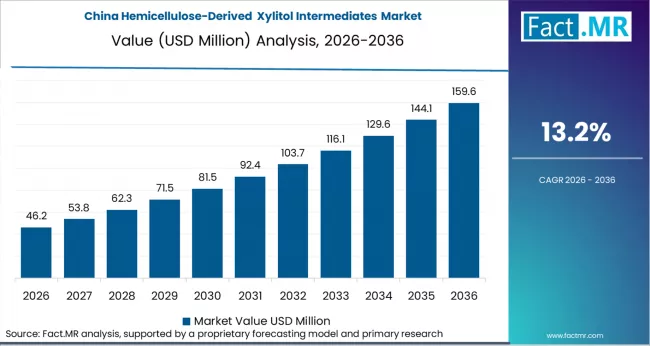
According to latest Fact.MR analysis, the global market is estimated at USD 420 million in 2026, expected to reach USD 465 million in 2027, and projected to surpass USD 1.45 billion by 2036, expanding at a CAGR of 11.9%. Within this landscape, Finland stands out with a projected CAGR of 12.5% through 2036, outpacing several developed markets due to its deep integration of forestry resources and biochemical processing.
The transformation is being driven by Finland’s ability to convert pulp mill side streams into high-value sugar alcohol intermediates, reinforcing its leadership in sustainable industrial biotechnology.
Quick Stats
- Global Market Size (2026): USD 420 Million
- Global Market Size (2027): USD 465 Million
- Global Forecast Value (2036): USD 1.45 Billion
- Global CAGR (2026–2036): 11.9%
- Finland CAGR: 12.5%
- Leading Segment: Food Grade (55% share)
- Leading Source: Hardwood (48% share)
- Regional Focus: Finland (Nordic biorefinery hub)
- Key Players: Danisco (IFF), Roquette Frères, Fazer, Shandong Longlive Bio
Executive Insight for Decision Makers
Finland’s market leadership is anchored in biorefinery integration and circular resource utilization, offering a blueprint for sustainable chemical manufacturing globally.
Strategic Imperatives:
- Leverage pulp mill integration to reduce feedstock costs
- Invest in high-purity processing technologies for food and pharma applications
- Strengthen export-oriented supply chains targeting Europe and global markets
- Align with EU bioeconomy and REACH compliance frameworks
Risk of Inaction:
Companies not aligning with Finland’s integrated and sustainable production model risk losing access to premium markets that prioritize traceability, compliance, and environmental performance.
Market Dynamics
Key Growth Drivers
- Strong forestry resource base enabling consistent hemicellulose supply
- Advanced biorefinery infrastructure integrated with pulp mills
- Rising demand for sustainable sweeteners and excipients
- EU-driven push for circular economy and bio-based chemicals
Key Restraints
- High capital investment required for biorefinery integration
- Complex processing and purification technologies
- Dependence on export markets for volume growth
Emerging Trends
- Conversion of pulp side streams into value-added chemicals
- Development of circular xylitol from oat hulls and biomass residues
- Increasing focus on traceable and certified supply chains
- Strategic collaborations across Nordic industrial clusters
Segment Analysis
- Leading Segment: Food-grade intermediates dominate with 55% share, driven by strict EU food safety standards
- Leading Source: Hardwood accounts for 48% share, supported by Finland’s forestry ecosystem
Breakdown:
- By Source: Hardwood (dominant), pulp residues, agricultural biomass
- By Grade: Food grade > Pharma grade > Industrial grade
- By Application: Sweeteners, pharmaceuticals, oral care
Strategic Importance:
Finland’s strength lies in high-quality, food-grade production, enabling premium pricing and strong export competitiveness.
Supply Chain Analysis (Who Supplies Whom)
Raw Material Suppliers:
- Finnish forestry companies supplying hardwood and pulp feedstock
Manufacturers / Producers:
- Integrated pulp mills and biorefineries extract hemicellulose and convert it into xylose and xylitol intermediates
Distributors:
- European specialty chemical and food ingredient distributors
End-Users:
- Food & beverage companies (low-calorie sweeteners)
- Pharmaceutical manufacturers (excipients)
- Oral care brands (functional ingredients)
Flow Explanation:
Forestry biomass → Pulp mill processing → Hemicellulose extraction → Biochemical conversion → High-purity intermediates → Export distribution → End-use industries
Finland’s vertically integrated model ensures cost efficiency, quality control, and supply stability.
Pricing Trends
- Finland-produced intermediates command premium pricing due to quality and traceability
- Pricing influenced by:
- Forestry feedstock costs
- Processing efficiency
- EU compliance and certification standards
Margin Insights:
- Strong margins in food and pharmaceutical-grade segments
- Export markets enhance value realization
Regional Analysis – Finland Focus
Finland operates as a biorefinery-centric hub within Europe, driven by:
- Abundant forestry resources
- Advanced pulp and paper industry integration
- Strong policy support for bioeconomy initiatives
Growth Drivers in Finland:
- Integration of industrial biotechnology with traditional forestry
- Long-term supply contracts and export strategies
- Investments in process optimization and sustainability
Comparison:
- Compared to other European markets, Finland leads in feedstock integration and process maturity
- Maintains competitive advantage over emerging markets through technology and compliance leadership
Competitive Landscape
- Market Structure: Semi-consolidated in Finland with strong presence of integrated players
Key Players:
- Danisco (IFF)
- Roquette Frères
- Fazer
- Futaste Pharmaceutical
- Huakang Pharma
Competitive Strategies
- Investment in circular production models
- Focus on high-purity and specialty applications
- Expansion of biorefinery capacities
- Strategic partnerships across European value chains
Strategic Takeaways
For Manufacturers:
- Integrate with pulp and forestry operations
- Focus on premium-grade production
For Investors:
- Finland offers strong opportunities in bio-based industrial innovation
- Target companies with scalable biorefinery models
For Marketers / Distributors:
- Emphasize European quality standards and sustainability credentials
- Expand presence in food and pharma segments
Future Outlook
Finland is expected to remain at the forefront of the hemicellulose-derived xylitol intermediates market, driven by:
- Continued investment in biorefinery innovation
- Expansion of circular economy initiatives
- Growing demand for sustainable and traceable ingredients
The country is likely to play a pivotal role in shaping the global bio-based chemicals value chain.
Conclusion
Finland’s leadership in the hemicellulose-derived xylitol intermediates market underscores the strategic importance of integrating natural resources with advanced industrial processing.
Why this market matters: Finland demonstrates how sustainable resource utilization, technological innovation, and regulatory alignment can unlock high-value opportunities in the global bioeconomy, making it a benchmark for future-ready chemical manufacturing.