Quick Stats
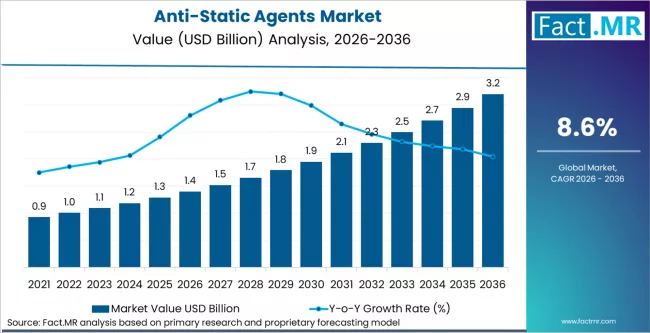
- Global Market Size (2026): USD 1.4 Billion
- Brazil CAGR (2026–2036): 9.1%
- Global Forecast Value (2036): USD 3.1 Billion
- Incremental Opportunity (Global): USD 1.7 Billion
- Leading Segment: Emulsion/Dispersion (~49% share)
- Brazil Key Demand Sectors: Packaging, Electronics, Automotive
- Key Players Active in Brazil: BASF SE, Dow Inc., Clariant AG, Evonik Industries AG, Croda International Plc
Executive Insight for Decision Makers
Brazil’s anti-static agents market is transitioning from basic additive consumption to performance-driven adoption.
- Manufacturers must localize production and tailor formulations for tropical climate conditions and diverse industrial applications.
- OEMs should prioritize ESD compliance in packaging and electronics assembly to meet export standards.
- Investors should focus on companies expanding distribution networks and partnerships in Latin America.
Risk of inaction: Companies that fail to adopt advanced anti-static technologies risk product damage during transport, regulatory non-compliance, and reduced competitiveness in export markets.
Market Dynamics
Key Growth Drivers
- Expansion of Brazil’s industrial and manufacturing base
- Rising demand for anti-static packaging in logistics and exports
- Growth in consumer electronics and automotive production
- Increasing awareness of ESD safety and product quality standards
Key Restraints
- Dependence on imported raw materials and price volatility
- Limited availability of advanced formulation technologies locally
- Cost sensitivity among small and mid-scale manufacturers
Emerging Trends
- Adoption of high-performance and permanent anti-static additives
- Growing demand for sustainable and bio-based solutions
- Increased use in flexible packaging and industrial films
- Integration with advanced polymer processing technologies
Segment Analysis
- Leading Segment: Emulsion/Dispersion (~49% share globally)
- Widely used in Brazil for packaging films and textiles due to ease of application
- Material Leader: Quaternary ammonium compounds (~46%)
- Preferred for cost-effective static control and antimicrobial benefits
- Fastest-Growing Segment in Brazil: Internal anti-static agents
- Driven by demand from electronics and automotive component manufacturing
Strategic Insight:
Brazilian industries are gradually shifting toward durable, long-lasting anti-static solutions, especially for export-oriented manufacturing.
Supply Chain Analysis (Very Important)
Raw Material Suppliers:
Primarily global petrochemical firms supplying amines, surfactants, and specialty chemicals, often imported into Brazil.Manufacturers / Producers:
Multinational chemical companies operate regional facilities or supply through imports to produce custom anti-static formulations.Distributors:
Local chemical distributors play a crucial role in supplying plastic processors, packaging manufacturers, and textile producers.End-Users in Brazil:
- Packaging companies → export-oriented goods requiring ESD-safe handling
- Electronics assemblers → static-sensitive components
- Automotive manufacturers → interior plastics and components
- Textile producers → synthetic fabrics requiring static control
Who Supplies Whom:
Global raw material suppliers → regional chemical manufacturers → Brazilian distributors → industrial processors → OEMs and exporters.
Pricing Trends
- Commodity Segment: External anti-static agents dominate price-sensitive applications
- Premium Segment: Internal, permanent additives gaining traction in high-value sectors
Key Influencing Factors:
- Import costs and currency fluctuations
- Raw material price volatility
- Performance requirements for export compliance
- Volume-based industrial demand
Margin Insight:
Premium products offer higher margins but are limited to advanced manufacturing sectors, while commodity products dominate mass-market applications.
Regional Analysis – Brazil Focus
Brazil is the fastest-growing market in Latin America, supported by:
- Strong expansion in industrial manufacturing and exports
- Increasing demand for advanced packaging solutions
- Growth in automotive production and electronics assembly
Comparison:
- Brazil (Emerging Market): High growth, cost-sensitive, import-dependent
- Developed Markets: Slower growth but higher adoption of premium technologies
Brazil’s strategic position as a regional manufacturing hub is expected to drive sustained demand for anti-static agents.
Competitive Landscape
Market Structure: Moderately fragmented with strong multinational presenceKey Players in Brazil:
- BASF SE
- Dow Inc.
- Clariant AG
- Evonik Industries AG
- Croda International Plc
- Solvay S.A.
Competitive Strategies:
- Expansion of regional distribution networks
- Focus on cost-effective and customized formulations
- Investment in sustainable product development
- Strategic partnerships with local manufacturers
Strategic Takeaways
For Manufacturers:
- Localize supply chains to reduce import dependency
- Develop cost-efficient yet high-performance formulations
For Investors:
- Target companies expanding in Latin America, especially Brazil
- Focus on firms with strong distribution and local partnerships
For Marketers & Distributors:
- Highlight ESD compliance and export-readiness
- Strengthen relationships with packaging and automotive sectors
Future Outlook
Brazil’s anti-static agents market is set to benefit from industrial modernization, export growth, and increasing regulatory alignment. The shift toward sustainable and high-performance materials will open new opportunities for innovation and premium product adoption.Conclusion
Brazil is rapidly evolving into a key growth engine for the anti-static agents market in Latin America. As industries scale and global trade intensifies, demand for reliable static control solutions will continue to rise.For decision-makers, success will depend on balancing cost, performance, and supply chain efficiency while aligning with global quality and sustainability standards.