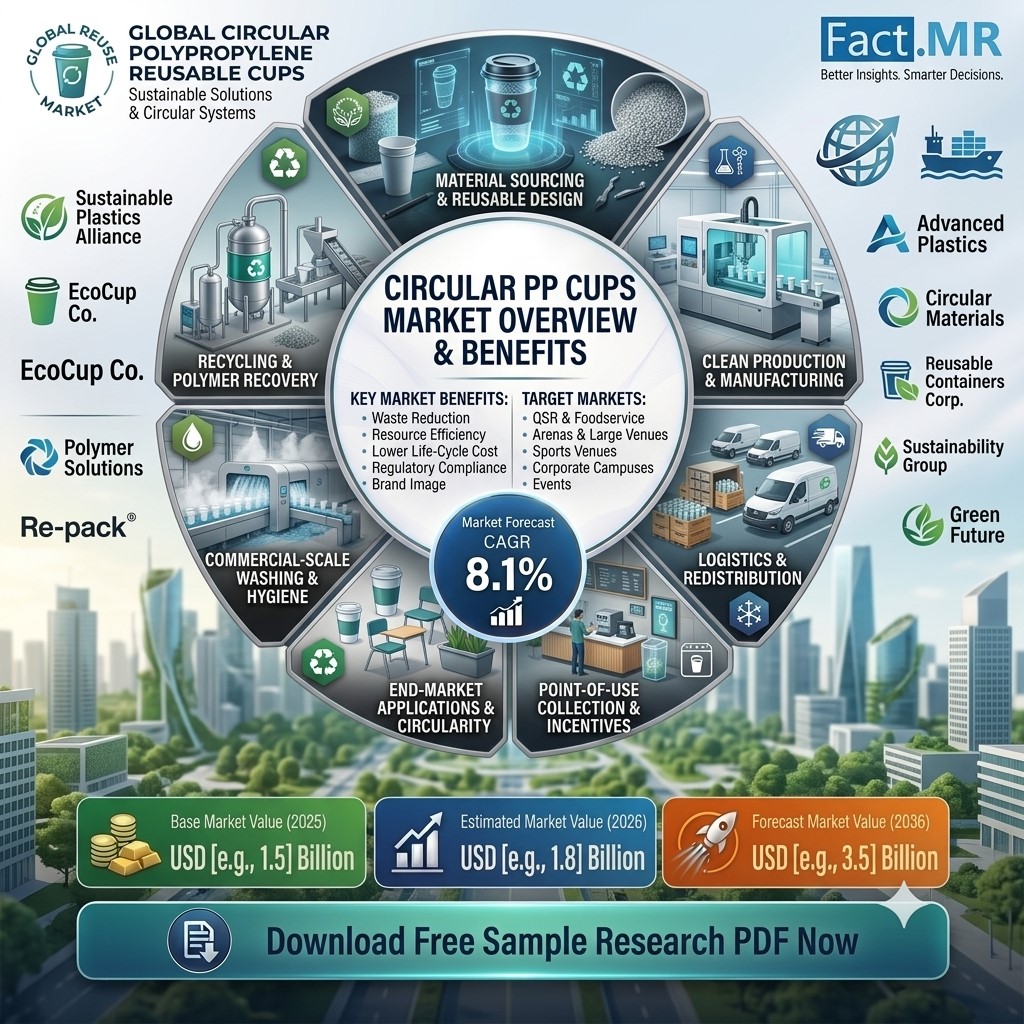
Rockville, MD., October 13, 2026 — The Circular Polypropylene Reusable Cups Market is projected to grow from USD 1.7 billion in 2026 to USD 5.1 billion by 2036, registering an 11.9% CAGR, according to Fact.MR. The market was valued at USD 1.5 billion in 2025 and is expected to create an absolute opportunity of USD 3.4 billion between 2026 and 2036. Stadiums, festivals and foodservice operators are among the end users adopting reusable cup systems to support repeated serving, collection and washing.
The market’s expansion is closely linked to the practical requirements of returnable packaging. Venue operators need cups that withstand repeated handling, fit concession counters and return efficiently to washing facilities. Fact.MR estimates that post-consumer recycled (PCR) polypropylene will account for 36.0% of the market by cup material in 2026, while venue deposit-return models will hold a 31.0% share by use model.
Get detailed market forecasts, competitive benchmarking, and pricing trends.
Circular Polypropylene Reusable Cups Market: Deposit-Return Models Shape Demand
Circular polypropylene reusable cups are designed for repeated beverage service, collection, washing and redeployment. Their applications include stadiums, festivals, cinemas, theme parks and campus foodservice. Unlike single-use cups, reusable formats depend on an operating system that brings used cups back into circulation.
The business case depends on more than the cup itself. Operators must consider collection points, washing capacity, storage and replacement costs. Fact.MR identifies cup losses outside controlled venues, washing expenses and food-contact documentation as restraints on market adoption.
Regulatory developments are also influencing purchasing decisions. The German Federal Environment Ministry states that the European Union’s Packaging and Packaging Waste Regulation (EU) 2025/40 entered into force on February 11, 2025, and applies from August 12, 2026. The regulation establishes requirements covering packaging sustainability, recycled content and reuse targets in specified sectors.
[LINK: European Commission packaging and packaging waste regulation]
PCR Polypropylene Leads the Material Segment
PCR polypropylene is expected to account for 36.0% of the Circular Polypropylene Reusable Cups Market in 2026. Fact.MR links its leading position to recycled-content objectives and the material’s suitability for repeated handling and washing.
Virgin and recycled polypropylene blends, rPET/PET blends, bio-attributed polypropylene and other reusable polymers also feature in the report’s segmentation. Buyers need to assess durability and food-contact suitability alongside recycled-content claims before selecting a material for repeated beverage service.
Venue deposit-return is projected to represent 31.0% of the market by use model in 2026. A refundable deposit gives customers a direct reason to return their cups and provides operators with a defined collection process.
The capacity segment below 300 mL is expected to hold a 29.0% share in 2026. Smaller formats suit coffee, water and soft-drink portions in venues where stacking, washing and rapid service affect operating efficiency.
Stadiums are estimated to account for 33.0% of market demand by end use in 2026. Controlled concession areas, predictable attendance and organized collection points can make these venues practical settings for reusable cup programs.
France Leads Country-Level Market Growth
France is projected to record the highest country CAGR at 12.8% through 2036. Fact.MR attributes the outlook to reuse policy and event-led foodservice demand. France received 102 million international visitors in 2025, according to the country’s Ministry of Economy in February 2026.
China is forecast to expand at a 12.1% CAGR. The National Bureau of Statistics of China reported that catering industry income reached 5,798.2 billion yuan in 2025, up 3.2% from the previous year. The size of the foodservice market creates opportunities for reusable cup programs in urban venues and entertainment locations.
The United States and Japan are each projected to grow at an 11.6% CAGR through 2036. The U.S. Department of Agriculture’s Economic Research Service reported that inflation-adjusted food-away-from-home spending reached USD 1.41 trillion in 2025, measured in 2025 dollars. In Japan, the Japan National Tourism Organization reported 42,683,600 inbound visitor arrivals during 2025.
Germany is forecast to record an 11.4% CAGR, the lowest among the five countries covered. Reusable-offer requirements and event-based cup programs are among the factors supporting its market outlook.
Competitive Landscape
The Circular Polypropylene Reusable Cups Market includes Amcor plc, including the former Berry Global reusable-cup portfolio, Greiner Packaging and Faerch. Competition spans cup design, recycled-material selection, durability, decoration and compatibility with collection and washing systems.
In February 2025, Berry Global reported that its reusable polypropylene cup range could incorporate embedded radio-frequency identification (RFID) chips or unique QR codes. According to the company, these technologies can support deposit and refill systems, wash-cycle tracking and inventory management. Such features provide operators with options for tracking cups across repeated-use cycles.
Greiner Packaging reported in June 2025 that reusable polypropylene drinking cups replaced single-use plastic cups during a DTM race weekend at DEKRA Lausitzring, attended by around 52,000 fans. The example illustrates how managed sporting events can provide a controlled setting for reusable cup operations.
Shambhu Nath Jha, Principal Consultant at Fact.MR, said, “Reusable cup economics now depend on return behavior as much as cup design. A durable polypropylene cup works when the venue collects cups and redeploys them after washing. Suppliers are expected to pair material know-how with tracking. Branding and operator training help each event keep leakage low.”
Report Scope and Methodology
Fact.MR’s analysis covers cup material, use model, capacity and end use, alongside regional and country-level forecasts from 2026 to 2036. The study uses a hybrid top-down and bottom-up approach informed by foodservice demand, venue adoption, reuse policy, material selection and supplier portfolios. The methodology draws on primary research, desk research, market sizing, forecasting and data validation.
Top Reports:
HDR (High Dynamic Range) Video Camera Market
Coin-Operated Laundries and Drycleaners Market
About FactMR
Fact.MR is a market research and consulting firm providing syndicated research, customized research and market intelligence across industries. Its research combines market sizing, forecasting, competitive assessment and industry analysis to support business decisions.