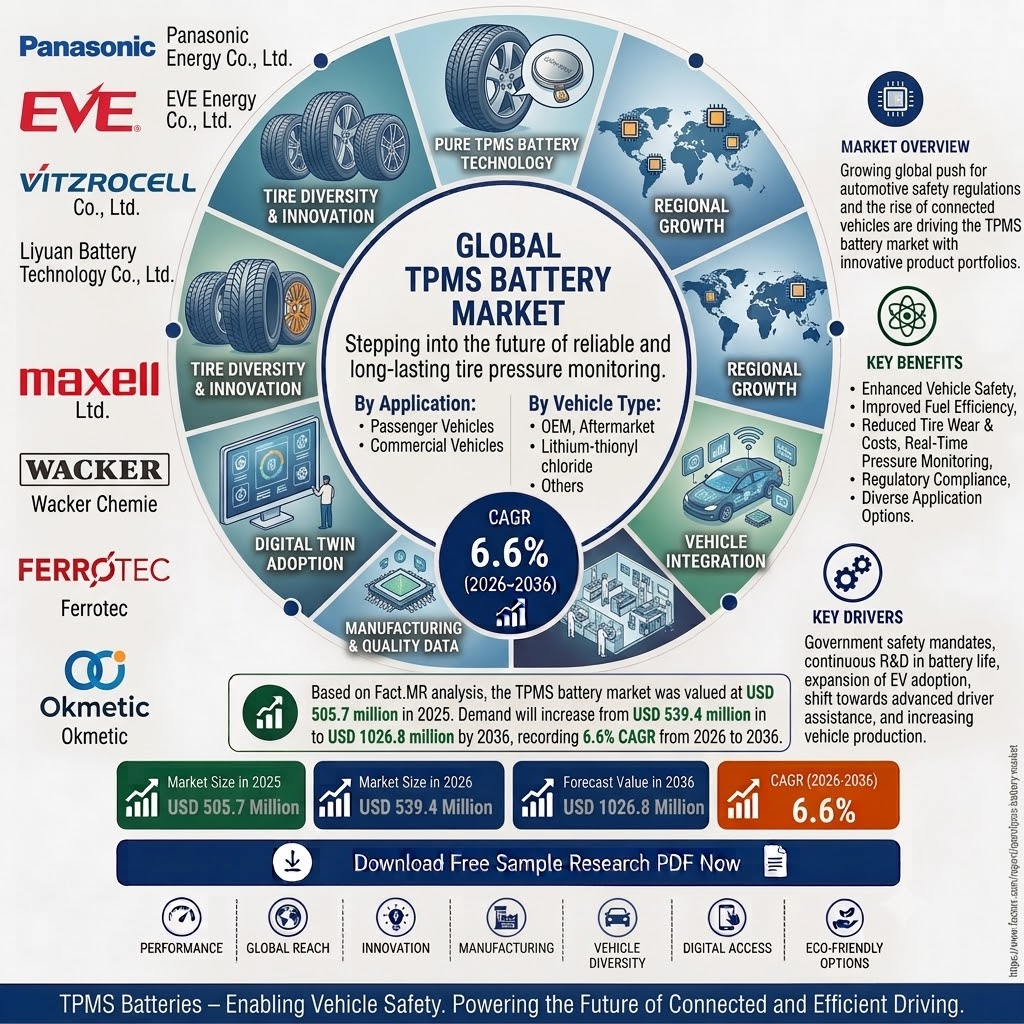
The global TPMS battery market is projected to grow from USD 539.4 million in 2026 to USD 1.03 billion by 2036, registering a compound annual growth rate (CAGR) of 6.6%, according to Fact.MR. The market is expected to create an absolute dollar opportunity of USD 487.4 million over the forecast period. Demand is supported by factory installation of tire-pressure monitoring systems, replacement of aging sensor units, and the need for dependable battery performance under changing temperatures and continuous wheel rotation.
Tire pressure monitoring system (TPMS) batteries power sensors that measure tire pressure and transmit readings to vehicle systems. Their reliability affects how consistently drivers receive tire-pressure alerts. As vehicles remain in service for longer periods, battery replacement and complete sensor replacement create additional demand alongside original equipment installations.
Get detailed market forecasts, competitive benchmarking, and pricing trends
OEM Installation and Replacement Demand Support Growth
Original equipment manufacturers (OEMs) are projected to account for 63.5% of the TPMS battery market’s sales-channel share in 2026. Automakers incorporate approved tire-pressure sensors during vehicle production, making battery performance and compatibility important during component qualification. Battery suppliers must meet requirements for operating life, temperature tolerance, power consumption, and dependable communication with sensor electronics.
Passenger vehicles are expected to represent 76.8% of the market by vehicle type in 2026. The segment’s leading position reflects the large number of passenger vehicles fitted with direct TPMS technology. Each compatible sensor requires a suitable power source, creating demand through both new-vehicle production and replacement cycles.
The aftermarket provides another source of revenue. When a sealed direct TPMS sensor battery reaches the end of its operating life, technicians often replace the complete sensor assembly rather than the battery alone. This makes accurate vehicle compatibility information and access to appropriate replacement parts important for workshops and distributors.
Battery Longevity and Operating Conditions Shape Product Selection
Lithium-ion batteries are projected to hold 58.4% of the battery-type segment in 2026, according to Fact.MR. Battery selection depends on more than capacity alone. TPMS batteries must support low-power operation over extended periods while tolerating the heat, cold, vibration, and rotation experienced inside a wheel.
Sensor manufacturers assess batteries alongside the electronic circuits they power. Changes in circuit design and wireless reporting frequency can affect energy consumption and overall sensor life. Suppliers that demonstrate consistent performance under real operating conditions can strengthen their position with sensor manufacturers and automotive customers.
Longer battery life can reduce the frequency of sensor replacement and associated workshop labor. However, manufacturers must balance durability, size, cost, and compatibility with specific sensor designs. Testing complete sensor assemblies is therefore an important part of product qualification.
Germany and Brazil Present Strong Growth Opportunities
Germany’s TPMS battery market is forecast to expand at a CAGR of 8.3% through 2036, the highest rate among the countries highlighted in the Fact.MR report. The country’s established automotive industry, large passenger-car fleet, and demanding automotive component qualification requirements create opportunities for suppliers that can demonstrate reliable performance and consistent quality.
Brazil is projected to record a CAGR of 7.6%. Its broad vehicle base and replacement demand create opportunities for aftermarket suppliers. As vehicles equipped with direct TPMS sensors age, workshops will need suitable replacement units and reliable information on compatibility across different vehicle models.
The United States is expected to grow at a CAGR of 6.8%, supported by widespread TPMS use and replacement needs as installed sensors age. The United Kingdom is forecast to register a 6.1% CAGR, while Japan is projected to expand at 5.4%. Across these markets, product qualification, battery endurance, and efficient aftermarket servicing will influence supplier opportunities.
Analyst Perspective
Shambhu Nath Jha, Principal Consultant at Fact.MR, states, “Longer battery life reduces the need for sensor replacement, which often involves removing the wheel. Sensor designers will focus on reliable power in hot and cold conditions, while repair businesses need replacement parts that match each vehicle model.”
This outlook highlights the role of battery reliability in the overall cost of maintaining TPMS-equipped vehicles. Battery producers and sensor manufacturers can address this need by testing power sources under realistic operating conditions and improving compatibility information for replacement parts.
Competitive Landscape
Competition in the TPMS battery market is shaped by operating life, temperature performance, quality consistency, and the ability to meet automotive qualification requirements. Battery manufacturers must demonstrate that their products work reliably within compact sensor assemblies over extended service periods.
Key companies profiled by Fact.MR include Panasonic Energy Co., Ltd., EVE Energy Co., Ltd., VITZROCELL Co., Ltd., Liyuan Battery Technology Co., Ltd., and Maxell Ltd. These suppliers operate in the battery segment, where product suitability depends on the technical requirements of individual sensor designs.
Manufacturers that provide traceable cell supply, consistent testing results, and technical support can improve their prospects with OEMs and aftermarket customers. As sensor replacement demand develops, distributors and repair businesses will also need accurate part-matching information to reduce installation errors and unnecessary service work.
Market Snapshot
The global TPMS battery market was valued at USD 505.7 million in 2025 and is estimated to reach USD 539.4 million in 2026. Fact.MR projects the market to reach USD 1.03 billion by 2036, representing a CAGR of 6.6% from 2026 to 2036. Lithium-ion batteries are projected to account for 58.4% of battery-type share, passenger vehicles for 76.8% of vehicle-type share, and OEMs for 63.5% of sales-channel share in 2026.
To View Top Reports
Lithium-ion Battery Recycling Market
About Fact.MR
Fact.MR is a market research and consulting company providing market intelligence, competitive analysis, and forecasting across global industries. Its research covers emerging technologies, evolving consumer trends, industrial developments, and changing business environments. Fact.MR delivers data-driven insights designed to support strategic planning, investment decisions, and market-entry initiatives.