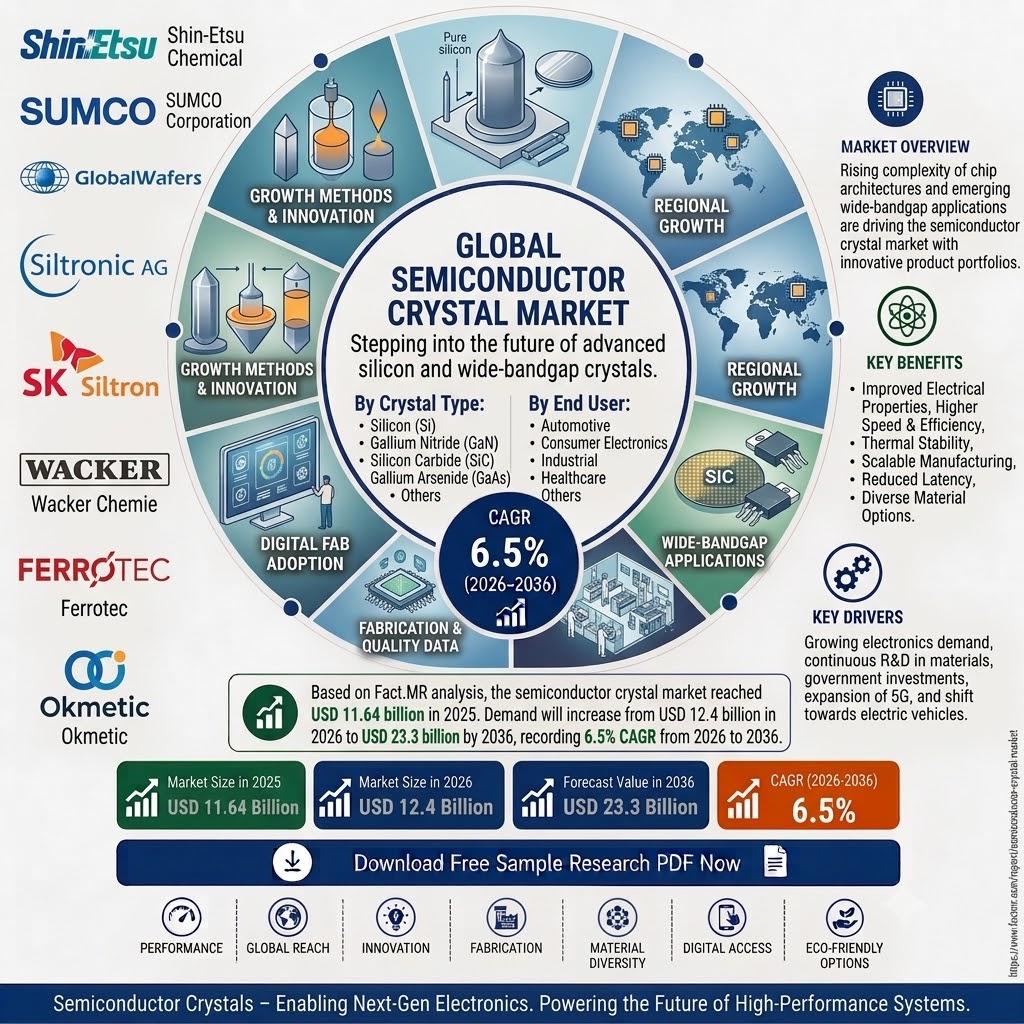
The global semiconductor crystal market is projected to grow from USD 12.4 billion in 2026 to USD 23.3 billion by 2036, registering a compound annual growth rate (CAGR) of 6.5%, according to Fact.MR. The market is expected to create an absolute dollar opportunity of USD 10.9 billion over the forecast period. Rising demand for power electronics, advanced computing, and radio-frequency components is increasing the need for high-quality crystal materials used in semiconductor wafer and substrate manufacturing.
Semiconductor crystals provide the foundation for manufacturing chips used in vehicles, data centers, telecommunications equipment, industrial systems, and consumer electronics. As chipmakers expand fabrication capacity and adopt more demanding device architectures, crystal purity, defect control, and supply reliability are becoming central considerations in material procurement. Suppliers that can meet strict specifications while scaling production are positioned to benefit from evolving semiconductor requirements.
Get detailed market forecasts, competitive benchmarking, and pricing trends
Electric Vehicles and AI Infrastructure Drive Material Demand
The expansion of electric vehicles is strengthening demand for semiconductor materials capable of handling higher voltages and operating temperatures. Silicon carbide crystals are particularly relevant to power electronics used in electric and hybrid vehicles, charging systems, and renewable energy equipment. Their role in wide-bandgap devices creates opportunities for crystal and substrate suppliers to expand beyond conventional silicon products.
AI infrastructure is adding another source of demand. Data centers and AI accelerators require advanced processors, memory, and supporting power systems. These applications depend on semiconductor manufacturing processes that require consistent crystal quality and reliable wafer supply. Continued investment in computing infrastructure is therefore increasing the importance of qualified material suppliers.
Telecommunications remains another area of opportunity. The rollout of 5G networks and expansion of radio-frequency device manufacturing support demand for compound semiconductor materials, including gallium arsenide. These crystals serve applications where electrical and optical properties differ from those of conventional silicon.
Silicon Retains Its Lead as Compound Crystals Gain Attention
Silicon is projected to account for 54.2% of the semiconductor crystal market by type in 2026. Its established manufacturing ecosystem, cost efficiency, and widespread use in logic and memory devices support its leading position. Established crystal-growth methods and extensive wafer-processing capabilities also make silicon a core material for semiconductor fabrication.
However, the market is not limited to silicon. Gallium arsenide supports radio-frequency and optoelectronic applications, while silicon carbide is gaining traction in high-power devices. Germanium and other specialty crystals serve selected sensing, photonics, and related applications.
Automotive is expected to represent 29.0% of the application segment in 2026. The growing electronic content of vehicles, including power-control systems and sensors, supports demand for crystal substrates used in automotive semiconductors. Industrial electronics, consumer devices, and telecommunications equipment contribute additional demand across the market.
High Capital Costs and Qualification Requirements Shape Competition
Semiconductor crystal production requires specialized facilities, tight process controls, and substantial capital investment. Manufacturers must maintain purity and manage crystal defects to meet the specifications required by semiconductor customers. These technical demands can make capacity expansion costly and slow.
Raw material and energy price fluctuations create further operational challenges. New suppliers also face extended qualification cycles before their materials are accepted for use in chip manufacturing. Buyers are increasingly diversifying their supply sources to reduce dependence on individual suppliers, creating opportunities for qualified producers while raising the importance of consistent performance.
Capacity expansion in silicon carbide and other wide-bandgap materials represents a strategic opportunity. Suppliers that invest in crystal-growth technology, defect management, and customer qualification programs may be better placed to serve automotive, power electronics, and advanced computing customers.
USA Leads Country-Level Growth Forecasts
The United States is projected to record the fastest growth among the countries highlighted by Fact.MR, with a CAGR of 8.2% through 2036. Investment in domestic semiconductor fabrication and efforts to strengthen supply-chain resilience are supporting demand for crystal materials and wafers. New manufacturing capacity can create additional opportunities for suppliers able to meet local customer requirements.
The United Kingdom is forecast to expand at a CAGR of 7.4%, supported by power electronics and compound semiconductor demand. Brazil is projected to grow at 7.1%, with expanding electronics assembly contributing to demand. Germany is expected to register a CAGR of 5.9%, while Japan is forecast to grow at 5.5%, reflecting established semiconductor and electronics industries.
These markets present different growth profiles. New fabrication investment and supplier diversification are important in the United States, while compound semiconductor capabilities and automotive electronics contribute to demand across several other countries.
Analyst Perspective
Shambhu Nath Jha, Principal Consultant at Fact.MR, states, “Buyers are now treating crystal purity and supply security as measurable procurement criteria rather than secondary concerns. Fabricators will favor suppliers that can document consistent defect rates and scale wide-bandgap output alongside core silicon production. Vendors that combine qualified wafer supply with dedicated technical support will capture the strongest share of automotive and data center design wins.”
The analysis points to a market in which production scale alone may not be sufficient to secure customer relationships. Material consistency, qualification support, and the ability to supply different crystal types will remain important as semiconductor manufacturers respond to changing device requirements.
Competitive Landscape
Competition spans large silicon wafer producers and specialist suppliers serving compound semiconductor and specialty wafer applications. Companies compete on purity, wafer-size coverage, manufacturing consistency, technical support, and the ability to meet customer qualification requirements.
Key companies profiled by Fact.MR include Shin-Etsu Chemical, SUMCO Corporation, GlobalWafers, Siltronic AG, SK Siltron, Wacker Chemie, Ferrotec, and Okmetic. Their product portfolios address different parts of the semiconductor materials supply chain, from mainstream silicon wafers to specialty substrates and materials used in selected device applications.
The expansion of wide-bandgap semiconductor production is creating additional opportunities for suppliers with relevant crystal-growth capabilities. Continued investment in production capacity and quality control will be important as automotive, industrial, and data center applications demand increasingly specialized materials.
Market Snapshot
The semiconductor crystal market was valued at USD 11.64 billion in 2025 and is estimated to reach USD 12.4 billion in 2026. Fact.MR projects the market to reach USD 23.3 billion by 2036, representing a CAGR of 6.5% during 2026–2036. Silicon is projected to account for 54.2% of type share, while automotive is expected to represent 29.0% of application share in 2026.
To View Top Reports
About Fact.MR
Fact.MR is a market research and consulting company providing market intelligence, competitive analysis, and forecasting across global industries. Its research covers emerging technologies, evolving consumer trends, industrial developments, and changing business environments. Fact.MR delivers data-driven insights designed to support strategic planning, investment decisions, and market-entry initiatives.