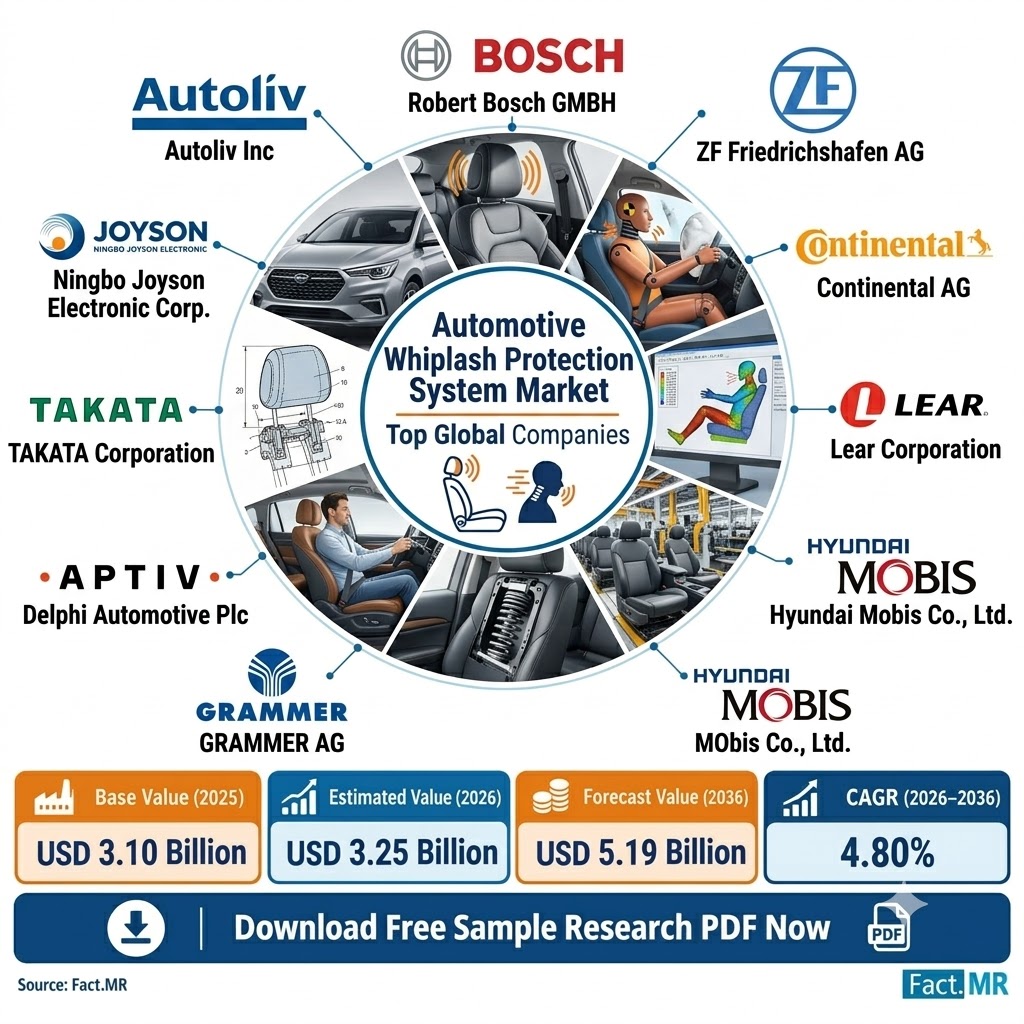
The global automotive whiplash protection system market is projected to increase from USD 3.25 billion in 2026 to USD 5.19 billion by 2036, expanding at a compound annual growth rate (CAGR) of 4.80%, according to the supplied Fact.MR market analysis. The market was valued at USD 3.10 billion in 2025. The forecast represents an incremental opportunity of approximately USD 1.94 billion between 2026 and 2036.
Demand is linked to automakers’ efforts to improve occupant protection, meet applicable head-restraint requirements and achieve stronger crash-test ratings. Manufacturers are also evaluating electronically controlled proactive head restraints that use pre-crash sensor information to adjust headrest position before impact. These systems offer suppliers an opportunity to move beyond conventional mechanical designs, although additional electronics and assembly requirements can increase costs.
Get detailed market forecasts, competitive benchmarking, and pricing trends:
Safety requirements shape procurement decisions
Crash-test performance and occupant-protection requirements influence how automakers specify seating systems across vehicle platforms. The supplied source identifies the European New Car Assessment Programme (Euro NCAP) and the US National Highway Traffic Safety Administration (NHTSA) as important influences on whiplash protection adoption.
The source bibliography lists Euro NCAP’s 2024 Assessment Protocol: Adult Occupant Protection, Whiplash Test Procedure, Version 9.1, and NHTSA’s 2024 Federal Motor Vehicle Safety Standard No. 202a: Head Restraints. Procurement teams should verify the applicable protocol versions and regulatory requirements for each vehicle category and market before using these references in compliance decisions.
The analysis also identifies insurance-related incentives, expanding vehicle production in Asian markets and the wider adoption of advanced safety features as demand drivers. However, the source does not provide a dated regulatory deadline or a newly announced mandate establishing universal whiplash protection requirements across all vehicles.
Where growth is fastest
The country outlook points to stronger projected growth in selected Asian markets, while European markets continue to provide an important reference point for vehicle safety specifications. The detailed country outlook in the supplied material reports the following CAGRs for 2026–2036:
- India — 7.3% CAGR: The source attributes growth potential to rising vehicle sales, increased road-safety awareness and the possibility of stronger safety requirements. Cost sensitivity and the pace of regulatory adoption remain relevant considerations.
- China — 6.8% CAGR: Vehicle production, demand for advanced safety features and investment in electric and autonomous vehicle technologies are identified as growth drivers.
- United States — 6.6% CAGR: The detailed country section identifies vehicle safety requirements and consumer interest in occupant protection as demand factors.
- Germany — 4.5% CAGR: The country comparison in the supplied source lists Germany among the established automotive markets with continued demand for whiplash protection systems.
- United Kingdom — 3.9% CAGR: The source’s regional comparison indicates a more moderate growth trajectory through 2036.
These figures are reproduced from the source’s country-level sections and comparison text. The report material contains conflicting US and India growth estimates elsewhere; these differences require confirmation before publication.
What leads the market
Passenger vehicles and proactive head restraints are the two leading segments identified in the supplied analysis.
- Passenger vehicles — 81.0% share in 2026: Passenger cars account for the largest reported share by vehicle type. The source associates this position with consumer demand for occupant protection and the integration of head-restraint technologies into vehicle safety packages.
- Proactive head restraints — 27.0% share in 2026: This configuration is identified as the leading system-type segment in the supplied key takeaways. Proactive systems adjust headrest position before a collision, while electronically controlled versions can incorporate sensor information into the adjustment process.
The analysis covers reactive head restraints, proactive head restraints, pendulum-based systems, spring-activated mechanisms and pyrotechnic head-restraint devices. Its scope includes original equipment manufacturer (OEM) and aftermarket sales for passenger and commercial vehicles. Standard non-adjustable headrests without active or reactive whiplash mitigation technology are excluded.
The hurdle: Cost and integration complexity
System cost remains a constraint on broader adoption of more advanced configurations. The supplied analysis identifies actuator material prices and assembly complexity as factors affecting costs. Electronically controlled proactive systems can also require sensor integration and changes to seat-module architecture.
For automakers, the procurement decision involves balancing occupant-protection performance against component costs, packaging requirements and manufacturing complexity. Suppliers that can integrate head-restraint technology with wider seating and occupant-restraint systems may be better positioned to compete for vehicle-platform specifications. This is a strategic implication of the supplied analysis, not a reported guarantee of commercial performance.
The source also identifies cost sensitivity in India and differences in the pace of safety-standard adoption across markets as factors that could influence deployment.
Industry investment and competitive activity
The supplied report identifies established automotive safety and seating suppliers as participants in the market. It does not provide sufficiently specific, dated company announcements to support a list of recent developments with month and year.
Companies profiled in the source include:
- Autoliv Inc.
- TAKATA Corporation
- Robert Bosch GmbH
- Delphi Automotive Plc
- ZF Friedrichshafen AG
- Continental AG
- GRAMMER AG
- Lear Corporation
- Hyundai Mobis Co., Ltd.
- Ningbo Jpyson Electronic Corp.
The source describes product offerings across head restraints, seating systems, airbags, seatbelt technologies and other occupant-safety components. These descriptions are presented as company profiles in the supplied material; they should not be interpreted as confirmation that every company currently supplies a specific whiplash protection product in every market.
Analyst opinion
The supplied Fact.MR material contains the following analyst commentary. The analyst’s name and professional title were not provided, so the passage should not be presented as a fully verified, named quotation until attribution is confirmed.
“Whiplash protection system procurement is increasingly governed by crash test rating algorithms rather than standalone safety feature marketing. Automakers that fail to achieve maximum occupant protection scores face measurable sales penalties in markets where safety ratings directly influence buyer decisions. The migration from reactive mechanical systems to electronically controlled pro-active configurations represents the primary margin opportunity, but requires sensor integration capabilities that add cost and complexity to the seat assembly process. Tier-1 suppliers that cannot bundle whiplash protection with broader occupant restraint packages risk losing specification authority to competitors offering integrated safety modules.”
What this means for automotive buyers and suppliers
- Review seat-module specifications early. Engineering and procurement teams should evaluate whether proactive head restraints can be integrated into planned seat architectures while meeting the applicable requirements for each target vehicle and market.
- Assess total integration cost, not just component price. Buyers should compare actuator costs, sensor requirements, assembly complexity and compatibility with existing occupant-restraint systems when evaluating alternative designs.
- Prioritise regional compliance and sourcing plans. Suppliers considering expansion in India and China should validate local regulatory requirements, OEM qualification processes and production schedules before committing capacity. In established markets, specifications should be checked against the relevant crash-test protocols and vehicle-category requirements.
These recommendations follow from the source’s stated market drivers, cost constraints and regional growth outlook. They are not substitutes for regulatory or engineering validation.
Report coverage
The supplied analysis examines the automotive whiplash protection system market from 2026 to 2036, including market sizing, system-type and vehicle-type segmentation, regional growth, competitive positioning and procurement considerations.
Top Trending Reports:
Taurine Supplements Industry Analysis in the USA
Medicinal Herbs Industry Analysis in the USA
Centella Asiatica Industry Analysis in the USA
Myrrh Gum Industry Analysis in the USA
About Fact.MR
Fact.MR is a market research and consulting firm that provides market intelligence, industry analysis and forecasts to support business and strategic decisions across multiple sectors.