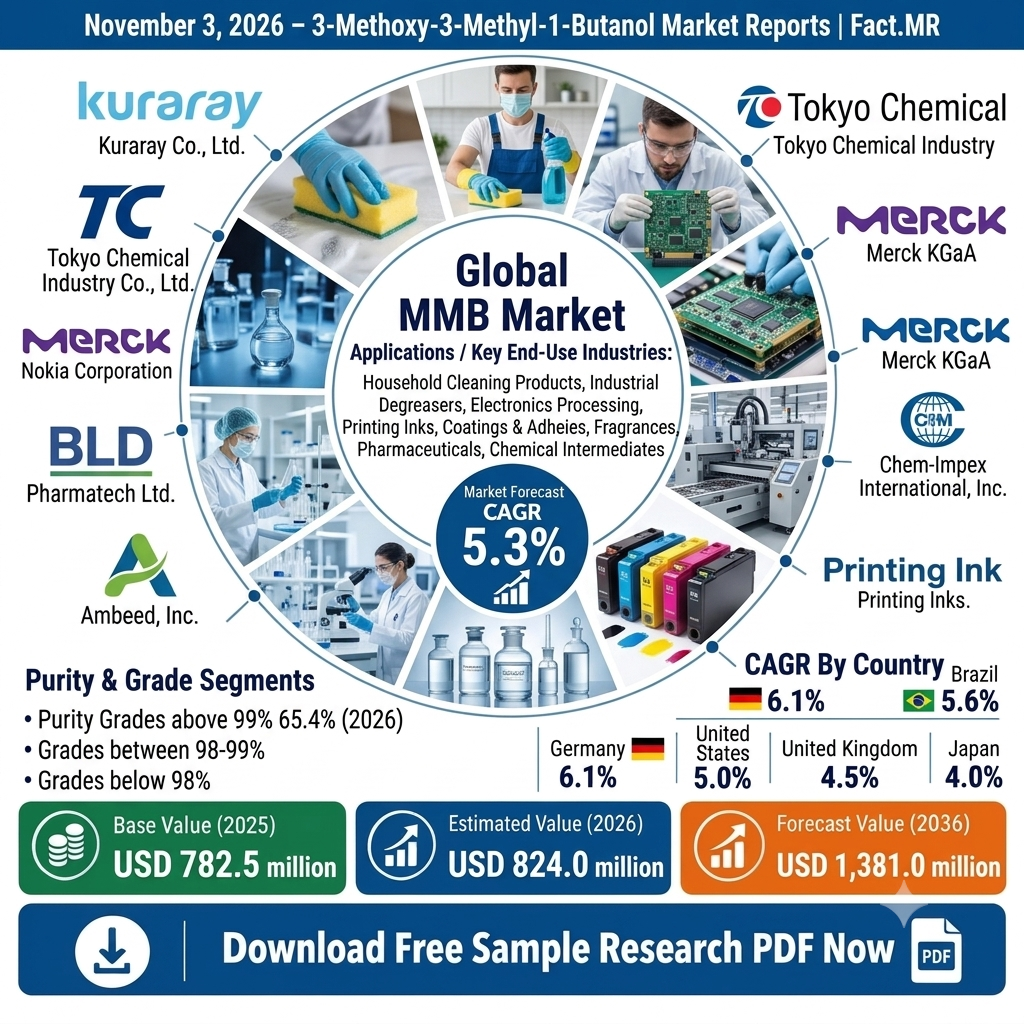
The global 3-Methoxy-3-Methyl-1-Butanol market is projected to reach USD 1,381.0 million by 2036, increasing from USD 824.0 million in 2026 at a compound annual growth rate (CAGR) of 5.3%, according to the latest analysis by Fact.MR. The market was valued at USD 782.5 million in 2025. Growing use of water-compatible solvents in household and industrial cleaning products, printing inks, coatings, and electronics processing is expected to support this expansion over the forecast period.
Fact.MR estimates an absolute dollar opportunity of USD 557.0 million between 2026 and 2036. Manufacturers are responding to demand for solvents with lower odor, water compatibility, and controlled impurity levels. The compound, commonly known as MMB, is also gaining attention as formulators evaluate alternatives to conventional glycol ether solvents.
Get detailed market forecasts, competitive benchmarking, and pricing trends: https://www.factmr.com/connectus/sample?flag=S&rep_id=17107
Safer Cleaning Formulations and Electronics Processing Support Market Demand
Demand for safer cleaning ingredients continues to influence solvent selection. Household cleaner brands increasingly evaluate ingredients against environmental and product safety requirements. The U.S. Environmental Protection Agency added 18 chemicals to its Safer Chemical Ingredients List in July 2025, bringing the total to 983 chemicals. Such initiatives encourage formulators to assess alternative ingredients when developing cleaning products.
Industrial cleaning applications provide another source of demand. MMB helps dissolve oily soils in water-based formulations while maintaining compatibility with different cleaning ingredients. Industrial degreasers and surface cleaning products use the solvent where effective cleaning performance and formulation stability are important.
Electronics processing is opening an additional avenue for higher-purity MMB. The compound is used in resist removers, printed circuit board cleaners, and color filter resist applications. These processes require solvents with controlled impurity levels and low-residue characteristics to protect sensitive electronic surfaces.
Printing and coatings also contribute to recurring consumption. Ink manufacturers use MMB in blanket cleaners and fountain solutions, where its relatively slow evaporation rate supports cleaning performance. Its compatibility with certain plastic components provides another formulation advantage in equipment containing mixed materials.
Solvents and High-Purity Grades Lead Key Segments
Solvents are projected to account for 38.5% of the application segment in 2026, making them the leading application category. Household cleaning products and industrial degreasers use MMB to remove oily contaminants in water-based formulations. Demand for eco-labelled cleaning products further supports this segment.
Chemical intermediates, pharmaceuticals, and personal care applications represent additional areas of use. The compound also functions as a hydrotrope, helping maintain the stability of concentrated formulations.
By purity, grades above 99% are expected to capture 65.4% of market value in 2026. Electronics, fragrance, and pharmaceutical manufacturers require tighter impurity controls for applications where residue and product consistency can affect performance. Grades between 98% and 99% serve general cleaning and printing ink formulations, while grades below 98% are used in applications with wider purity tolerances.
The growing requirement for specialized cleaning solvents is expected to maintain the importance of high-purity grades throughout the forecast period.
Germany Leads Country-Level Growth Outlook
Germany is projected to record the fastest growth among the five countries analyzed, with an estimated CAGR of 6.1% through 2036. Brazil follows at 5.6%, while the United States is forecast to grow at 5.0%. The United Kingdom and Japan are expected to register CAGRs of 4.5% and 4.0%, respectively.
Germany’s outlook reflects its established specialty chemicals industry and demand from cleaning, coatings, and adhesive manufacturers. Industrial activity also provides support for functional solvent consumption. Automotive coating and car care manufacturers represent additional users of MMB-based formulations.
Brazil’s growth prospects are supported by expanding industrial activity and demand for household cleaning products. According to data from Brazil’s IBGE, industrial production increased 0.6% in 2025, marking its third consecutive year of growth. The shift toward water-based cleaning formulations creates opportunities for specialty solvents.
In the United States, safer-ingredient screening and reformulation initiatives are supporting interest in lower-toxicity cleaning ingredients. The country’s established chemical manufacturing industry also provides a substantial customer base for industrial solvents and specialty formulations.
The United Kingdom is expected to experience moderate growth as chemical manufacturers and contract cleaning companies evaluate lower-odor and eco-labelled ingredients. Japan’s market is supported primarily by electronics processing, where resist removers and circuit board cleaning applications require high-purity solvents.
Competition Focuses on Purity, Supply Reliability, and Sustainability
The competitive landscape includes Kuraray Co., Ltd., Tokyo Chemical Industry Co., Ltd., Merck KGaA, Chem-Impex International, Inc., BLD Pharmatech Ltd., and Ambeed, Inc.
Kuraray holds an important position as an integrated producer of MMB through its isoprene chemical operations at the Kashima plant in Japan. In February 2026, the company secured ISCC PLUS certification for seven isoprene chemical products manufactured at the facility, including MMB. This certification provides an additional sustainability credential for customers evaluating certified chemical supply.
The company also announced an average price increase of approximately 20% for its isoprene chemical products in April 2026, citing feedstock and logistics costs.
Tokyo Chemical Industry, Merck KGaA, Chem-Impex International, BLD Pharmatech, and Ambeed participate through laboratory and research-grade chemical supply. Their offerings support formulation development and pilot-scale applications, with availability and technical documentation influencing purchasing decisions.
According to Fact.MR, consistent purity, reliable supply, and sustainability credentials will remain important competitive considerations. Producers that can meet the technical requirements of electronics and specialty cleaning customers may strengthen their market position.
Analyst Opinion at Fact.MR
Shambhu Nath Jha, Principal Consultant at Fact.MR, states, “MMB has moved from a niche cleaning additive to a solvent that formulators reach for when they need water compatibility without the odor of glycol ethers. Over the next ten years, electronics cleaning and eco-labelled household products will pull demand toward purer grades and certified supply. Producers that can document biodegradability and sustainable feedstock will hold a pricing edge with brand owners.”
Strategic Priorities for Industry Participants
Manufacturers should prioritize technical documentation covering biodegradability, pH stability, and plastic compatibility. These characteristics can help cleaner brands evaluate MMB against safer-ingredient requirements and formulation standards.
Distributors can strengthen their position by maintaining high-purity inventory near electronics and fragrance manufacturing clusters. Shorter delivery times and dependable product specifications can help secure repeat business from specialized buyers.
Cleaning and ink formulators should evaluate MMB in concentrated water-based blends, particularly where solvent compatibility and oily-soil removal influence product performance. Producers should also monitor feedstock costs and mass-balance certification as these factors affect supply economics.
However, the market faces challenges. Established glycol ether solvents remain competitive because of their lower cost and existing acceptance among formulators. Feedstock price fluctuations and logistics expenses can also increase production costs. Electronics and pharmaceutical applications require lengthy qualification processes before new solvent grades receive commercial approval.
The analysis draws on more than 120 sources, 35 company portfolios, 25 countries, and over 20 industry interviews, combining primary research with government statistics, regulatory publications, company information, and industry developments.
View Related Reports:
Metal Cleaning Chemicals Market
Organic Low-Methoxyl Pectins Market
Embedded Subscriber Identity Module (e-SIM) Market
About Fact.MR
Fact.MR is a market research and consulting firm providing industry intelligence, market forecasts, and strategic analysis across global industries. The company delivers data-driven insights to help businesses understand market developments, evaluate opportunities, and make informed decisions.