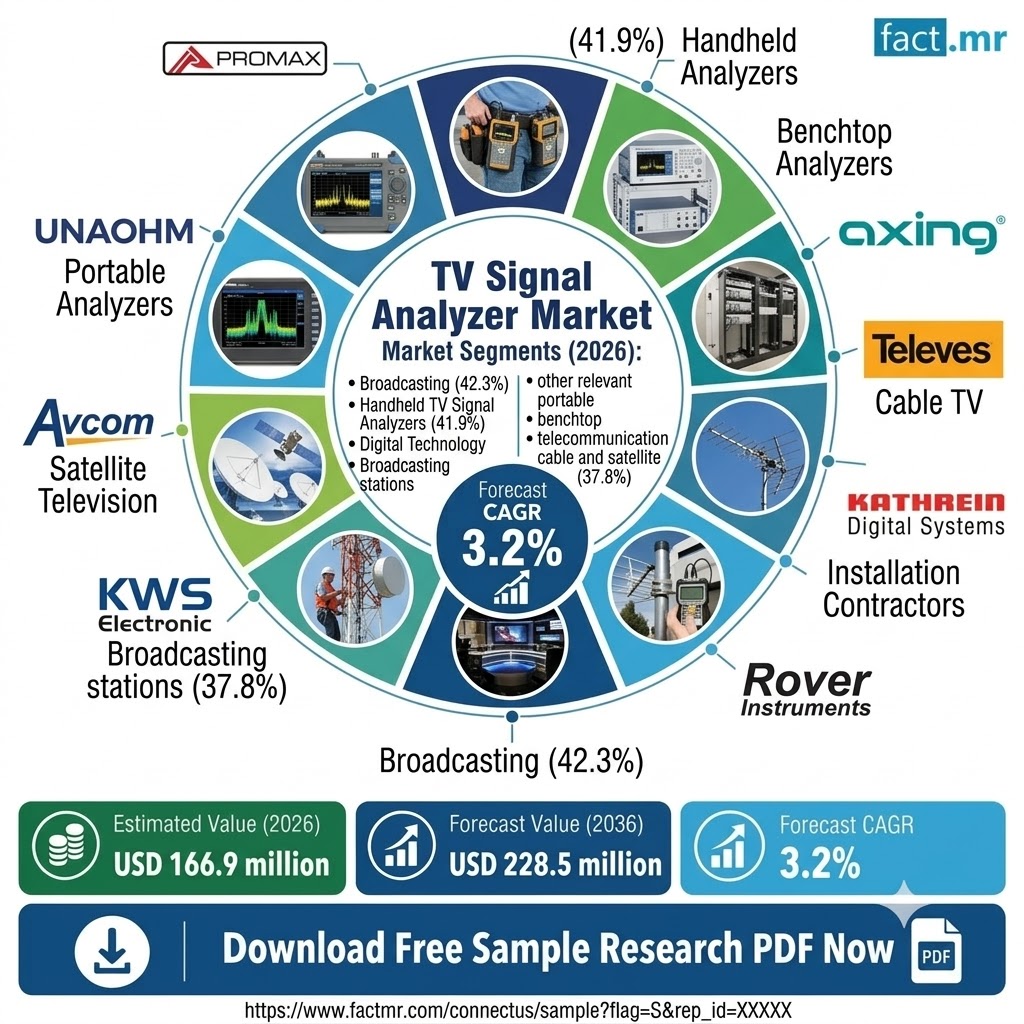
The global TV signal analyzer market is projected to increase from USD 166.9 million in 2026 to USD 228.5 million by 2036, expanding at a compound annual growth rate (CAGR) of 3.2%, according to Fact.MR. The market was valued at USD 161.8 million in 2025. Growing adoption of next-generation terrestrial broadcasting standards, ongoing transmitter maintenance, and increasing requirements for accurate signal measurements are supporting demand for advanced TV signal analyzers.
The market is expected to generate an additional USD 61.6 million in revenue between 2026 and 2036. Broadcasters, cable operators, satellite providers, and installation contractors represent the primary sources of demand. The transition toward ATSC 3.0 in the United States and TV 3.0 in Brazil is creating additional requirements for measurement instruments capable of evaluating modern digital transmission signals.
Get detailed market forecasts, competitive benchmarking, and pricing trends: https://www.factmr.com/connectus/sample?flag=S&rep_id=XXXXX
Next-Generation Broadcasting Standards Strengthen Market Demand
The transition toward advanced terrestrial television standards is creating new opportunities for TV signal analyzer manufacturers. In September 2025, the Federal Communications Commission (FCC) clarified the processing procedures for ATSC 3.0 applications, giving broadcasters in the United States a clearer route to upgrade their transmission infrastructure. These conversions require fresh signal measurements at transmitter facilities and across coverage areas.
Brazil is also preparing for next-generation broadcasting. Decree No. 12,595, issued on August 27, 2025, adopted the ATSC 3.0 physical layer for the country’s TV 3.0 standard. The framework incorporates multiple-input multiple-output (MIMO), layered division multiplexing, and transmitter identification. Equipment capable of measuring these transmission characteristics will become increasingly relevant as commercial deployments progress.
Routine network maintenance provides another source of recurring demand. Broadcast engineers regularly monitor modulation error ratio (MER), bit error rate (BER), and channel power to identify signal deterioration before it affects television reception. Portable analyzers allow technicians to conduct these measurements during transmitter inspections, antenna alignment, and distribution network maintenance.
The growing combination of radio frequency (RF) and internet protocol (IP) broadcasting is also influencing product development. Instruments that evaluate both signal formats allow technicians to inspect different parts of a broadcast delivery chain without carrying separate testing equipment.
Handheld TV Signal Analyzers Account for 41.9% Share
Handheld TV signal analyzers are projected to capture 41.9% of the product type segment in 2026, making them the leading category in the market.
Field engineers frequently work at transmitter towers, distribution networks, and residential installation sites. Battery-powered meters with spectrum displays and built-in decoding functions allow technicians to perform measurements without transporting laboratory equipment. Many handheld instruments also offer RF spectrum analysis and signal measurement capabilities extending up to 6 GHz.
Portable and benchtop analyzers continue to serve applications requiring more detailed testing. These instruments are commonly used in laboratories, broadcast headends, and equipment manufacturing facilities where engineers conduct advanced transmitter and receiver evaluations.
By application, broadcasting is expected to account for 42.3% of market revenue in 2026. Digital technology will represent 68.4% of the technology segment, reflecting the widespread adoption of digital terrestrial, cable, and satellite transmission standards.
Broadcasting stations are projected to account for 37.8% of end-user demand in 2026. Their requirements are supported by scheduled transmitter inspections, commissioning activities, and signal verification following network upgrades.
Regional Broadcasting Investments Shape Growth Opportunities
Japan is projected to record the fastest growth among the assessed countries, with a CAGR of 4.1% through 2036. The country’s established 4K and 8K satellite broadcasting infrastructure supports continued requirements for signal measurement and installation equipment. Japan’s Ministry of Internal Affairs and Communications reported that cumulative shipments of receivers compatible with 4K and 8K satellite broadcasts reached approximately 25.7 million units by March 2026. Planned satellite launches during fiscal 2029 are expected to sustain installation and reception testing requirements.
The United States follows with a projected CAGR of 3.7%. The FCC counted 1,777 full-power television stations and 1,772 low-power television stations as of June 30, 2026. The transition toward ATSC 3.0 creates opportunities for analyzers capable of verifying transmitter performance and signal coverage across existing broadcasting networks.
Brazil is forecast to expand at a CAGR of 3.4% through 2036. According to the Brazilian Institute of Geography and Statistics (IBGE), 86.5% of television households, representing 65.1 million homes, received free-to-air television through conventional antennas in 2024. The development of TV 3.0 infrastructure and testing facilities in São Paulo and Brasília is expected to increase demand for compatible field measurement equipment.
Germany is expected to register a CAGR of 3.0%. Continued maintenance of cable, satellite, and DVB-T2 broadcasting infrastructure supports demand for signal testing instruments. The United Kingdom is projected to grow at 2.6% through 2036, with equipment purchases largely influenced by replacement cycles and ongoing maintenance requirements across terrestrial and satellite networks.
Supplier Strategies Focus on Multi-Standard Testing and Integration
Competition in the TV signal analyzer market centres on digital standard compatibility, measurement accuracy, portability, and combined RF and IP testing capabilities. PROMAX, Televes, Rover Instruments, KWS Electronic, UNAOHM, KATHREIN Digital Systems, AXING, and Avcom are among the companies participating in the market.
PROMAX has positioned its ATLAS NG platform as a replacement for discontinued laboratory TV analyzers, with support for DVB-T2, ISDB-Tb, and ATSC 3.0. In October 2026, the company announced NDI certification for its ATLAS NG and ATLAS IP analyzers, highlighting the growing importance of testing across connected broadcast environments.
Other suppliers focus on field measurement equipment for installers and service contractors. Televes and KATHREIN Digital Systems offer reception and distribution equipment alongside testing instruments, while Rover Instruments and UNAOHM serve professional installation requirements. Avcom provides spectrum analysis solutions for satellite communication and teleport applications.
Shambhu Nath Jha, Principal Consultant at Fact.MR, states, “A TV signal analyzer is bought when something changes: a new standard, a new transmitter or a new installation. ATSC 3.0 in the United States and TV 3.0 in Brazil will create those moments over the next decade, even though mature networks keep older meters in service for years. Suppliers whose meters read RF and IP signals in one handheld will win the most repeat orders from engineers.”
The report identifies high equipment costs and long replacement cycles as restraints on wider market adoption. Smaller installation businesses may delay purchases when existing meters continue to meet routine testing requirements. The technical complexity of newer transmission standards can also increase training and equipment configuration requirements.
Manufacturers that introduce firmware-based standard upgrades, integrated RF and IP measurement functions, and simplified testing interfaces may be better positioned to address these challenges. These capabilities can help broadcasters and installation contractors extend instrument usability while preparing for changing transmission requirements.
View Related Reports:
Dynamic Signal Analyzer Market
About the TV Signal Analyzer Market Report
Fact.MR is a market research and consulting firm that provides market intelligence, industry analysis, and strategic insights across global industries. Its TV signal analyzer market study evaluates handheld, portable, and benchtop instruments across broadcasting, telecommunication, cable and satellite television, and other applications. The analysis draws on more than 120 sources, over 35 company portfolios, more than 20 industry interviews, and coverage of over 25 countries.