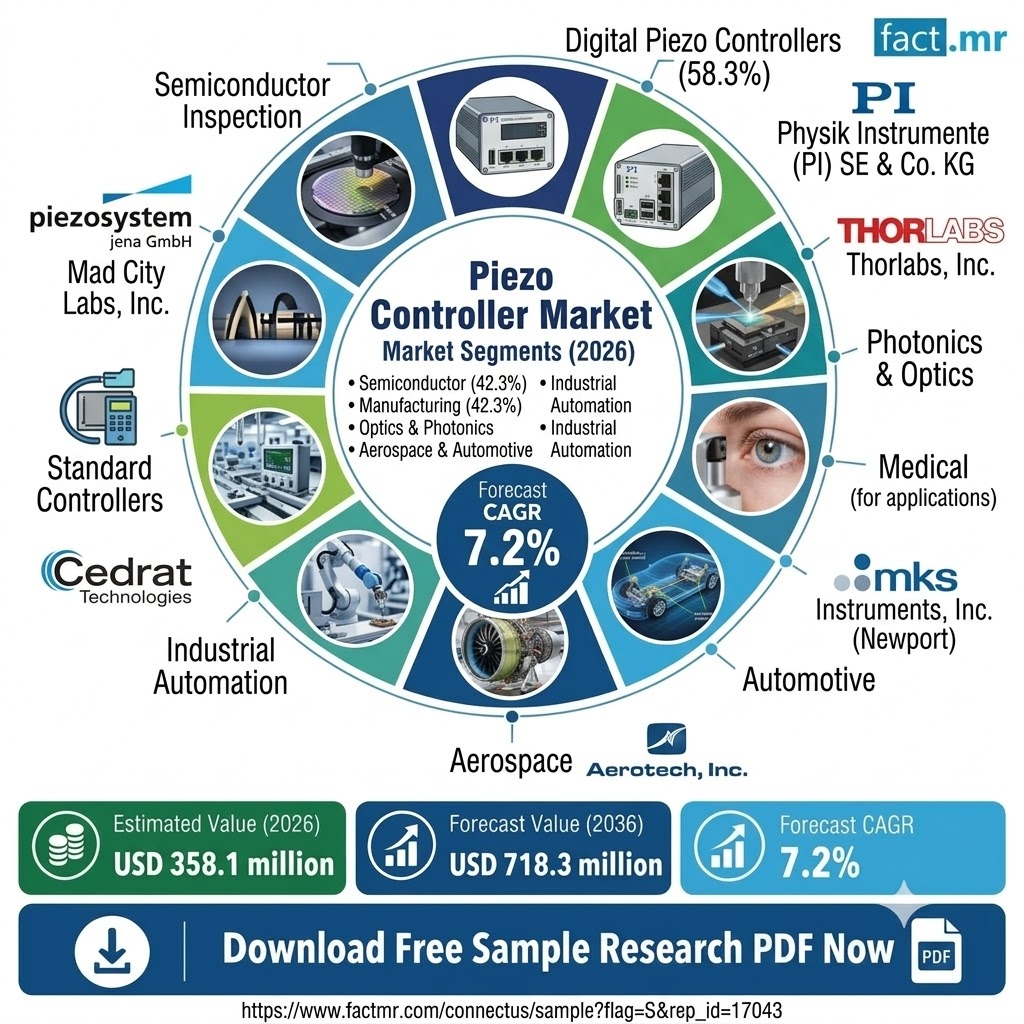
The global piezo controller market is projected to increase from USD 358.1 million in 2026 to USD 718.3 million by 2036, expanding at a compound annual growth rate (CAGR) of 7.2%, according to Fact.MR. The market was valued at USD 334.0 million in 2025. Growing investment in semiconductor manufacturing, tighter wafer inspection tolerances, and rising demand for precision optical alignment are creating new requirements for advanced piezoelectric motion control systems.
The market is expected to generate an additional USD 360.3 million in revenue between 2026 and 2036. Semiconductor equipment manufacturers represent a major source of demand, as wafer inspection, overlay metrology, and mask alignment applications increasingly require nanometer-level positioning accuracy. Photonics manufacturers and research laboratories are also adopting digitally controlled systems to improve motion stability and reduce positioning errors.
Get detailed market forecasts, competitive benchmarking, and pricing trends: https://www.factmr.com/connectus/sample?flag=S&rep_id=17043
Semiconductor Manufacturing Strengthens Piezo Controller Market Demand
Investment in semiconductor production capacity is creating opportunities for precision motion technology suppliers. The European Commission reported in April 2025 that the European Chips Act had catalysed more than EUR 80 billion in semiconductor manufacturing investment. Five pilot lines also received EUR 3.7 billion in European and national funding.
Each new manufacturing line requires inspection and metrology equipment capable of maintaining highly accurate positioning. Piezo controllers regulate actuator movement in these systems, supporting precise adjustments during wafer handling, lithography, and defect detection.
Government-backed semiconductor expansion is extending beyond established manufacturing centres. In November 2025, the European Commission approved EUR 450 million in Czech state aid for an integrated semiconductor manufacturing facility operated by onsemi. The investment is expected to support demand for equipment incorporating piezo-driven focus and alignment mechanisms.
Photonics manufacturing is another important demand source. Physik Instrumente introduced its 6D NanoCube in January 2026, featuring a six-axis piezo system that identifies optical coupling peaks in less than one second under its E-713 digital controller. This development highlights the growing importance of controller performance in fiber-to-chip alignment and silicon photonics assembly.
Microscopy and surface analysis applications require equally stable movement. Research laboratories increasingly use closed-loop controllers with low-noise outputs and data recording capabilities to limit positioning errors during imaging and measurement.
Digital Piezo Controllers Account for 58.3% Share
Digital Piezo Controllers are projected to capture 58.3% of the product type segment in 2026, making them the leading category in the piezo controller market.
Manufacturers favour digital configurations because software-based tuning, network connectivity, and programmable feedback functions simplify integration into automated equipment. These controllers support closed-loop servo control, notch filtering, and multi-axis coordination through firmware.
Analog controllers continue to serve applications where straightforward operation and lower equipment costs remain priorities. However, manual adjustments can increase setup time when equipment configurations change. The transition toward networked motion systems is encouraging more original equipment manufacturers (OEMs) to consider digital alternatives during equipment upgrades.
By application, semiconductor is expected to account for 42.3% of market revenue in 2026. Manufacturing will also hold a 42.3% share among end users, reflecting repeat purchases from industrial equipment builders and production facilities.
Regional Semiconductor Investments Shape Growth Opportunities
Germany is projected to record the fastest growth among the assessed countries, with a CAGR of 7.9% through 2036. The opening of Infineon’s EUR 5 billion power semiconductor fabrication facility in Dresden in July 2026 strengthens the country’s requirement for precision inspection and testing equipment. The project received approximately EUR 920 million in European Chips Act funding and is expected to create 1,000 jobs.
Brazil follows with a projected CAGR of 7.3%. In June 2026, the Brazilian Development Bank (BNDES) approved R$143.3 million for Zilia Technologies to expand semiconductor production and modernize its Atibaia facility. The investment covers equipment for testing, assembly, handling, and measurement.
The United States is forecast to expand at 6.6% CAGR through 2036. National Institute of Standards and Technology (NIST) information published in June 2025 highlighted Micron’s planned USD 200 billion investment in American semiconductor manufacturing and research and development, alongside up to USD 275 million in additional CHIPS Act funding.
The United Kingdom and Japan are expected to register CAGRs of 5.9% and 5.2%, respectively. The UK’s semiconductor sector study published in June 2026 identified 703 semiconductor companies, including 295 dedicated semiconductor firms, with estimated industry revenue of GBP 10.6 billion in 2025. In Japan, government support for Rapidus and new TSMC manufacturing capacity in Kumamoto is expected to sustain demand for advanced inspection and alignment equipment.
Supplier Strategies Focus on Integration and Precision
Competition in the piezo controller market centres on closed-loop accuracy, software compatibility, and integration capabilities. Physik Instrumente (PI) SE & Co. KG, Thorlabs, Inc., Aerotech, Inc., MKS Instruments, Inc. (Newport), Cedrat Technologies, and Mad City Labs, Inc. are among the companies participating in the market.
Other identified suppliers include piezosystem jena GmbH, Micronix USA, and Dynamic Structures and Materials, LLC.
Shambhu Nath Jha, Principal Consultant at Fact.MR, states, “The controller has become the part of a piezo system that customers judge first, because closed-loop accuracy, noise and software access decide what the actuator can deliver. New fab and photonics capacity in Europe, the United States and Japan will keep inspection tool makers ordering in volume. Suppliers that ship tuned controller and stage sets with open programming interfaces will shorten OEM design cycles and win repeat business.”
The report identifies high equipment costs and system integration requirements as restraints on wider adoption. Smaller laboratories may also face difficulties matching controllers with sensors and actuators, particularly when specialist motion-control engineers are unavailable.
Manufacturers that provide open programming interfaces, firmware libraries, and matched controller-actuator packages may be better positioned to address these integration challenges. These capabilities can reduce equipment configuration time for semiconductor tool builders and precision assembly equipment manufacturers.
View Related Reports :
Weighing Indicator Controller Market
About the Piezo Controller Market Report
Fact.MR is a market research and consulting firm that provides market intelligence, industry analysis, and strategic insights across global industries. Its piezo controller market study evaluates digital and analog controllers across semiconductor, optics and photonics, aerospace, automotive, and industrial automation applications. The analysis draws on more than 120 sources, 35 company portfolios, over 20 industry interviews, and coverage of more than 25 countries.