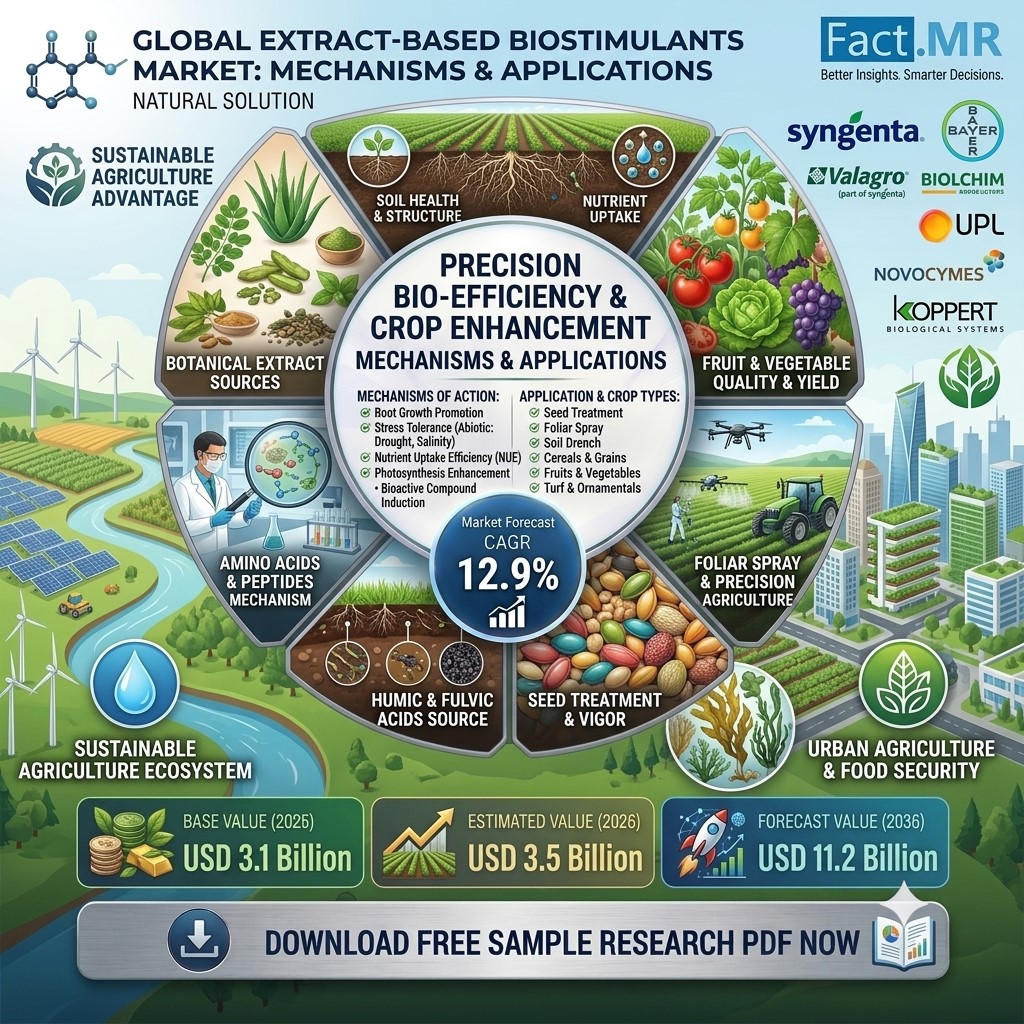
Rockville, MD., October 30, 2026 — The global Extract-based Biostimulants Market is projected to increase from USD 1.83 billion in 2026 to USD 3.45 billion by 2036, expanding at a 6.9% CAGR, according to Fact.MR. The market was valued at USD 1.72 billion in 2025 and is expected to generate an absolute dollar opportunity of approximately USD 1.62 billion between 2026 and 2036. Germany leads the five-country growth outlook at 8.3% CAGR, while Japan records the lowest projected rate at 5.4%.
Agricultural producers are increasingly evaluating extract-based biostimulants to improve nutrient-use efficiency, crop performance and tolerance to environmental stress. Seaweed extracts are expected to account for 38.6% of market demand in 2026. Liquid formulations lead with 62.4% share, reflecting their compatibility with existing spraying and fertigation systems.
Get detailed market forecasts, competitive benchmarking, and pricing trends
Agricultural Productivity Drives Extract-based Biostimulants Market Demand
Extract-based biostimulants are agricultural inputs derived from seaweed, plant extracts and other qualifying biological materials. They support natural plant processes and are used alongside conventional crop nutrition programs.
The demand outlook is supported by large agricultural production bases. Brazil’s National Supply Company (Conab) reported on September 15, 2026, that grain production for the 2025/26 season was estimated at 361.7 million tonnes, covering approximately 83.5 million hectares.
This agricultural scale creates opportunities for manufacturers offering crop-specific formulations. However, the effectiveness of extract-based products depends on application timing, local growing conditions and documented field performance.
Fact.MR identifies crop stress management as a major growth driver, assigning it an estimated positive CAGR impact of 1.0 percentage point. Interest in nutrient-use efficiency contributes an additional estimated 0.9 percentage point in the report’s driver analysis.
Extractable fact: Extract-based biostimulants are agricultural products containing qualifying biological extracts that support plant physiological processes, nutrient-use efficiency and tolerance to abiotic stress.
Seaweed Extracts and Liquid Formulations Lead Market Segments
Seaweed extracts are projected to hold 38.6% market share in 2026, followed by plant extracts at 28.4% and humic substances at 24.8%.
Seaweed-derived ingredients are used in formulations intended to support plant growth and stress management. Their commercial performance depends on extraction methods, ingredient consistency and crop-specific evidence.
Key Market Segments:
- Seaweed Extracts — 38.6%: Leading source category, supported by agricultural formulation applications.
- Foliar Treatment — 45.2%: Largest application segment, allowing direct application to plant leaves.
- Cereals & Grains — 38.2%: Leading crop category, reflecting extensive cultivated acreage.
- Liquid Formulations — 62.4%: Dominant product form, supported by dilution convenience and spraying compatibility.
Liquid formulations offer manufacturers opportunities to develop products suited to existing agricultural equipment. Nevertheless, storage stability and mixing compatibility remain important considerations for commercial adoption.
Germany Leads Country Growth at 8.3% CAGR
Germany — 8.3% CAGR: Germany records the highest projected growth among the five countries analyzed. The German Federal Statistical Office reported approximately 45.3 million tonnes of grain harvested in 2025, based on statistics updated in September 2026. Extensive cereal cultivation provides opportunities for biostimulant suppliers.
Brazil — 7.6% CAGR: Brazil’s large soybean and maize production base supports opportunities for extract-based agricultural inputs. Conab’s September 2026 grain forecast highlights the scale of cultivation, although adoption depends on field-trial performance and treatment economics.
United States — 6.8% CAGR: The USDA National Agricultural Statistics Service estimated 95.3 million acres of corn and 85.4 million acres of soybeans planted in 2026. These production areas represent potential applications for biostimulant formulations.
United Kingdom — 6.1% CAGR: The UK Department for Environment, Food & Rural Affairs reported a final wheat harvest of 12 million tonnes for 2025. Arable farming provides opportunities for crop-specific products where measurable benefits justify treatment costs.
Japan — 5.4% CAGR: Japan’s Ministry of Agriculture, Forestry and Fisheries estimated approximately 7.181 million tonnes of food rice harvested in 2025. Rice cultivation and horticulture offer potential applications for specialized formulations.
Competitive Landscape: Leading Extract-based Biostimulant Companies
Fact.MR identifies the following companies operating in relevant biostimulant and agricultural biological portfolios:
- Syngenta Crop Protection AG (Syngenta Biologicals)
- J.M. Huber Corporation (Biolchim)
- REKA Group B.V.
- BASF SE
- Gowan Company, L.L.C.
- UPL Limited
Syngenta markets plant-derived biostimulants, including MEGAFOL, containing selected vegetal extracts. BASF maintains a biostimulant portfolio and has announced distribution arrangements involving seaweed-based products.
REKA Group assumed management of Koppert’s biostimulant and fertilizer portfolio in 2025, while Koppert retained distribution responsibilities. This ownership distinction is important when evaluating competitive positioning.
Gowan offers Siapton, a natural-origin plant bio-activator containing amino acids and peptides. UPL’s NPP Biosolutions portfolio includes agricultural biostimulants.
Field Evidence and Product Consistency Shape Commercial Opportunities
Shambhu Nath Jha, Principal Consultant at Fact.MR, stated:
“Extract-based biostimulants are positioned to benefit from agricultural input programs that prioritize crop performance and nutrient-use efficiency. Commercial success will depend on whether suppliers can demonstrate repeatable results under relevant crop and field conditions.”
The analyst also emphasized the importance of pricing, raw-material consistency and field evidence in determining commercial adoption.
Manufacturers face measurable barriers. Fact.MR assigns high treatment costs a negative 0.8-percentage-point impact on CAGR, while inconsistent field results contribute an estimated negative 0.6 percentage point.
Replicated crop-specific trials represent an opportunity. Fact.MR estimates that stronger field validation could contribute a positive 0.8 percentage point to market growth.
The research draws on more than 120 sources, 35 company portfolios and over 20 industry interviews, supporting market estimates across 25 countries.
Top Reports:
Giant Knotweed Rhizome Extract Market
About Fact.MR
Fact.MR is a market research and consulting firm providing syndicated research and customized industry intelligence. Its research combines primary interviews, secondary analysis and market forecasting to support business decisions across global industries.