Food-processing hygiene requirements, automated conveyor operations and demand for fire-resistant hydraulic fluids are shaping opportunities for hydro lubricant suppliers, according to Fact.MR.
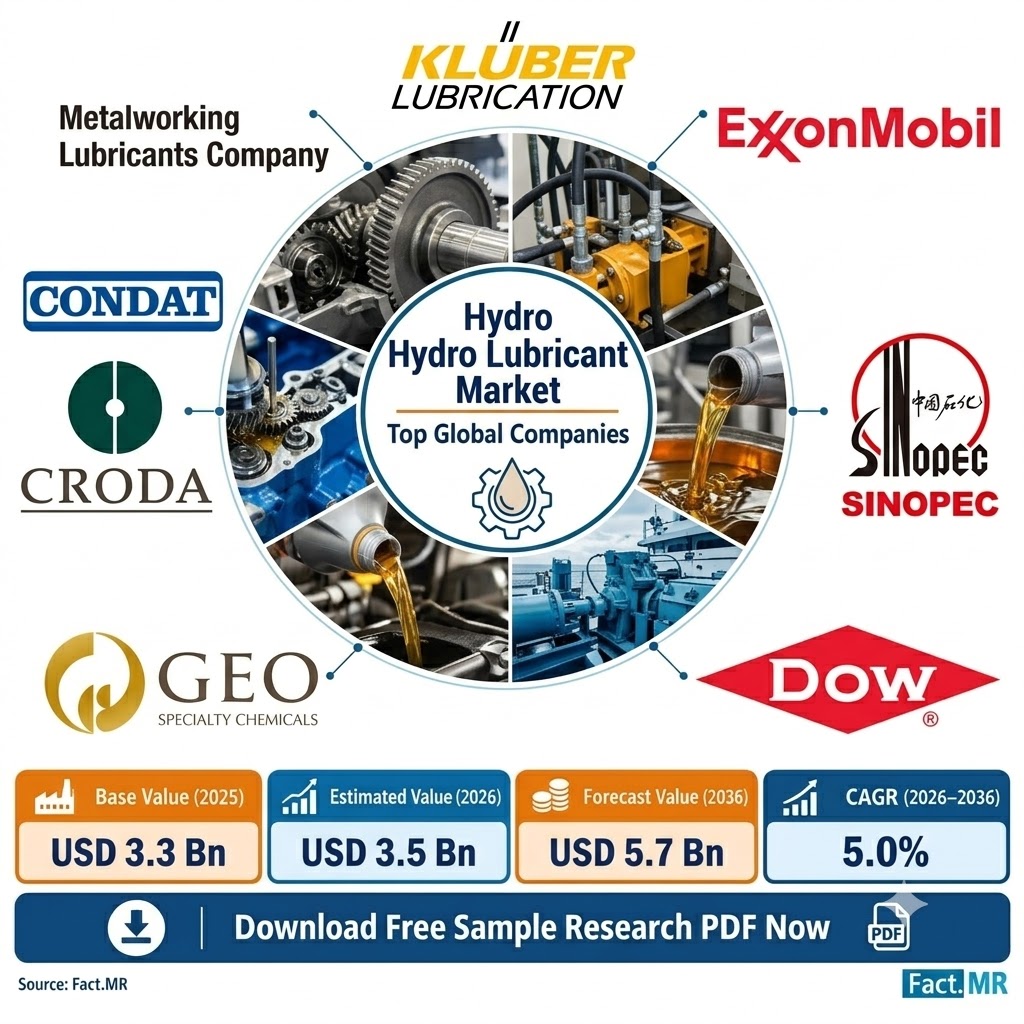
The global hydro lubricant market is projected to grow from USD 3.5 billion in 2026 to USD 5.7 billion by 2036, expanding at a compound annual growth rate (CAGR) of 5.0%, according to Fact.MR. The market was valued at USD 3.3 billion in 2025. The forecast represents an absolute opportunity of USD 2.2 billion between 2026 and 2036.
Demand is supported by food manufacturers seeking lubrication systems that can operate around frequent washdowns, automated production lines requiring controlled lubricant application, and industrial operators using water-containing fluids in applications where fire resistance matters.
Get detailed market forecasts, competitive benchmarking, and pricing trends:
Hygiene requirements and automation shape demand
Food-processing plants are an important market for hydro lubricants because conveyors and packaging equipment often operate near exposed products. Lubricants must control friction while meeting the plant’s cleaning procedures and applicable incidental food-contact requirements.
NSF H1 lubricant registration and ISO 21469 provide relevant benchmarks for lubricant use in food-processing environments. In the United States, 21 CFR 178.3570 addresses lubricants with incidental food contact and specifies permitted conditions of use. These frameworks make product documentation, formulation control and application guidance important considerations for buyers.
Conveyor operations provide another source of demand. Water-and-oil hydro-lubrication systems can be metered during operation, helping operators manage friction and residue on production and packaging lines. Their suitability depends on equipment design, lubricant compatibility and operating conditions.
Demand also extends beyond food manufacturing. Steel mills, foundries and mining operations can use water-containing fire-resistant hydraulic fluids in applications where fire exposure is a concern. These buyers must assess corrosion protection, seal compatibility and fluid performance before switching from conventional hydraulic oils.
Where growth is fastest
Fact.MR projects different growth rates across the five profiled national markets.
- Germany: The market is forecast to grow at a 5.5% CAGR from 2026 to 2036. Food manufacturing, metal processing and machinery operations support demand across conveyor lubrication and fire-resistant hydraulic applications.
- Brazil: A 5.0% CAGR is projected through 2036. Food-processing activity supports recurring demand for lubrication across production and packaging equipment.
- United States: The market is expected to expand at a 4.5% CAGR. Food-contact requirements and the installed base of food-processing equipment support demand for specialized formulations.
- United Kingdom: A 4.0% CAGR is forecast through 2036. Automated production and washdown-intensive food manufacturing create opportunities for low-residue lubrication systems.
- Japan: The market is projected to grow at a 3.6% CAGR. Investment in labor-saving automation and advanced food-production equipment supports demand for controlled lubricant application.
Germany leads the profiled countries by projected growth rate. Its combination of food manufacturing and metal-processing applications gives suppliers opportunities across both hygiene-focused and fire-resistant lubricant categories.
What leads the market
Two application groups account for the largest reported shares in 2026.
- Food Processing Industries: This segment accounts for 45.6% of the market by industry. Bakery, dairy, meat, poultry and beverage operations use conveyors and packaging equipment that require regular lubrication and cleaning.
- Conveyor Belt Hydro Lubricants: This application accounts for 87.9% of the market. Continuous production and packaging lines create repeated lubrication requirements, while controlled dosing can help operators manage residue and cleaning.
These shares indicate that food processing and conveyor applications are central to the market’s current structure. Suppliers targeting these segments need to demonstrate performance under actual washdown conditions rather than relying solely on general claims about water-based formulations.
The hurdle: Compatibility and conversion costs
Corrosion, seal compatibility and water-concentration control remain important barriers to adoption. Water-containing fluids behave differently from conventional mineral and synthetic oils, and a formulation that works in one system may not suit another.
Fact.MR identifies corrosion and materials compatibility requirements as a restraint with a reported impact of -0.9% on CAGR. Water evaporation and concentration control account for a further reported impact of -0.7%, while conversion and validation costs versus established oil systems contribute -0.6%.
For industrial buyers, replacing an established lubricant can require equipment checks, fluid validation and changes to maintenance procedures. These requirements may slow adoption, particularly in high-duty systems where unplanned downtime is costly.
Industry investment and competitive positioning
The supplied Fact.MR report identifies three opportunity areas for suppliers through 2036:
- Low-residue conveyor lubrication for wet-processing lines, with a reported +1.0% impact on CAGR over 2027–2036.
- Water-glycol fire-resistant systems for hot-process equipment, with a reported +0.8% impact on CAGR over 2026–2035.
- OEM-approved hydro formulations for gear and chain systems, with a reported +0.6% impact on CAGR over 2028–2036.
These figures are the report’s stated impact estimates, not independently verified forecasts of additional market growth.
Key companies profiled in the report include Kluber Lubrication, Exxon Mobil Corporation, Sinopec Corporation, The DOW Chemical Company, GEO Specialty Chemicals, Croda International Plc., Condat Lubricants and Metalworking Lubricants Company.
Their relevant product categories address different operational requirements. Conveyor applications emphasize precise metering and manageable residue. Fire-resistant hydraulic applications place greater emphasis on fluid performance, corrosion protection and compatibility with pumps and seals. Food-processing applications also require appropriate product documentation and adherence to applicable use conditions.
The supplied report does not identify specific company developments with publication months and years. Accordingly, no individual product launches, partnerships or investment announcements are presented here as dated developments.
Analyst opinion
“Hydro lubrication is commercially strongest where conventional lubrication creates a second operational problem, such as residue on a food conveyor, fire risk near hot metal, or difficult cleanup after a leak. Suppliers that can prove friction control, corrosion protection, material compatibility and hygiene performance in the same formulation will have the clearest route to repeat industrial use.”
— Shambhu Nath Jha, Principal Consultant, Fact.MR
What this means for industrial buyers
- Food manufacturers should evaluate lubrication alongside sanitation procedures. Assess dosing accuracy, conveyor-material compatibility, residue management and suitability for the plant’s cleaning routine. Confirm that the selected product meets the applicable food-contact requirements for its intended use.
- Metal and mining operators should validate fluid compatibility before conversion. Check the requirements of pumps, seals and other system materials, and verify corrosion protection and fire-resistant performance under actual operating conditions.
- Procurement teams should separate product requirements by application. Food-grade conveyor lubricants, water-glycol hydraulic fluids and gear or chain formulations serve different purposes. Clear specifications and supplier changeover guidance can reduce selection errors and help control conversion costs.
Report coverage
Fact.MR’s Hydro Lubricants Market report examines market size and forecasts, industry and application segments, country-level growth rates, demand drivers, restraints, opportunities and the competitive landscape through 2036.
Top Trending Reports:
Digital Decarbonization Solutions Market
Office of the CFO Software Market
About Fact.MR
Fact.MR is a market research and consulting firm providing market intelligence, industry analysis and strategic research across multiple sectors. Its research supports business planning, market assessment and commercial decision-making.