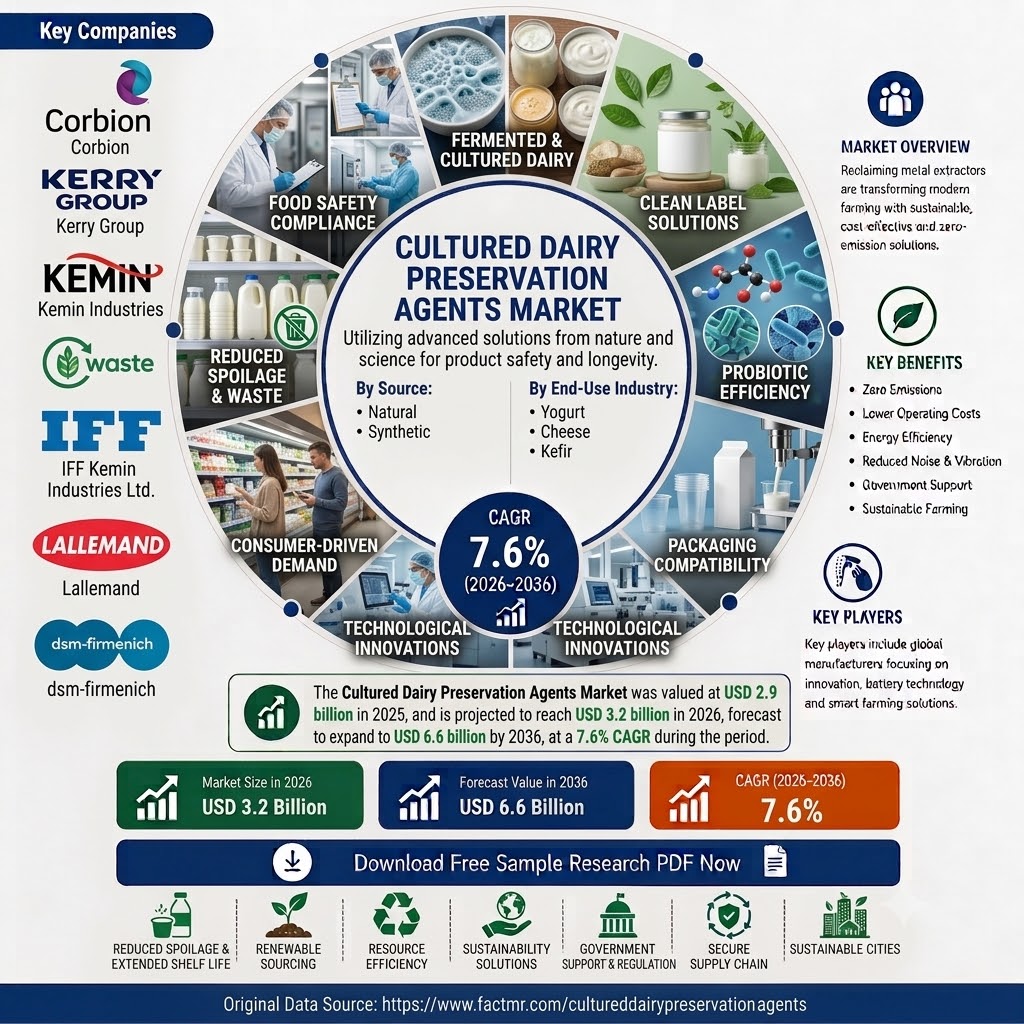
The global cultured dairy preservation agents market is projected to increase from USD 3.2 billion in 2026 to USD 6.6 billion by 2036, registering a compound annual growth rate (CAGR) of 7.6%, according to Fact.MR. Demand is being supported by dairy manufacturers seeking to control spoilage while maintaining product taste, texture, and compatibility with starter cultures. The forecast points to an incremental market opportunity of approximately USD 3.4 billion over the period.
Cheese and yogurt producers face different shelf-life challenges. Cheese manufacturers need to limit mold growth during storage and distribution, while yogurt producers must manage yeast and other spoilage risks without compromising acidity or texture. As dairy products move through processing, refrigerated storage, and distribution, preservation agents that perform consistently in the final product are becoming important purchasing considerations.
Get detailed market forecasts, competitive benchmarking, and pricing trends
Clean-Label Preservation Drives Product Development
Cultured dairy preservation agents include fermentation-derived ingredients and protective cultures used to control spoilage and support product shelf life. These solutions can help manufacturers maintain quality without making major changes to established recipes or production processes.
Clean-label preservation is one of the market’s growth drivers. Food manufacturers are evaluating fermentation-derived ingredients as they respond to customer interest in recognizable ingredients and effective preservation. However, product performance depends on the dairy matrix, storage conditions, and microorganisms that need to be controlled.
Cold-chain shelf-life extension is another demand driver. Dairy products can experience quality changes during storage and transportation, particularly when distribution periods are long. Preservation suppliers that demonstrate reliable results under realistic storage conditions can help dairy processors assess the suitability of their formulations.
The market also presents technical challenges. An ingredient that works well in cheese may not deliver the same results in yogurt or dairy desserts. Manufacturers need product-specific efficacy testing to confirm that preservation systems control spoilage without interfering with starter cultures, flavor, or texture.
Cultured Dextrose Leads by Agent Type
Cultured dextrose is expected to account for 39.0% of the market by culture-derived agent in 2026, according to Fact.MR. Produced through fermentation, it contains acids and other compounds that can help extend shelf life across different dairy applications. Its versatility supports use in both liquid and dry formulations.
Cultured whey, fermented milk permeate, protective cultures, and dairy fermentate blends serve additional formulation needs. Protective cultures use selected live cultures to help limit spoilage, while fermented ingredients can support preservation in products where manufacturers want to maintain established processing methods.
Mold control is projected to represent 38.0% of the market by preservation target in 2026. Mold can make cheese and other cultured dairy products unsuitable for sale before the end of their intended shelf life. Yeast control is also relevant to sweetened yogurt and cultured drinks, while bacterial control requirements vary by product and manufacturing process.
Cheese is expected to account for 34.0% of the market by dairy application in 2026. Its storage and ripening requirements make spoilage management a key consideration for producers. By delivery format, liquid fermentate is projected to hold a 31.0% share, supported by its compatibility with existing ingredient-mixing and production processes.
United Kingdom Leads Country-Level Growth
The United Kingdom is projected to record the fastest growth among the five countries detailed in Fact.MR’s comparison, with a CAGR of 9.5% through 2036. Its established dairy processing industry and production of cheese and cultured dairy products support demand for shelf-life solutions that work within existing manufacturing systems.
The United States is forecast to expand at a CAGR of 8.3%, supported by its large cheese and yogurt manufacturing base. Germany follows at 8.0%, while France is projected to grow at 7.7%. Japan is expected to record a CAGR of 6.2%, with demand linked to maintaining chilled dairy quality and consistency.
These markets offer different routes to growth. Cheese production supports demand for mold-control solutions, while yogurt and other fresh cultured dairy products require preservation approaches that address yeast and related spoilage risks. Suppliers that can provide application-specific evidence are better positioned to support dairy manufacturers during product evaluation and supplier qualification.
Analyst Perspective
Shambhu Nath Jha, Principal Consultant at Fact.MR, highlights the importance of demonstrating preservation performance in finished dairy products.
“Dairy plants need ingredients that slow spoilage without affecting production, starter cultures, or taste. Suppliers that show clear results in the final dairy product are expected to see higher demand.”
This outlook places product validation at the center of commercial adoption. Preservation suppliers need to demonstrate how their solutions perform under relevant processing, storage, and distribution conditions. Dairy manufacturers can use these results to compare options and select ingredients that meet both shelf-life targets and product-quality requirements.
Competitive Landscape
Competition in the cultured dairy preservation agents market is shaped by fermentation expertise, protective-culture portfolios, application testing, and the ability to support dairy processors with product-specific solutions.
Key companies profiled by Fact.MR include Corbion, Kerry Group, Kemin Industries, International Flavors & Fragrances (IFF), Lallemand, and dsm-firmenich. Their offerings span fermented ingredients, protective cultures, and food preservation solutions for dairy and cheese applications.
As manufacturers assess preservation systems, suppliers that offer clear performance data across cheese, yogurt, dairy desserts, and other cultured products can help reduce uncertainty during product development. Liquid fermentates may suit plants with established liquid dosing systems, while dry powders and concentrates can serve formulations with different storage and recipe requirements. Blended systems offer another option where manufacturers need to address multiple shelf-life functions.
Market Snapshot
The Fact.MR report projects the cultured dairy preservation agents market to reach USD 3.2 billion in 2026 and USD 6.6 billion by 2036, representing a reported CAGR of 7.6% during 2026–2036. Cultured dextrose is expected to hold a 39.0% share by culture-derived agent, mold control a 38.0% share by preservation target, cheese a 34.0% share by dairy application, and liquid fermentate a 31.0% share by delivery format in 2026. The United Kingdom leads the detailed country comparison with a projected 9.5% CAGR.
To View Top Reports
About Fact.MR
Fact.MR is a market research and consulting company providing market intelligence, competitive analysis, and forecasting across global industries. Its research covers emerging technologies, evolving consumer trends, industrial developments, and changing business environments. Fact.MR delivers data-driven insights designed to support strategic planning, investment decisions, and market-entry initiatives.