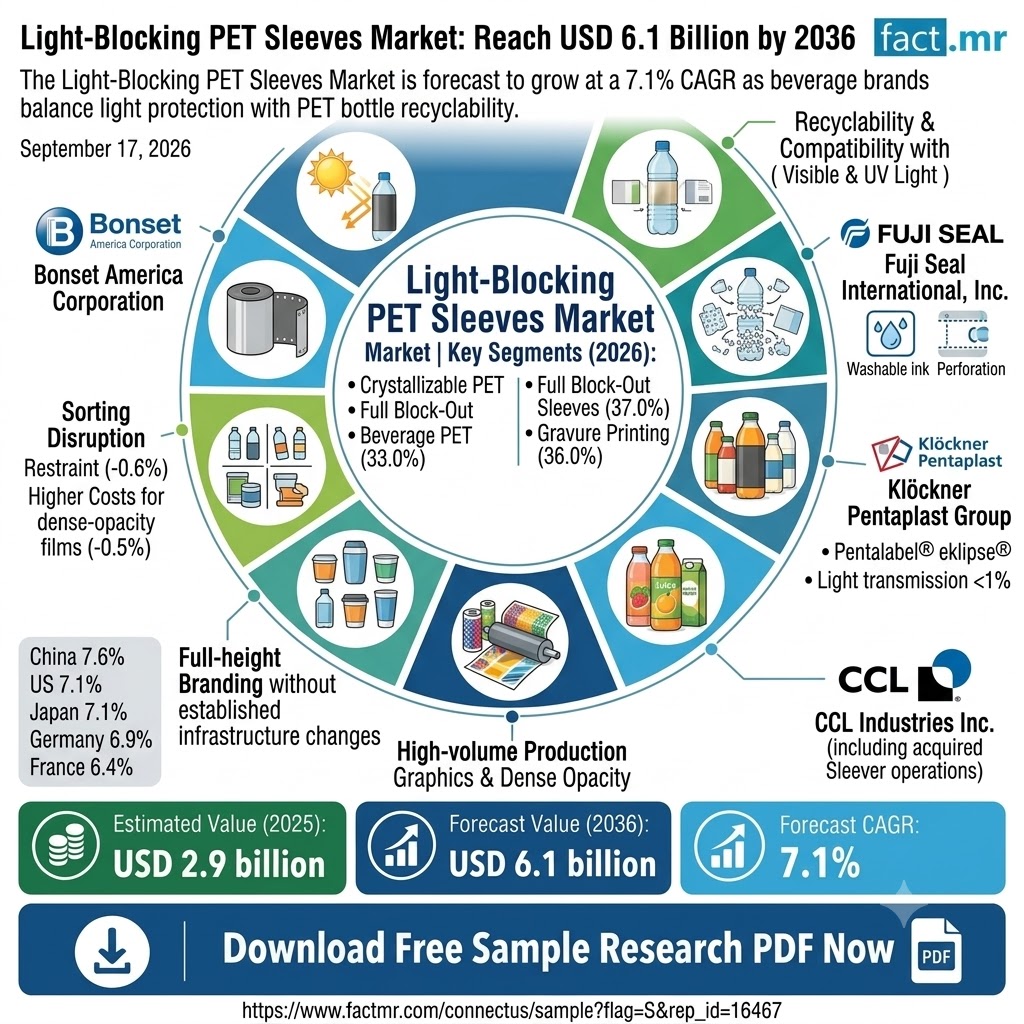
September 17, 2026 The global light-blocking PET sleeves market is projected to increase from USD 3.1 billion in 2026 to USD 6.1 billion by 2036, according to Fact.MR. Valued at USD 2.9 billion in 2025, the market is expected to expand at a compound annual growth rate (CAGR) of 7.1% over the forecast period. Demand reflects the need to protect light-sensitive beverages while ensuring that shrink sleeves remain compatible with PET bottle recovery systems.
The forecast represents an absolute market opportunity of USD 3.0 billion between 2026 and 2036. Beverage and dairy manufacturers are a central part of this outlook, as they seek packaging that combines product protection with full-height branding without requiring changes to established bottle formats or filling infrastructure.
Get detailed market forecasts, competitive benchmarking, and pricing trends: https://www.factmr.com/connectus/sample?flag=S&rep_id=16467
Light-Blocking PET Sleeves Market Growth Depends on Packaging Compatibility
Fact.MR is a market research and consulting firm that provides industry analysis, market forecasts, and strategic insights to businesses. Its assessment of the light-blocking PET sleeves market examines material selection, optical performance, container types, printing methods, and regional adoption through 2036.
Clear PET bottles remain useful for beverage packaging, but light exposure can affect the quality of certain products. Juices, dairy drinks and fortified beverages may require greater protection from visible light or ultraviolet radiation. Full-body shrink sleeves allow manufacturers to add an opaque printed layer while retaining their existing bottle platforms.
Recyclability presents a parallel consideration. The European Commission stated in August 2026 that packaging must be recyclable by 2030, with harmonized packaging labels scheduled to apply from 2028 to facilitate waste sorting. These requirements increase the importance of evaluating sleeve materials, inks and separation features before approving packaging designs.
The market analysis, updated September 17, 2026, identifies sorting disruption from full-body sleeves as a restraint with an estimated negative 0.6 percentage-point impact on CAGR. Higher costs for dense-opacity and specialty films carry a further negative 0.5 percentage-point impact, highlighting the commercial trade-offs facing packaging suppliers.
Crystallizable PET and Full Block-Out Lead Key Segments
Crystallizable PET is projected to account for 34.0% of the sleeve material segment in 2026. Its relevance comes from efforts to keep shrink-sleeve materials compatible with PET bottle recovery and recycling processes.
Material compatibility requires practical testing. Reclaimers assess whether printed sleeves can be separated, washed or processed alongside PET flakes without compromising recovered material quality. Bonset America Corporation offers a crystallizable PETG heat-shrink film designed for reclamation with PET bottle flake, illustrating how film development is responding to recycling requirements.
Full block-out sleeves are expected to hold 37.0% of the optical function segment in 2026. These sleeves serve products that require greater protection from light while retaining prominent package graphics. Klöckner Pentaplast Group states that its Pentalabel® eklipse® film has a light transmission rate below 1% and is designed for light-sensitive dairy products, juices, fortified beverages and isotonic drinks.
Beverage PET is forecast to capture 33.0% of the container segment in 2026. Gravure printing is expected to account for 36.0% of the printing segment, supported by its suitability for high-volume production requiring dense opacity and repeatable graphics.
China Leads Country Growth Through 2036
China is projected to record the fastest growth among the five profiled countries, with a 7.6% CAGR from 2026 to 2036. The United States and Japan are each forecast to grow at 7.1%, followed by Germany at 6.9% and France at 6.4%.
China’s outlook reflects packaged beverage demand and local film-converting capacity. The National Bureau of Statistics of China reported in February 2026 that retail sales of beverages by enterprises above the designated size increased by 1.0% in 2025.
In the United States, beverage packaging demand intersects with recycled-content requirements. The U.S. Census Bureau reported beverage manufacturers’ shipments of USD 12.075 billion in January 2026. California’s recycled-plastic-content rules also create compliance considerations for beverage manufacturers; CalRecycle specifies penalties of USD 0.20 per pound based on the recycled-content shortfall.
Japan’s forecast is supported by established PET bottle collection systems. The Ministry of the Environment reported in March 2026 that municipalities separately collected 360,498 tonnes of PET bottles in fiscal year 2024. Fuji Seal International, Inc. is developing recycling-oriented sleeve solutions, including washable inks, recyclable films and perforations that support label separation.
Germany’s packaging recycling requirements influence full-body sleeve approvals, while France’s dairy packaging demand and bottle collection policies shape adoption. The different growth rates reflect variations in packaging practices, recycling infrastructure and commercial qualification requirements.
Suppliers Face New Design and Qualification Priorities
Shambhu Nath Jha, Principal Consultant at Fact.MR, said, “Decoration alone is no longer enough. Brands want sleeves that block light while still passing PET recovery checks. Demand is expected to concentrate around films, inks and perforation designs that protect products and keep bottles easier to recover.”
The competitive landscape includes CCL Industries Inc., including its acquired Sleever operations; Fuji Seal International, Inc.; Klöckner Pentaplast Group; and Bonset America Corporation. These companies participate across shrink-sleeve labels, film production, printing and recycling-compatible packaging solutions.
For film suppliers, documenting shrink behavior and PET-stream compatibility can help shorten customer trials. Label converters also need to consider ink selection, seam construction and perforation placement before commercial approval, particularly where packaging must meet regional recovery requirements.
Fact.MR’s analysis draws on more than 120 references, over 35 company portfolios, information spanning 25-plus countries, and more than 20 interviews. The study combines primary research with government statistics, regulatory publications, company information and industry data to assess market size, segment shares and regional growth.
View Related Reports :
Coin-Operated Laundries and Drycleaners Market
About Fact.MR
Fact.MR is a market research and consulting firm providing data-driven insights, industry forecasts and strategic analysis across global markets. Its research combines primary interviews, secondary sources, market sizing methods and industry developments to help organizations evaluate demand patterns, competitive positioning and emerging business opportunities.