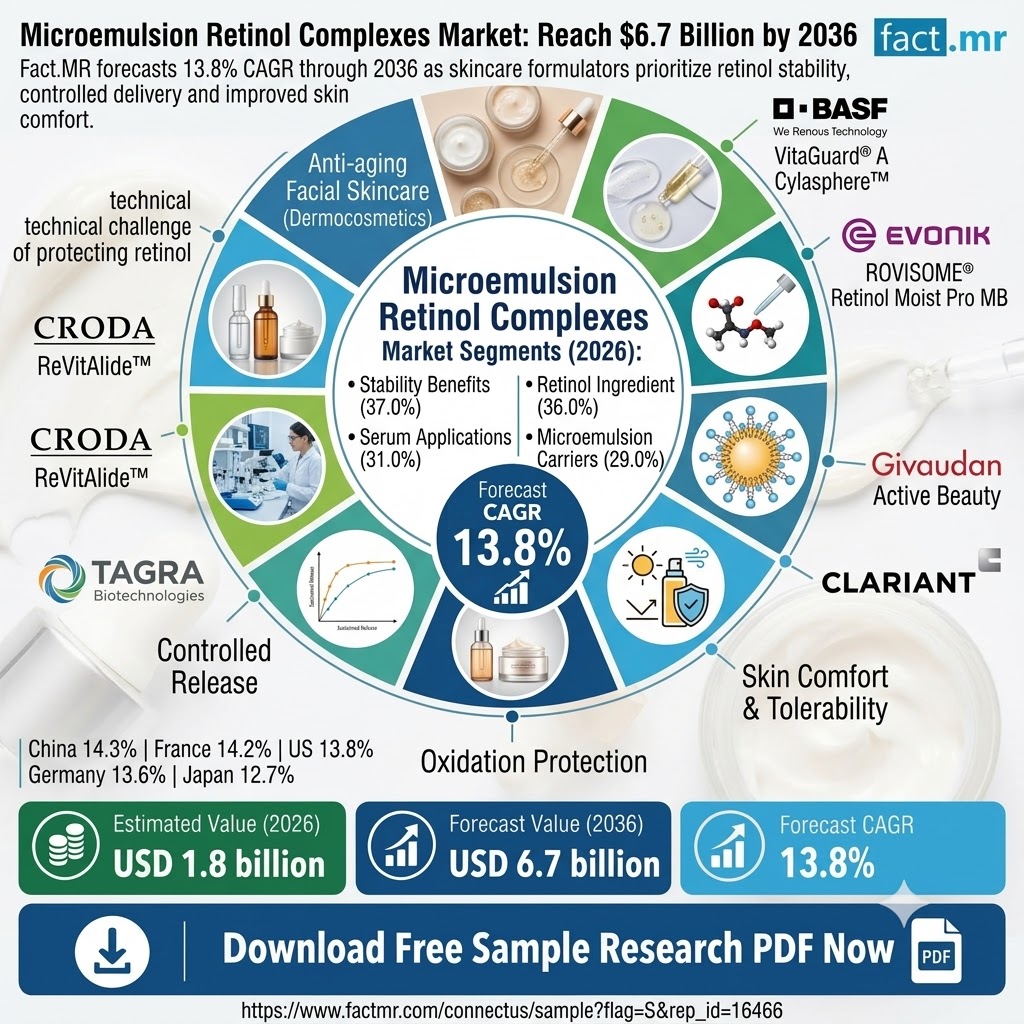
October 13, 2026 The global microemulsion retinol complexes market is projected to grow from USD 1.8 billion in 2026 to USD 6.7 billion by 2036, according to Fact.MR, reflecting a compound annual growth rate (CAGR) of 13.8%. The market was valued at USD 1.6 billion in 2025. Growing demand for protected retinoid delivery systems is expected to support adoption as beauty brands develop daily-use facial skincare products that balance active performance with skin comfort.
The forecast represents an absolute market opportunity of USD 4.9 billion between 2026 and 2036. Ingredient suppliers and formulators face a practical challenge: retinol can degrade when exposed to light and air, while its potential to irritate skin can affect product positioning and repeat use. Delivery technology is therefore becoming a key consideration in product development.
Get detailed market forecasts, competitive benchmarking, and pricing trends: https://www.factmr.com/connectus/sample?flag=S&rep_id=16466
Microemulsion Retinol Complexes Market Growth Depends on Stability
Microemulsion retinol complexes are cosmetic ingredient systems designed to disperse retinoid actives within carrier structures that support formulation stability and topical delivery. Fact.MR evaluates these systems across carrier types, retinoids, applications and performance benefits, including controlled release and oxidation protection.
Fact.MR is a market research and consulting firm that provides industry analysis, market sizing and long-term forecasts. Its assessment of the microemulsion retinol complexes market draws on more than 120 sources, over 35 company portfolios, more than 25 countries and over 20 industry interviews.
Stability leads the benefit segment, accounting for an estimated 37.0% market share in 2026. This reflects the technical challenge of protecting retinol throughout storage and product use. BASF reported in September 2025 that its solid lipid-particle retinol formulation retained 83% retinol after four months in a company-described real-life study, compared with a market benchmark.
That finding illustrates why ingredient performance data matters. Suppliers must demonstrate how their delivery systems behave under relevant conditions rather than relying solely on formulation claims.
Serum Formulations and Retinol Delivery Shape Demand
Microemulsion carriers are projected to hold 29.0% of the market in 2026, making them the leading carrier segment. Their small dispersed droplets suit lightweight serum and cream formulations where texture, stability and active delivery influence product development.
Retinol is expected to account for 36.0% of the retinoid segment. Its familiarity in anti-aging facial skincare supports continued use across premium beauty and dermocosmetic ranges. Serums are forecast to capture 31.0% of application demand in 2026, reflecting their fit with concentrated active ingredients and established skincare routines.
Ingredient companies are responding through different delivery technologies. BASF offers VitaGuard® A and Cylasphere™ Retinol systems. Evonik markets ROVISOME® Retinol Moist Pro MB, while Croda’s ReVitAlide™ is described as a water-soluble capsule carrying 3% active retinol. Givaudan Active Beauty, Clariant and Tagra Biotechnologies also participate with protected retinol delivery systems.
These products differ in carrier design and intended performance. Formulators must assess each system against the finished product’s stability requirements, sensory characteristics and regulatory conditions.
Fact.MR Analyst Highlights Formulation Priorities
Shambhu Nath Jha, Principal Consultant at Fact.MR, said, “Retinol is becoming a delivery-system decision before it becomes a claims decision. Brands are asking whether the carrier can protect the molecule and make the finished formula easier to tolerate. Supplier selection is expected to favor partners that combine retinoid chemistry, carrier design, claim evidence and regional compliance support.”
For product developers, this means evaluating delivery systems early in the formulation process. Stability testing under light and temperature stress can help determine whether a carrier is suitable for the intended application. Prototype serums and creams also allow brands to compare release behavior and skin feel before commercial scale-up.
Regulatory preparation remains another consideration. The European Commission’s Regulation (EU) 2024/996 introduced restrictions concerning vitamin A in cosmetic products, including limits applicable to retinol and specified vitamin A derivatives. In the United States, the FDA reported 16,398 unique active cosmetic product facility registrations under MoCRA as of June 30, 2026. These facility registrations are distinct from product listings and illustrate the documentation environment facing cosmetics businesses.
China and France Lead Forecast Country Growth
China is projected to record the fastest growth among the five countries analyzed, with a 14.3% CAGR from 2026 to 2036. France follows at 14.2%, supported by its established cosmetics industry and dermocosmetic positioning.
The United States is forecast to expand at 13.8%, while Germany is expected to register 13.6%. Japan is projected to grow at 12.7% over the same period.
Retail activity provides context for these forecasts. China’s National Bureau of Statistics reported that cosmetics retail sales among enterprises above designated size reached CNY 465.3 billion in 2025. In Germany, the industry association IKW reported that skin and facial care product sales increased by 11.1% in 2025.
However, comparable growth rates do not imply identical market-entry conditions. Ingredient suppliers must account for local regulations, distribution channels and consumer expectations when selecting target markets.
Compliance and Testing Could Constrain Expansion
Fact.MR identifies European retinol-equivalent limits as a restraint, with an estimated negative 0.8 percentage-point impact on CAGR in its driver and restraint analysis. Higher formulation and testing costs carry a negative 0.6 percentage-point impact, while carrier scale-up sensitivity contributes a negative 0.4 percentage-point impact.
These challenges place pressure on suppliers to maintain consistent carrier behavior during manufacturing. Contract manufacturers must validate processing conditions, while regulatory teams need to map applicable retinoid requirements before selecting ingredients for regional launches.
View Related Reports :
Optical Coating Systems Market
About Fact.MR
Fact.MR is a market research and consulting firm providing market intelligence, industry analysis and strategic insights across global sectors. Its research combines primary interviews, secondary sources, market sizing and forecasting methodologies to examine market opportunities, competitive activity and evolving industry requirements.