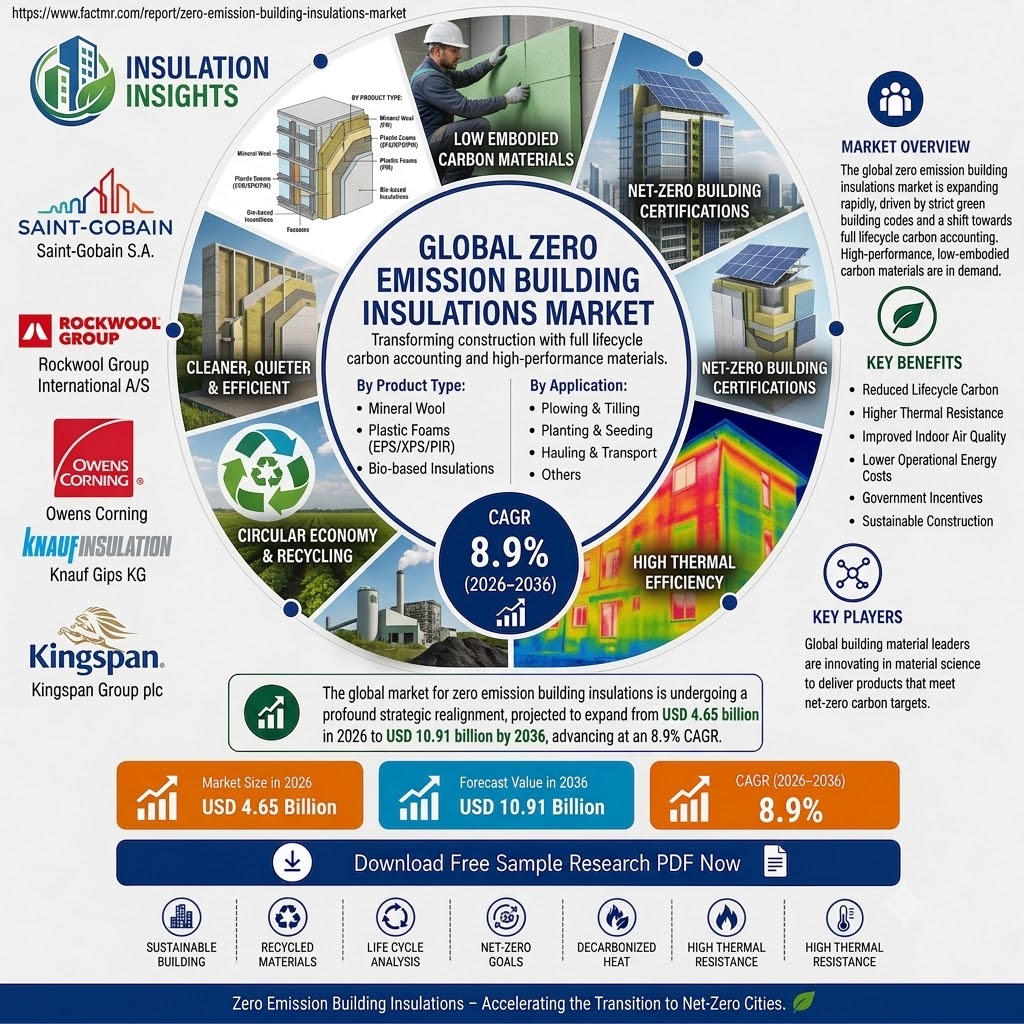
The global zero emission building insulations market is valued at approximately USD 4.65 billion in 2026 and is forecast to reach USD 10.91 billion by 2036, advancing at a CAGR of 8.9% during the period, according to Fact.MR. The market is being reshaped as building regulations and certification systems increasingly consider embodied carbon alongside operational energy efficiency.
Get detailed market forecasts, competitive benchmarking, and pricing trends
Building Codes Turn Insulation into a Decarbonization Requirement
Demand is increasingly tied to mandatory building energy codes and net-zero carbon standards that incorporate limits on embodied carbon. Regulatory developments, including the recast EU Energy Performance of Buildings Directive, Germany’s Energiewende framework, and progressive building codes in U.S. states, are converting insulation upgrades from discretionary sustainability projects into compliance-related investments.
Energy prices are also influencing purchasing decisions. Higher utility costs improve the economic case for high-performance insulation, while green financing and preferential lending conditions for certified buildings can support investment in advanced insulation systems. The report also identifies growing interest in bio-based and carbon-storing materials, including cellulose, wood fiber, and mycelium-based foams.
The shift is changing how insulation performance is assessed. Instead of focusing only on thermal resistance, material selection is increasingly considering global warming potential across production, building use, and end-of-life stages. This is creating opportunities for products with recycled content, lower-carbon manufacturing processes, and stronger circularity credentials.
Mineral Wool Retains the Largest Material Share
Mineral wool, comprising rock and glass wool, holds a 30.0% share of the market in 2026, making it the leading material category. Its established combination of non-combustibility, acoustic performance, moisture resistance, durability, and compatibility with higher recycled-content manufacturing supports its continued use in zero emission construction and major renovation projects.
Residential buildings represent the largest building-type segment, accounting for 46.0% of market share in 2026. The segment benefits from stricter energy requirements for new housing and government-backed retrofit programs aimed at improving the efficiency of existing homes. Walls and facades form the leading application area at 39.0%, reflecting the extensive envelope area and the need to manage thermal bridging in increasingly efficient building designs.
Advanced facade systems are adding another layer of demand. Ventilated rainscreens and prefabricated insulated panels increasingly incorporate insulation as an integral part of building-envelope performance, supporting material consumption across both new construction and retrofit activity.
China and Europe Define Key Growth Markets
China records the highest country CAGR in the report at 9.8% from 2026 to 2036. Its combination of large-scale urban construction, increasingly stringent local energy codes, and national carbon-reduction objectives is supporting demand for advanced insulation systems. Ultra-low-energy and near-zero-energy building pilot projects are also encouraging the adoption of newer insulation technologies.
Germany follows with a 9.4% CAGR. Market expansion is supported by near-zero operational energy requirements, thermal retrofit obligations, Energiewende-related subsidy structures, and demand for insulation products supported by verified environmental documentation. The German market is projected to rise from approximately USD 372 million in 2026 to USD 911.8 million by 2036.
France is expected to grow at an 8.6% CAGR through 2036. Its market is supported by national building renovation efforts, commercial energy-reduction requirements under the Tertiary Decree, and rising interest in insulation solutions that can contribute to summer heat resilience. France’s market is forecast to increase from approximately USD 279 million in 2026 to USD 637.3 million by 2036.
Competitive Landscape
The competitive landscape includes established insulation and building-material manufacturers such as Saint-Gobain, Rockwool Group, Owens Corning, Knauf Insulation, and Kingspan Group. Competition is increasingly shaped by material performance, recycled content, lower-carbon manufacturing, and the ability to meet evolving building certification and embodied-carbon requirements.
Fact.MR’s analysis indicates that the market will increasingly connect insulation specification with building decarbonization strategies and green finance requirements. Demand for bio-based materials, circular manufacturing, aerogels, and other high-efficiency solutions is expected to add new dimensions to product development as builders address stricter whole-life carbon expectations.
For detailed forecasts, segment analysis, country-level assessments, and competitive intelligence, readers can explore the full [LINK: Zero Emission Building Insulations Market] report from Fact.MR.
To View Top Reports
Active Pharmaceutical Ingredient Market
About Fact.MR
Fact.MR is a market research and consulting firm providing syndicated and customized research across industries. Its research covers market sizing, forecasts, competitive analysis, industry trends, and strategic insights designed to support business and investment decisions.