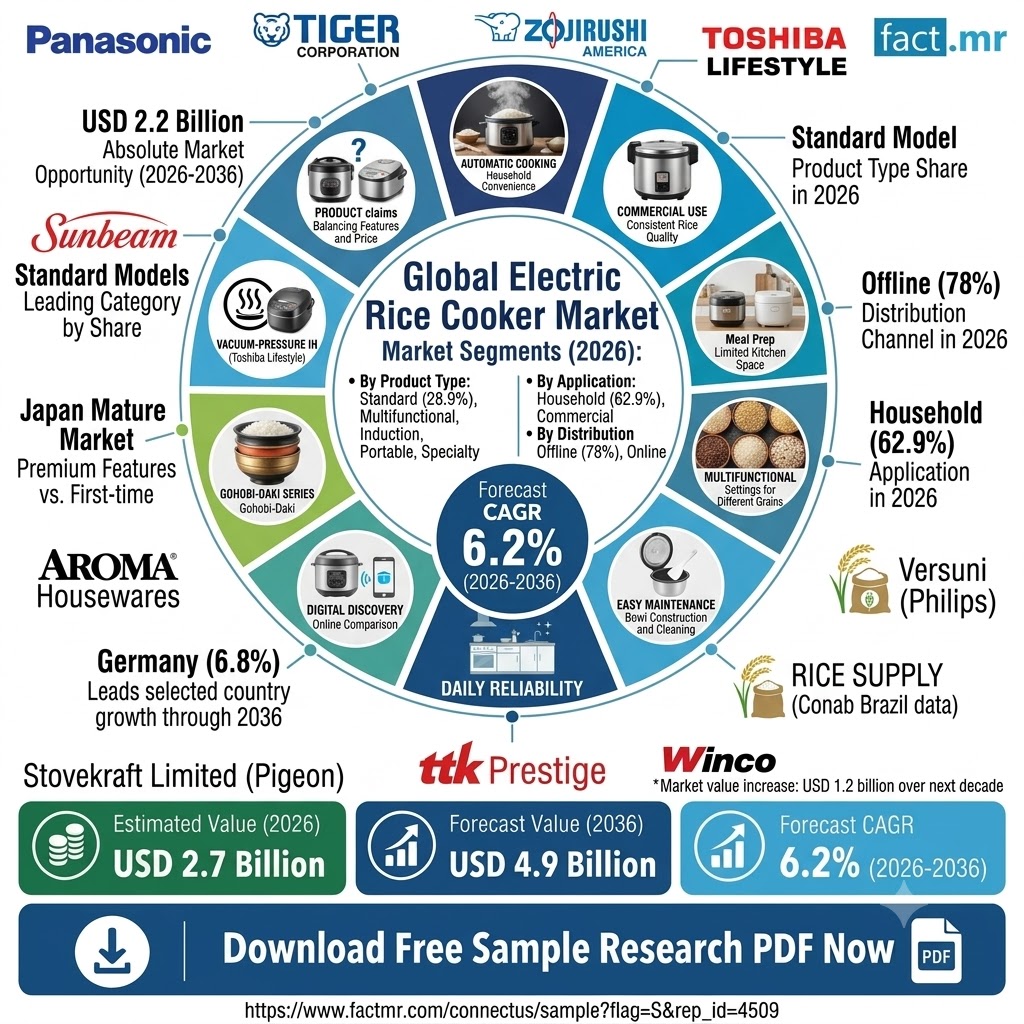
The global electric rice cooker market is projected to increase from USD 2.7 billion in 2026 to USD 4.9 billion by 2036, registering a compound annual growth rate (CAGR) of 6.2%, according to Fact.MR. The market was valued at USD 2.5 billion in 2025. Demand is expected to rise as households seek easier meal preparation and commercial kitchens require consistent rice cooking during service hours.
The forecast represents an absolute market opportunity of USD 2.2 billion between 2026 and 2036. Buyers are comparing cooking performance, capacity and maintenance requirements more closely, while manufacturers face pressure to justify premium prices for advanced heating technologies. Standard electric rice cookers are expected to remain the leading product category by share in 2026.
Get detailed market forecasts, competitive benchmarking, and pricing trends: https://www.factmr.com/connectus/sample?flag=S&rep_id=4509
Electric Rice Cooker Market Growth Reflects Everyday Cooking Needs
Electric rice cookers address a practical need. Automatic cooking and warming functions reduce the need for continuous stovetop monitoring, making these appliances suitable for households with regular rice-based meals. Compact countertop designs also appeal to consumers working with limited kitchen space.
Commercial demand follows a different pattern. Restaurants, cafeterias and smaller foodservice operators need equipment that can maintain rice quality throughout serving periods without assigning staff to constant manual preparation. For these buyers, holding time, cleaning requirements and replacement-part availability influence purchasing decisions.
Agricultural production provides additional context for the category. Brazil’s National Supply Company (Conab) estimated rice production at 11.1 million tonnes for the 2025/26 season and reported that the harvested volume was sufficient to meet domestic market demand. This supports the relevance of rice within Brazil’s food supply, although production levels alone do not determine appliance sales.
Retail access is also changing. The U.S. Census Bureau estimated seasonally adjusted U.S. retail e-commerce sales at USD 340.2 billion in the second quarter of 2026. While this figure covers the wider retail market rather than rice cookers specifically, it illustrates the scale of the online environment in which consumers discover and compare household appliances.
Standard Electric Rice Cookers Lead Product-Type Demand
Standard electric rice cookers are projected to account for 28.9% of the market in 2026, according to Fact.MR. Their position reflects familiar one-touch operation and accessible pricing. Consumers can prepare rice without paying extra for advanced induction heating or multiple specialized cooking programs.
Multifunctional models broaden the category by offering settings for different grains, steaming and warming. Induction models appeal to buyers seeking more precise heat control and consistent texture, but their higher prices can discourage upgrades among cost-conscious households.
Manufacturers have an opportunity to explain these differences more clearly. Product descriptions that specify usable cup capacity, bowl material, heating method and cleaning requirements can help buyers understand which features justify a higher purchase price.
Household Applications and Offline Retail Shape the Market
Household applications are forecast to represent 62.9% of the electric rice cooker market in 2026. Repeated meal routines and limited supervision requirements support this leading position. Commercial applications remain relevant where larger cooking capacities and warming functions help kitchens maintain service standards.
Offline distribution is expected to account for 78% of market share in 2026. Physical stores allow customers to inspect bowl construction, test controls and compare warranty conditions before purchasing. Online channels, however, give consumers greater access to product specifications and price comparisons.
Japan offers a useful example of the relationship between digital discovery and established appliance demand. The Ministry of Economy, Trade and Industry reported that Japan’s business-to-consumer e-commerce market reached JPY 26.1 trillion in 2024. Electrical appliances and related equipment represented JPY 2.7443 trillion within the reported merchandising sector.
Germany Leads Selected Country Growth Through 2036
Fact.MR projects Germany’s electric rice cooker market to expand at a 6.8% CAGR through 2036. Brazil is expected to record 6.2%, followed by the United States at 5.6%, the United Kingdom at 5.0% and Japan at 4.4%.
Germany’s outlook reflects appliance replacement and consumer confidence in store-based purchasing. Brazil’s forecast is supported by rice-based meal routines and household-appliance retail activity. In the United States, online discovery and varied rice-based meals contribute to demand, while British consumers benefit from online comparison alongside physical retail checks.
Japan’s market is more mature. Established rice-cooking habits support continued demand, although replacement purchases and premium features are expected to carry more weight than first-time adoption.
Manufacturers Compete on Cooking Precision and Practical Value
Competition spans established appliance manufacturers and suppliers serving different price points. Key companies identified by Fact.MR include Panasonic Corporation, Zojirushi America Corporation, Tiger Corporation, Toshiba Lifestyle Products & Services Corporation, Versuni (Philips), TTK Prestige Limited, Aroma Housewares Company, Sunbeam, Stovekraft Limited (Pigeon), Conair LLC (Cuisinart) and Winco.
Product launches illustrate the emphasis on cooking performance. Tiger Corporation announced in June 2025 that its Gohobi-Daki series would go on sale on June 21, following cumulative series shipments exceeding 800,000 units. Toshiba Lifestyle announced in April 2025 that its RC-10ZWX and RC-10SGX vacuum-pressure induction-heating rice cookers would launch from July 2025.
These developments highlight the role of heat control and texture management in product differentiation. However, higher prices remain a constraint, particularly when consumers can choose standard cookers or multifunctional appliances that perform several kitchen tasks.
Analyst Opinion at Fact.MR
Shambhu Nath Jha, Principal Consultant at Fact.MR, said, “Rice cooker demand is becoming less about novelty and more about daily reliability. The category is expected to reward brands that match capacity, cooking programs and service support to local meal habits. Suppliers should keep standard models accessible while making multifunctional and induction units easier to understand in stores and online.”
About the Electric Rice Cooker Market Report
The Fact.MR Electric Rice Cooker Market report examines market size, growth forecasts, product categories, applications, distribution channels, country-level demand and competitive developments for the 2026–2036 forecast period.
The report covers standard, multifunctional, induction, portable and specialty electric rice cookers across household and commercial applications. It evaluates offline and online distribution across North America, Latin America, Western Europe, Eastern Europe, East Asia, South Asia and Pacific, and the Middle East and Africa.
View Related Reports :
Airside Services Market
About Fact.MR
Fact.MR is a market research and consulting firm that provides market intelligence, industry analysis and demand forecasts to support business planning and strategic decisions across global industries.