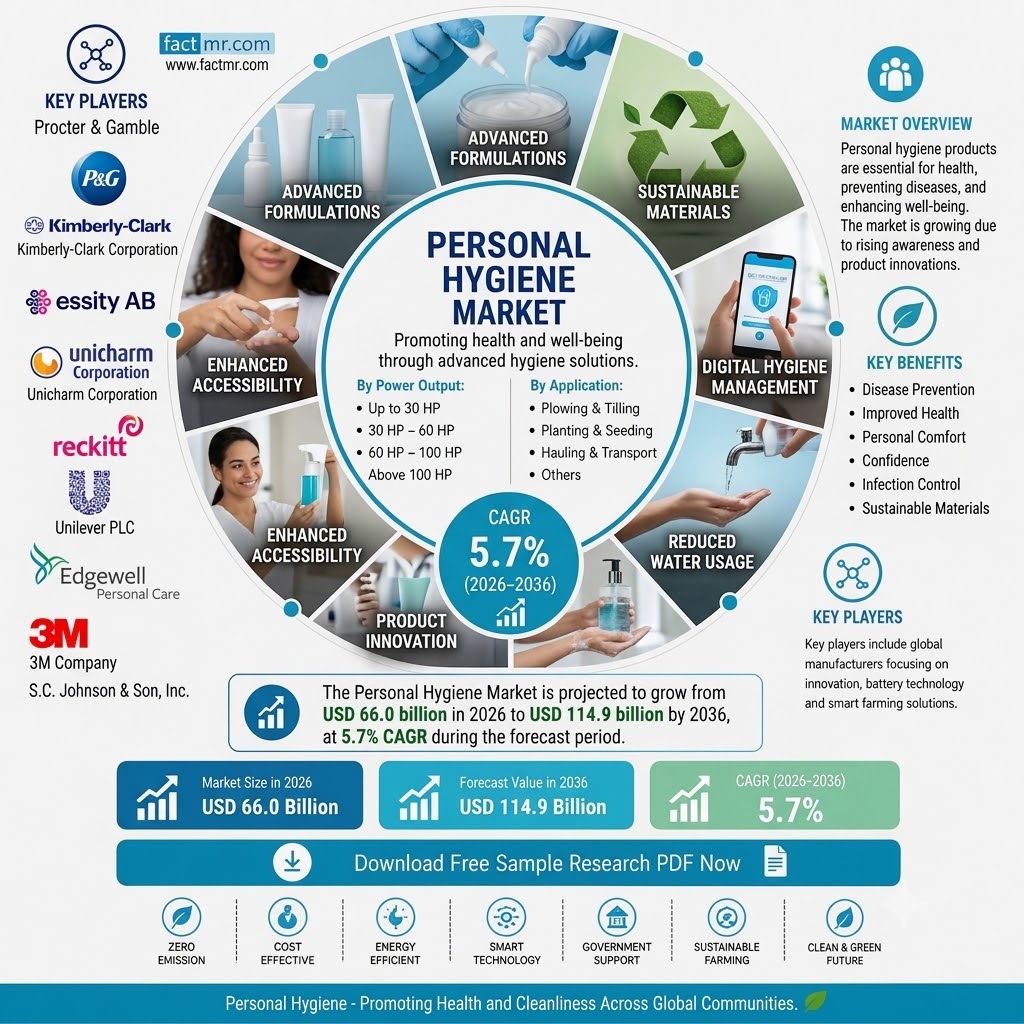
The global personal hygiene market is projected to increase from USD 66.0 billion in 2026 to USD 114.9 billion by 2036, registering a compound annual growth rate (CAGR) of 5.7% during the forecast period, according to Fact.MR. The market reached USD 62.4 billion in 2025. Demand is being supported by recurring purchases of feminine hygiene products, growing requirements for incontinence care and sustained attention to infection prevention across households and institutions.
The market covers a broad range of products, including feminine hygiene products, incontinence garments, disinfectants, hand sanitizers, surgical masks, gloves, surgical caps and antimicrobial wipes. Population ageing is expanding the need for absorbent care products, while hygiene programs in healthcare and community settings are supporting demand for sanitizers and protective supplies. Wider access through supermarkets, pharmacies and online stores is also bringing branded products to more consumers.
Get detailed market forecasts, competitive benchmarking, and pricing trends
Market Snapshot
- Market value (2025): USD 62.4 billion
- Estimated market value (2026): USD 66.0 billion
- Forecast value (2036): USD 114.9 billion
- CAGR (2026–2036): 5.7%
- Leading product segment: Feminine hygiene products, with 22.8% share in 2026
- Leading usability segment: Disposable products, with 68.3% share in 2026
- Leading distribution channel: Supermarkets/Hypermarkets, with 34.6% share in 2026
Feminine Hygiene and Disposable Products Support Market Demand
Feminine hygiene products are projected to account for 22.8% of the product segment in 2026. Pads, tampons and liners generate recurring purchases, while product development focused on thinner and more absorbent formats is giving consumers additional choices. Greater awareness of menstrual health is also encouraging wider discussion and access to period-care products.
Disposable products are expected to hold 68.3% of the usability segment. Single-use formats remain relevant in households, hospitals and care facilities because they reduce the need for washing and support hygiene routines. Disposable pads, gloves and wipes are regularly replenished by both individual consumers and institutional buyers. Reusable products, including washable period underwear and cloth incontinence pads, offer an alternative for buyers seeking longer product life and lower waste.
Supermarkets and Hypermarkets Lead Distribution
Supermarkets and hypermarkets are forecast to capture 34.6% of distribution-channel demand in 2026. These outlets allow consumers to compare brands, pack sizes and prices while purchasing everyday household essentials. Pharmacy networks remain relevant for products such as incontinence garments, hand sanitizers and disinfectants, where buyers may seek product guidance.
Online stores are creating opportunities for repeat purchases through home delivery and convenient price comparisons. Subscription purchasing can also help consumers maintain regular supplies of frequently used hygiene products. For manufacturers, a presence across retail, pharmacy and digital channels can improve product accessibility and support customer retention.
Regional Outlook: Germany Leads Country-Level Growth
Germany is projected to record the highest country-level CAGR at 6.6% through 2036. Strong hygiene awareness, established retail networks and an ageing population are supporting demand for feminine hygiene products, sanitizers and incontinence garments.
Brazil is expected to expand at a 6.0% CAGR, supported by a large consumer base and broader access to branded products through supermarkets, pharmacies and e-commerce. The United States market is forecast to grow at 5.4%, while the United Kingdom is projected to register a 4.8% CAGR. Japan is expected to record a 4.3% CAGR, with demand shaped by its ageing population and established cleanliness standards.
Analyst Perspective
Shambhu Nath Jha, Principal Consultant at Fact.MR, states, “Households and elderly care homes now treat personal hygiene products as essential purchases. Buyers will stay with trusted brands that offer consistent quality, convenient formats and reliable availability in every channel. Manufacturers that keep improving products, extend their retail and online reach, and serve the hygiene needs of each age group will capture the most growth through 2036.”
Competitive Landscape
The personal hygiene market features companies operating across absorbent hygiene, germ protection and institutional supply categories. Key companies profiled by Fact.MR include Procter & Gamble, Kimberly-Clark Corporation, Essity AB, Unicharm Corporation, Reckitt, Unilever PLC, Edgewell Personal Care, 3M Company and S.C. Johnson & Son, Inc.
Procter & Gamble, Kimberly-Clark, Essity and Unicharm compete in feminine care and incontinence products through portfolios focused on absorbency and comfort. Reckitt and Unilever participate in germ-protection and hand-hygiene categories, while Edgewell Personal Care offers antibacterial wipes. 3M and S.C. Johnson serve institutional and workplace hygiene requirements.
Competition is shaped by brand trust, product quality, retail reach and reliable supply. Manufacturers are also evaluating lower-waste designs, reusable product lines and skin-friendly formulations. However, environmental regulations affecting single-use products, fluctuations in pulp and polymer costs, and private-label price competition may constrain growth in some markets.
To View Related Reports
Electronic Drug Delivery Systems Market
About Fact.MR
Fact.MR is a market research and competitive intelligence provider delivering market intelligence, competitive analysis, and forecasting across global industries. Its research helps businesses evaluate market demand, understand competitive developments, and identify growth opportunities. The analysis draws on 120+ sources, 35+ company portfolios, coverage across 25+ countries and more than 20 industry interviews.