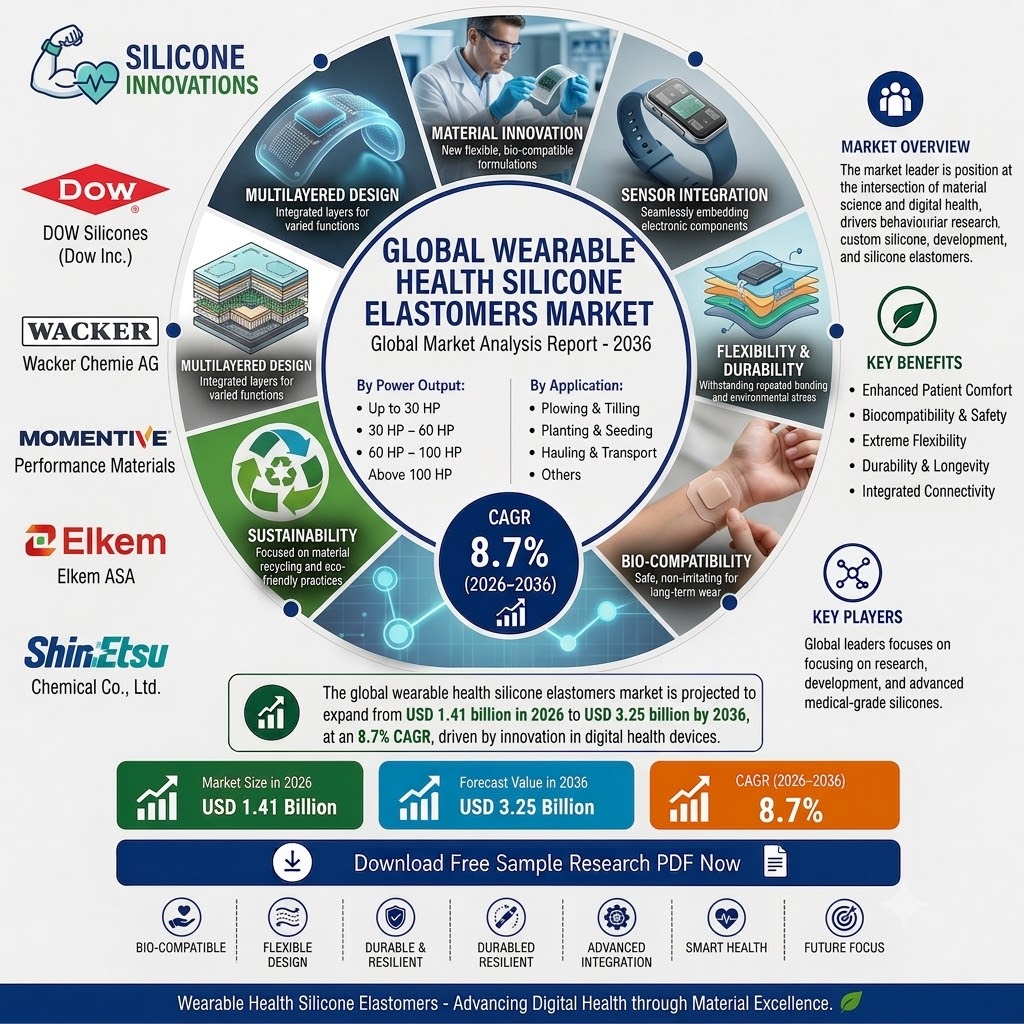
The global wearable health silicone elastomers market is projected to expand from USD 1.41 billion in 2026 to USD 3.25 billion by 2036, advancing at an 8.7% CAGR over the forecast period. Fact.MR analysis finds that the market is moving beyond conventional fitness accessories as medical-grade silicone materials become increasingly important for clinical-grade sensor housings, adhesive patches, and other wearable health components.
Preventive healthcare and remote patient monitoring are widening the role of wearable devices. As wearables move toward continuous biometric measurement and clinical diagnostics, manufacturers require elastomers capable of maintaining safe, reliable contact with the human body. At the same time, demand for all-day comfort is encouraging the development of softer, breathable, and more aesthetically adaptable silicone formulations.
Get detailed market forecasts, competitive benchmarking, and pricing trends
Medical-Grade Materials Lead Wearable Applications
Medical-grade silicone elastomers account for a 39.6% share of the elastomer type segment in 2026, making them the leading material category in the market. Their position reflects biocompatibility, hypoallergenic characteristics, and an established skin-safety profile, all of which matter for products designed for prolonged contact with users. These materials can also be formulated across different softness levels, allowing manufacturers to balance flexibility and durability in watch straps, sensor housings, and adhesive patches.
Fitness and activity trackers represent the largest device category, holding a 32.8% share in 2026. Their high consumer volume and frequent product refresh cycles generate recurring demand for silicone components, particularly straps that need comfort, sweat resistance, and cost-effective production. The report also identifies consumer electronics as the dominant end-use industry, accounting for 45% of market demand in 2026.
The material requirements are becoming more demanding as wearable health technology develops. Suppliers are working on ultra-soft, breathable, and antimicrobial formulations that can support prolonged use without skin irritation. Conductive silicones are also gaining attention for integrated biometric sensing, while self-adhesive elastomers can support medical patches without relying on harsher adhesive systems.
China, USA and Germany Set Distinct Growth Paths
China records the fastest country-level growth in the report, with demand projected to rise at a 10.1% CAGR through 2036. Its position as a major manufacturing center for consumer electronics and wearables supports demand for silicone materials, while domestic device makers continue developing health-monitoring products across consumer segments. Local suppliers are also scaling formulations aimed at meeting both domestic and export requirements.
The USA follows at a 9.2% CAGR. Growth is linked to the country’s technology innovation ecosystem and established digital health and medical device industries. Developers of diagnostic wearables require elastomers capable of meeting standards for extended skin contact, while collaboration between material suppliers and wearable OEMs is supporting application-specific material development.
Germany is projected to advance at an 8.5% CAGR, reflecting its established medical technology and precision engineering capabilities. German developers of professional health monitors and therapeutic wearables require silicone materials with consistent performance, purity, and detailed validation data. These requirements align with the country’s export-oriented medical wearable industry and its emphasis on stringent quality management.
South Korea is expected to grow at 9.0% CAGR, supported by its concentration of consumer electronics companies and demand for premium, precisely molded elastomers. Japan follows at 7.8%, with its market emphasizing miniaturized, conformable silicone formulations for health-monitoring patches and wearable sensors.
Competition Centers on Specialized Silicone Grades
The competitive landscape includes global silicone manufacturers with established research and development capabilities. Key companies profiled in the report include Dow Silicones (Dow Inc.), Wacker Chemie AG, Momentive Performance Materials, Elkem ASA, and Shin-Etsu Chemical Co., Ltd. Competition is increasingly focused on material purity, formulation flexibility, application engineering, and specialized grades for sensor-related wearable applications.
For suppliers, the opportunity extends beyond conventional wearable straps. Materials designed for optical clarity, conductivity, skin compatibility, precision molding, and long-term durability can address the increasingly technical requirements of diagnostic and health-monitoring devices. The report also identifies sustainable silicone development, hybrid elastomer systems, additive manufacturing, and smart materials with sensing capabilities as areas shaping future development.
The wearable health silicone elastomers market is therefore positioned around a broader transition in wearable technology: from lifestyle accessories toward devices capable of supporting continuous health measurement. With the market expected to reach USD 3.25 billion by 2036, material suppliers and wearable manufacturers are likely to remain focused on combining comfort, safety, manufacturing precision, and sensing performance.
To View Top Reports
About Fact.MR
Fact.MR is a market research and consulting firm providing syndicated and customized research across a wide range of industries. Its research covers market sizing, demand forecasting, competitive analysis, industry trends, and country-level assessments to support business and strategic planning.