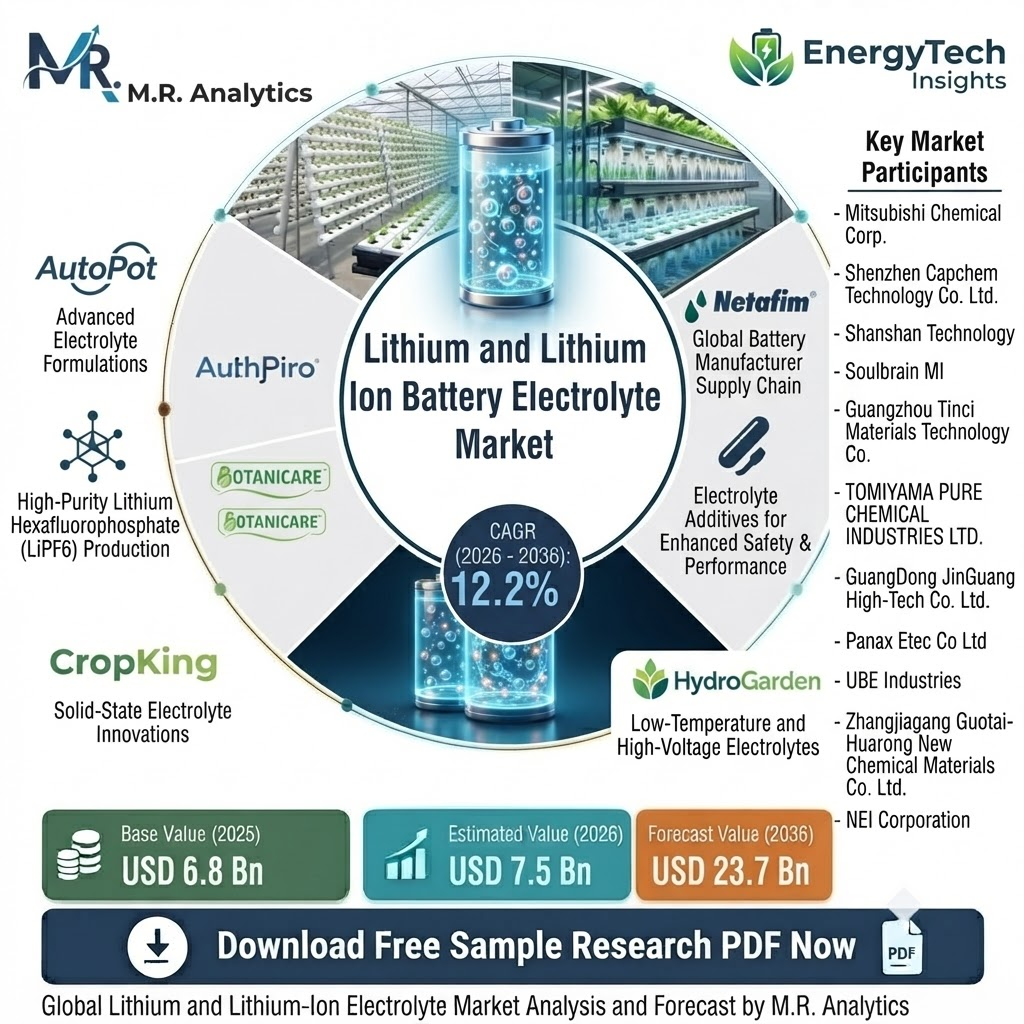
-The lithium and lithium ion battery electrolyte market is estimated at USD 7.5 billion in 2026 and is projected to reach USD 23.7 billion by 2036, expanding at a 12.2% CAGR during the forecast period. The market is benefiting from rising lithium-ion battery production for electric vehicles, stationary energy storage, and consumer electronics, alongside gigafactory investments and government electrification programs.
Lithium-based electrolytes remain the leading product type, accounting for about 84% of the market in 2026. Their established commercial use, conductivity, cost efficiency, and compatibility with NMC and LFP battery chemistries support their position. The automotive segment is also expected to hold about 38% share, reflecting high electrolyte consumption in EV traction battery production.
Get detailed market forecasts, competitive benchmarking, and pricing trends
Country-level growth varies across major battery manufacturing markets. India records the highest CAGR at 14.1%, supported by the Production Linked Incentive scheme for Advanced Chemistry Cells, EV expansion, and emerging gigafactory investments. Germany follows at 13.4%, with Volkswagen and BMW supporting battery production and electrolyte localisation. China is projected to expand at 13.0%, backed by its large EV manufacturing base and extensive gigafactory ecosystem.
The competitive landscape includes Mitsubishi Chemical Corp., Shenzhen Capchem Technology Co. Ltd., Guangzhou Tinci Materials Technology Co., and Shanshan Technology, alongside other electrolyte suppliers pursuing capacity expansion, high-voltage additives, and advanced solid-state formulations.
As battery manufacturing becomes increasingly regional, electrolyte suppliers are focusing on localized production, next-generation chemistries, and supply-chain partnerships across Asia, Europe, and North America.
To view related Reports
Countries chosen: Germany, India, and China — Germany provides the required European representation and strong 13.4% CAGR, while India and China capture two of the report’s highest-growth major markets at 14.1% and 13.0%, respectively.