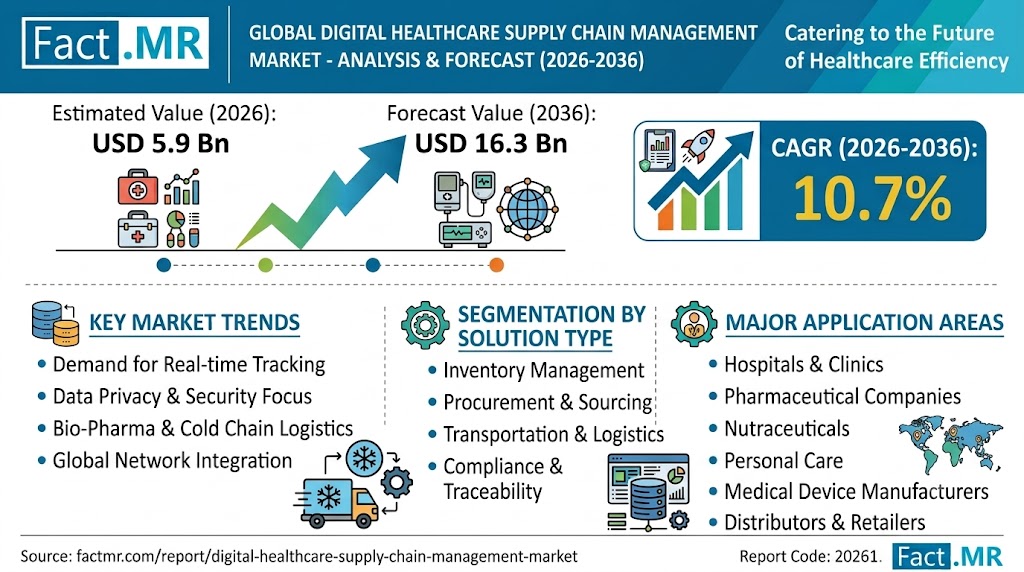
The global digital healthcare supply chain management market is projected to grow from USD 5.9 billion in 2026 to USD 16.3 billion by 2036, expanding at a 10.7% CAGR during the forecast period. The market was valued at USD 5.3 billion in 2025. Growth is being driven by healthcare providers’ need for live inventory visibility, cloud-based procurement workflows, product traceability, and analytics-led replenishment planning.
Healthcare organizations increasingly need digital platforms that connect purchasing records, inventory data, distributors, and internal stores. Traceability is also gaining importance when pharmaceuticals and medical products pass through multiple handoffs or require cold-chain monitoring. The market represents an absolute opportunity of USD 10.4 billion between 2026 and 2036, with cloud-based SCM software and inventory management identified as key areas of demand.
Get Detailed Market Forecasts, Competitive Benchmarking, and Pricing Trends
Global Segment Leaders
- Cloud-based SCM Software — 38.0% share in 2026: Cloud deployment supports easier implementation across hospitals, warehouses, and purchasing locations while reducing the need for extensive local infrastructure.
- Inventory Management — 40.0% share: Healthcare buyers commonly begin digital supply-chain programs with stock visibility because shortages, expiry, and excess inventory directly affect daily operations.
- Hospitals & Health Systems — 43.0% share: Large care networks manage extensive product inventories across departments and facilities, making reliable supply availability important for care continuity and spending control.
- Healthcare Providers — 39.0% share: Providers have direct responsibility for product availability at the point of care and use digital tools to monitor consumption, shortages, and replenishment.
- AI-powered Supply Chain Platform — 37.0% share: These platforms combine demand signals, replenishment recommendations, and exception alerts to support daily supply-chain decisions.
Country-Level Performance
- United States — 11.6% CAGR: Large healthcare provider networks create demand for dependable supply visibility across multiple facilities. Buyers also assess integration depth, traceability, and vendor continuity when expanding digital deployments.
- Germany — 11.1% CAGR: Compliance-led procurement and hospital inventory control support adoption. Healthcare organizations place strong emphasis on documentation, data governance, audit trails, and access controls.
- Japan — 10.5% CAGR: Quality-focused healthcare operations and disciplined procurement shape demand. Buyers place emphasis on reliable onboarding, stable operating support, and compatibility with established purchasing routines.
- United Kingdom — 9.9% CAGR: Centralized purchasing routes provide a base for wider platform deployment across hospitals and care settings. Solutions that connect supplier visibility with routine purchasing can support broader implementation.
- China — 9.3% CAGR: Hospital network expansion is increasing the need to coordinate inventory across providers and distributors. Domestic platforms may benefit where local support and pricing are important.
- India — 8.8% CAGR: Private healthcare expansion and the need for improved procurement visibility are supporting demand. Scalable platforms with simpler onboarding can address the requirements of growing hospital groups.
- Singapore — 8.2% CAGR: Compact healthcare logistics and regional service support create a connected environment for digital supply-chain tools. Digital handoff records can improve visibility across suppliers, hospitals, and logistics providers.
The country outlook spans 3.4 percentage points, from 11.6% CAGR in the United States to 8.2% in Singapore. Fact.MR’s regional coverage includes North America, Latin America, Europe, East Asia, South Asia and Pacific, and the Middle East and Africa.
Regional Context
North America benefits from the scale of healthcare provider networks and the need to connect supply-chain systems across multiple facilities. Europe presents strong demand for platforms that can document procurement processes, maintain audit trails, and address compliance requirements.
East Asian markets are also adopting digital tools as healthcare organizations place greater emphasis on quality, inventory control, and platform reliability. Across emerging markets, private healthcare expansion and improving procurement visibility provide additional opportunities.
Fact.MR identifies adoption and integration as a major short-term growth driver. Buyers are expected to adopt platforms more quickly when purchase orders can connect directly with inventory records and distributor information. Regulatory and compliance support is another important factor, particularly in the United States, Germany, and the United Kingdom.
At the same time, integration costs and system complexity can slow implementation. Legacy purchasing systems may require extensive work before they can connect with distributor data. Security reviews and compliance checks can also lengthen procurement cycles.
Competitive Landscape
The competitive landscape includes Oracle Corporation, SAP SE, Infor Inc., Blue Yonder, McKesson Corporation, Tecsys Inc., Manhattan Associates, Inc., Kinaxis Inc., E2open, and IBM Corporation. These companies bring different strengths across enterprise software, healthcare operations, supply-chain planning, procurement, distribution, and orchestration.
Oracle Corporation supports healthcare buyers through enterprise supply-chain and procurement tools, while SAP SE provides business-network capabilities for supplier collaboration. Infor Inc. brings healthcare operations experience, and Blue Yonder focuses on planning and execution workflows.
McKesson Corporation adds healthcare distribution exposure, while Tecsys Inc. provides healthcare supply-chain software capabilities. Manhattan Associates, Inc. contributes planning software expertise, Kinaxis Inc. brings supply-chain orchestration capabilities, and E2open and IBM Corporation broaden the technology provider landscape.
The report also references recent industry developments involving healthcare supply-chain digitalization. NHS Supply Chain published an update on inventory management deployment in January 2025 and introduced a policy on data standards for supplier product coding in September 2025. The UK Department of Health and Social Care also published guidance on digital and data-driven health technologies in January 2025.
Analyst Opinion
Shambhu Nath Jha, Principal Consultant at Fact.MR, states: “Digital Healthcare Supply Chain Management companies need to show how platforms fit each use case. Buyers are expected to reward suppliers that prove value and reliability. Transparent specifications and reliable service are likely to decide repeat sales more than broad category narratives.”
Strategic Implications
Healthcare procurement teams can define platform requirements around inventory accuracy and traceability before comparing vendors. Clear requirements can help buyers assess integration needs, compliance controls, and expected workflow changes.
Technology providers can strengthen customer evaluation by explaining implementation steps and compliance features in straightforward documentation. Platform vendors also have an opportunity to expand into pharmacy inventory and cold-chain logistics, while system integrators and healthcare procurement networks can support partner-led deployment.
The market covers cloud-based SCM software, on-premise SCM solutions, logistics visibility platforms, and digital procurement platforms. Supply-chain functions include inventory management, procurement management, cold-chain management, and demand planning. Technology categories include AI-powered platforms, hybrid deployment, IoT-enabled monitoring, and blockchain-enabled traceability.
Fact.MR’s analysis draws on 120+ sources, 35+ company portfolios, 25+ countries, and more than 20 interviews. The research combines primary interviews with manufacturers, service providers, technology developers, distributors, end users, and subject-matter experts with government statistics, regulatory publications, company filings, trade data, technical studies, industry associations, standards, and public policy sources.
Other Related Reports:
Low-Drag Satellite Platforms Market
Multi-Chamber Biobased Detergents Market
About Fact.MR
Fact.MR is a global market research and consulting firm delivering market intelligence across industries including Healthcare, Technology, Food & Beverage, Consumer Goods, Automotive, Industrial Goods, and Chemical & Materials. Its research combines primary and secondary sources to support market sizing, competitive analysis, demand assessment, and industry forecasting.