Rising demand for renal-anemia treatment and broader biosimilar purchasing options are supporting steady expansion of the global erythropoietin (EPO) drugs market.
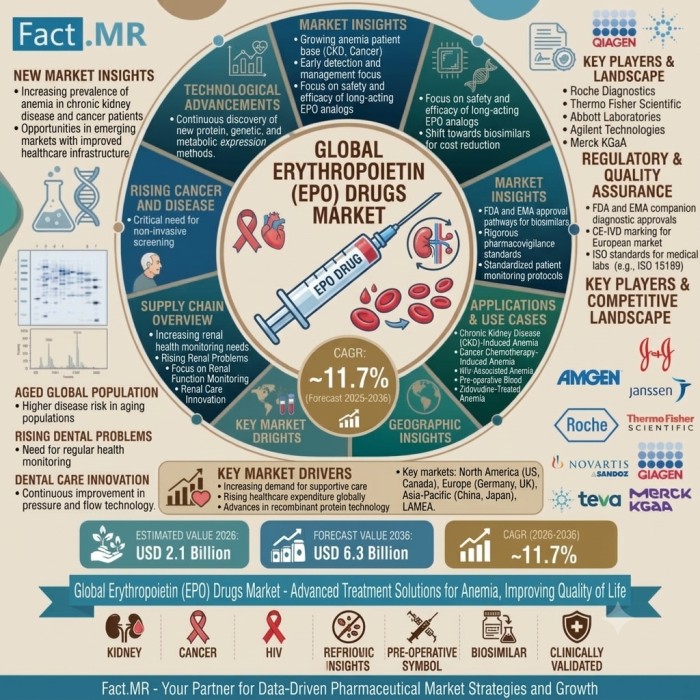
Rockville, Maryland – October 15, 2026 — The global erythropoietin (EPO) drugs market is projected to grow from USD 13.8 billion in 2026 to USD 22.7 billion by 2036, according to the latest market report published by Fact.MR. The industry is anticipated to expand at a compound annual growth rate (CAGR) of 5.1% over the forecast period, creating an incremental revenue opportunity of USD 8.9 billion.
Demand is supported by recurring treatment requirements for renal anemia, particularly among patients with chronic kidney disease, alongside the availability of biosimilar products that give hospitals and healthcare payers additional procurement options. Market development will also depend on treatment continuity, reliable product supply, reimbursement policies, and clinical monitoring requirements.
Get detailed market forecasts, competitive benchmarking, and pricing trends:
KEY MARKET TAKEAWAYS
- Market Valuation: USD 13.8 billion in 2026, projected to reach USD 22.7 billion by 2036.
- Growth Rate: A CAGR of 5.1% from 2026 to 2036.
- Leading Product Segment: Epoetin alfa is expected to account for 34.0% of the product-type segment in 2026.
- Leading Application: Chronic kidney disease-associated anemia is projected to represent 46.0% of the application segment in 2026.
- Leading End User: Hospitals are estimated to account for 39.0% of the end-user segment in 2026.
- Fastest-Growing Country: Germany leads the listed country markets with a projected CAGR of 5.9% through 2036.
- Core Growth Driver: Recurring renal-anemia treatment, supported by repeated monitoring requirements and continued demand for erythropoiesis-stimulating agents.
INDUSTRY SHIFTS & MARKET DYNAMICS
Recurring Renal-Anemia Treatment Supports Demand
The erythropoietin drugs market is benefiting from ongoing treatment needs associated with chronic kidney disease and related anemia. Patients receiving care for renal anemia may require repeated hemoglobin assessments, iron-status evaluations, and dose adjustments. These recurring clinical requirements support continued demand for erythropoietin products across hospitals and dialysis settings. Fact.MR identifies epoetin alfa as the leading product type, with a projected 34.0% share in 2026, reflecting its established clinical use and familiar procurement profile.
Biosimilar availability is also influencing purchasing decisions. Healthcare payers, hospitals, and dialysis providers can evaluate alternative products based on acquisition costs, administration requirements, clinical monitoring, and supply reliability. Products that support dependable treatment continuity and offer clear switching guidance may be better positioned to secure repeat procurement contracts. Opportunities also exist in specialty pharmacy coordination and delivery approaches that reduce administrative burdens without compromising appropriate safety oversight.
Reimbursement and Supply Reliability Remain Important Challenges
Despite the positive outlook, market participants face constraints associated with safety monitoring, reimbursement reviews, and the operational requirements of erythropoiesis-stimulating agent use. Dose adjustments and laboratory assessments add responsibilities for clinical teams, while authorization procedures can delay access in certain healthcare systems. Suppliers must therefore demonstrate dependable product availability and support treatment pathways that fit established prescribing and monitoring practices.
Cold-chain management and consistent fill rates are additional considerations for manufacturers and distributors. Interruptions in supply can affect repeat purchasing even when products remain competitively priced. Country-level growth also varies according to procurement arrangements, biosimilar substitution policies, reimbursement frameworks, and established dialysis practices. Companies seeking expansion will need to align their commercial strategies with local purchasing rules and the requirements of healthcare providers.
REGIONAL MARKET SUMMARY
Germany is projected to record the fastest growth among the country markets listed in the report, with a CAGR of 5.9% from 2026 to 2036. Biosimilar substitution and rebate-based procurement are expected to support its expansion. Brazil follows at 5.5%, while the United States is forecast to grow at 5.2%, supported by public access pathways and dialysis-related purchasing arrangements, respectively.
| Country | Projected CAGR (2026–2036) | Key Market Factor |
| Germany | 5.9% | Biosimilar substitution and rebate-based procurement |
| Brazil | 5.5% | Public treatment protocols and centralized access |
| United States | 5.2% | Dialysis contracting and utilization management |
| Australia | 4.9% | Specialist access and reimbursement controls |
| Canada | 4.6% | Provincial switching policies and biosimilar access |
The United Kingdom is projected to grow at 4.3%, while Japan is expected to record a CAGR of 3.8% over the same period. These differences highlight the importance of national reimbursement structures, formulary decisions, and treatment practices in shaping the commercial outlook for erythropoietin drugs.
ANALYST INSIGHTS
“EPO drug suppliers are expected to win durable accounts through dependable clinical execution. Price alone is not enough when buyers review monitoring burden and dose stability,” stated Shambhu Nath Jha, Principal Consultant at Fact.MR. “Product handling and refill performance can decide repeat account access.”
Unlock 360° insights for strategic decision making and investment planning:
FREQUENTLY ASKED QUESTIONS
Q: What is the projected size of the erythropoietin (EPO) drugs market by 2036?
A: The global market is estimated at USD 13.8 billion in 2026 and is projected to reach USD 22.7 billion by 2036, growing at a CAGR of 5.1%.
Q: Which product segment holds the leading market share?
A: Epoetin alfa is projected to lead the product-type segment with a 34.0% share in 2026.
Q: Which application accounts for the largest market share?
A: Chronic kidney disease-associated anemia is projected to account for 46.0% of the application segment in 2026.
Q: Which country exhibits the highest growth rate?
A: Germany is projected to lead the listed country markets with a CAGR of 5.9% between 2026 and 2036.
Q: What factors are driving growth in the EPO drugs market?
A: Recurring renal-anemia treatment requirements, repeated clinical monitoring, and broader biosimilar procurement options are the primary growth drivers identified in the report.
Q: What are the major challenges facing market participants?
A: Safety monitoring requirements, reimbursement delays, dose-review responsibilities, cold-chain management, and product supply reliability can constrain market expansion.
Q: Which companies are active in the erythropoietin drugs market?
A: Key companies profiled by Fact.MR include Amgen Inc., Johnson & Johnson, F. Hoffmann-La Roche Ltd., Pfizer Inc., Kyowa Kirin Co., Ltd., Teva Pharmaceutical Industries Ltd., STADA Arzneimittel AG, Intas Pharmaceuticals Ltd., and 3SBio Inc.
Explore More Related Studies Published by Fact.MR Research
Magnetic Stripe Readers Market
About Fact.MR
Fact.MR is a market research and consulting firm providing syndicated research, customized research, investment research, and market intelligence across a broad range of industries. Its research coverage includes food and beverage, healthcare, pharmaceuticals, biotechnology, consumer products, chemicals and materials, technology, industrial goods, and packaging.
Fact.MR provides market intelligence designed to help organizations understand market dynamics, emerging opportunities, competitive developments, and changing industry requirements.
Media Contact
Fact.MR
Email: sales@factmr.com
Phone: +1 (628) 251-1583
Website: www.factmr.com