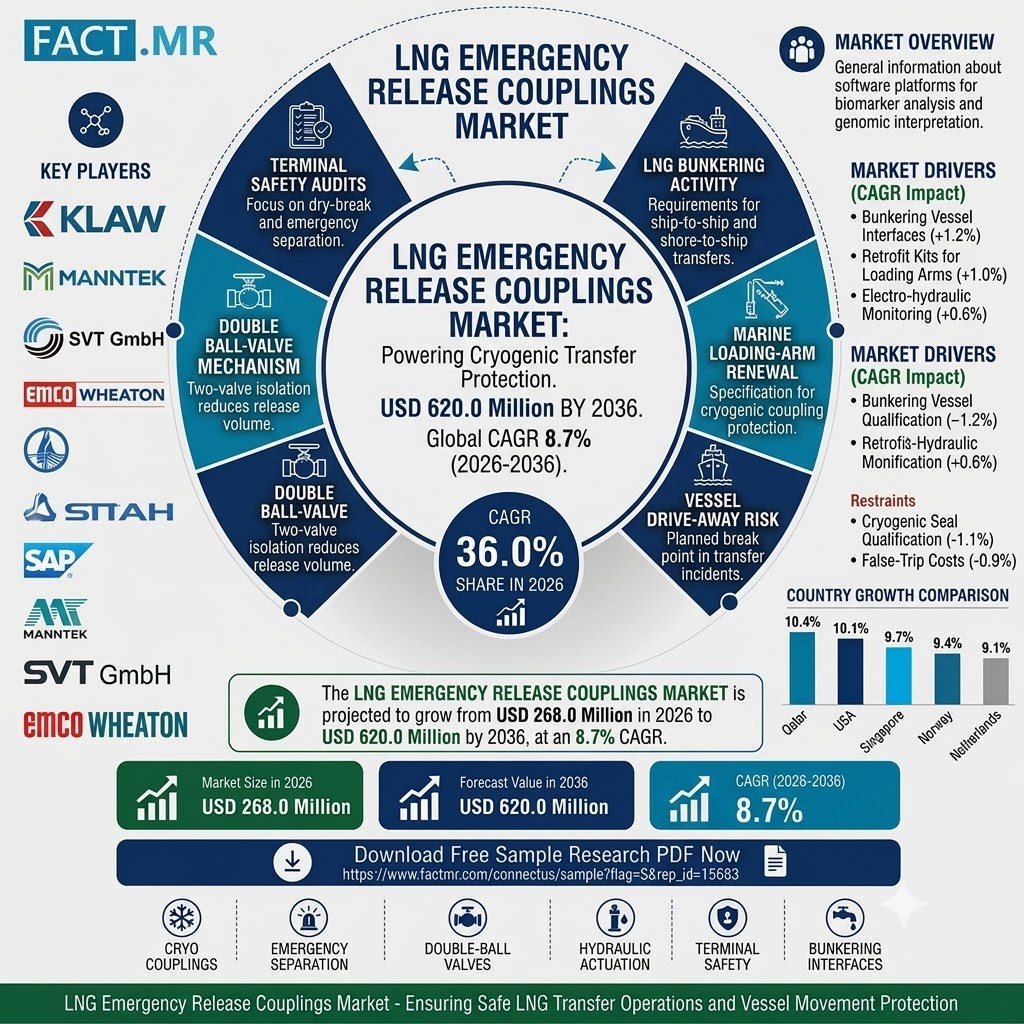
LNG emergency release couplings market rises from USD 268.0 million in 2026 to USD 620.0 million by 2036 at 8.7% CAGR.
September 21, 2026 — The global LNG Emergency Release Couplings Market is projected to increase from USD 268.0 million in 2026 to USD 620.0 million by 2036, expanding at an 8.7% CAGR, according to Fact.MR. The market was valued at USD 246.4 million in 2025, when terminal safety audits increasingly focused on dry-break isolation and emergency separation.
The is being shaped by terminal safety upgrades, marine loading-arm renewal and LNG bunkering activity. The market is expected to create an absolute opportunity of USD 352.0 million by 2036, with terminal operators and bunkering operators specifying couplings for cryogenic transfer protection.
Get detailed market forecasts, competitive benchmarking, and pricing trends:
Market outlook centers on controlled LNG transfer separation
Fact.MR is a market research and consulting company that provides syndicated and customized research across industries. Its LNG Emergency Release Couplings Market analysis covers equipment used to separate LNG transfer lines when vessel movement or drive-away risk threatens the transfer system.
The market’s defining segments already show where demand is concentrated. Double ball-valve PERCs are expected to hold 36.0% share in 2026, while hydraulic actuation is projected at 42.0%. LNG marine loading arms are anticipated to account for 52.0%, and terminal operators are estimated to represent 32.0% of the end-user segment.
These figures explain why now matters for equipment suppliers. Vessel movement can turn routine LNG transfer into a release risk when connections cannot separate cleanly. Emergency-release couplings are therefore specified to shut both sides of the line when movement exceeds permitted limits.
Shambhu Nath Jha, Sr. Consultant at Fact.MR, said, “Emergency release couplings are not routine hose hardware; they are the planned break point in an LNG transfer incident. Procurement is expected to favor providers that prove valve closure after cold cycling and show reset steps clearly.”
Double ball-valve PERCs lead the release mechanism segment
Double ball-valve PERCs are expected to lead the release mechanism category with 36.0% share in 2026. Two-valve isolation helps reduce release volume during separation, making the configuration relevant to terminal safety requirements.
Single ball-valve ERCs remain applicable to smaller transfer systems where reset procedures are straightforward. Guillotine-type and collet-locking couplings address narrower requirements in which release geometry influences equipment selection.
Hydraulic actuation is projected to account for 42.0% share in 2026. The configuration fits LNG terminals where loading-arm movement and valve closure follow a controlled sequence. Electro-hydraulic systems are also anticipated to receive attention as new terminals connect release status with control-room evidence.
The application picture is similarly defined. LNG marine loading arms are projected to capture 52.0% share in 2026, reflecting their direct role at export and import berths. LNG bunkering creates another demand point as ship-to-ship and shore-to-ship transfers require compact release hardware.
Country markets show different LNG transfer requirements
Qatar is forecast to record a 10.4% CAGR through 2036, supported by Ras Laffan expansion and high-duty LNG berth operations. The USA follows at 10.1% CAGR, linked to Gulf Coast LNG export-terminal use and safety reviews.
Singapore is projected to grow at 9.7% CAGR, reflecting LNG bunkering programs and port fuel requirements. Norway is estimated at 9.4% CAGR, with Arctic LNG transfer and cold-weather maintenance requirements shaping equipment needs.
The Netherlands is forecast to expand at 9.1% CAGR, supported by Gate terminal operations and Northwest Europe import flexibility.
The market also presents specific commercial opportunities. Bunkering vessel interfaces are associated with a +1.2% impact on CAGR, while retrofit kits for loading arms carry a +1.0% impact. Electro-hydraulic monitoring has a +0.6% impact, particularly across new terminal projects.
Cryogenic seal qualification remains a restraint, carrying a -1.1% impact on CAGR. False-trip costs account for -0.9%, while long terminal approval cycles and limited service access carry impacts of -0.7% and -0.5%, respectively.
Competition focuses on testing, actuation and service support
KLAW, a Trelleborg brand, MannTek, SVT GmbH and Emco Wheaton (Gardner Denver) are among the companies profiled in the Fact.MR analysis.
KLAW supports LNG transfer safety through its emergency release coupling range. MannTek supplies cryogenic breakaway couplings and powered emergency release systems for LNG transfer applications. SVT GmbH provides loading-arm and transfer-safety equipment, while Emco Wheaton provides LNG emergency release systems based on double-ball-valve isolation.
Shambhu Nath Jha added, “Better tender files combine type-test evidence and actuator sequence notes with local service coverage. That part matters, especially after a release event.”
The report’s analysis draws on 120+ sources, 35+ company portfolios, 25+ countries and more than 20 industry interviews. Primary research covers manufacturers, service providers, technology developers, distributors, end users, procurement teams and subject-matter experts.
The analysis also reviews government statistics, regulatory publications, company filings, trade data, technical studies and industry associations. Market estimates combine historical performance, demand indicators, pricing and volume trends, segment shares, country-level growth and company participation.
For terminal engineering teams, the findings place emergency release coupling selection alongside when arm movement and valve sequencing must correspond. The report also evaluates connections with where transfer safety equipment appears within the same project file.
Top Reports :
About Fact.MR
Fact.MR is a market research and consulting firm providing syndicated and customized market intelligence across technology, chemicals, energy, healthcare, materials and other industries. Fact.MR research combines primary interviews, secondary research, market sizing and forecasting to assess market developments, competitive activity and emerging opportunities.