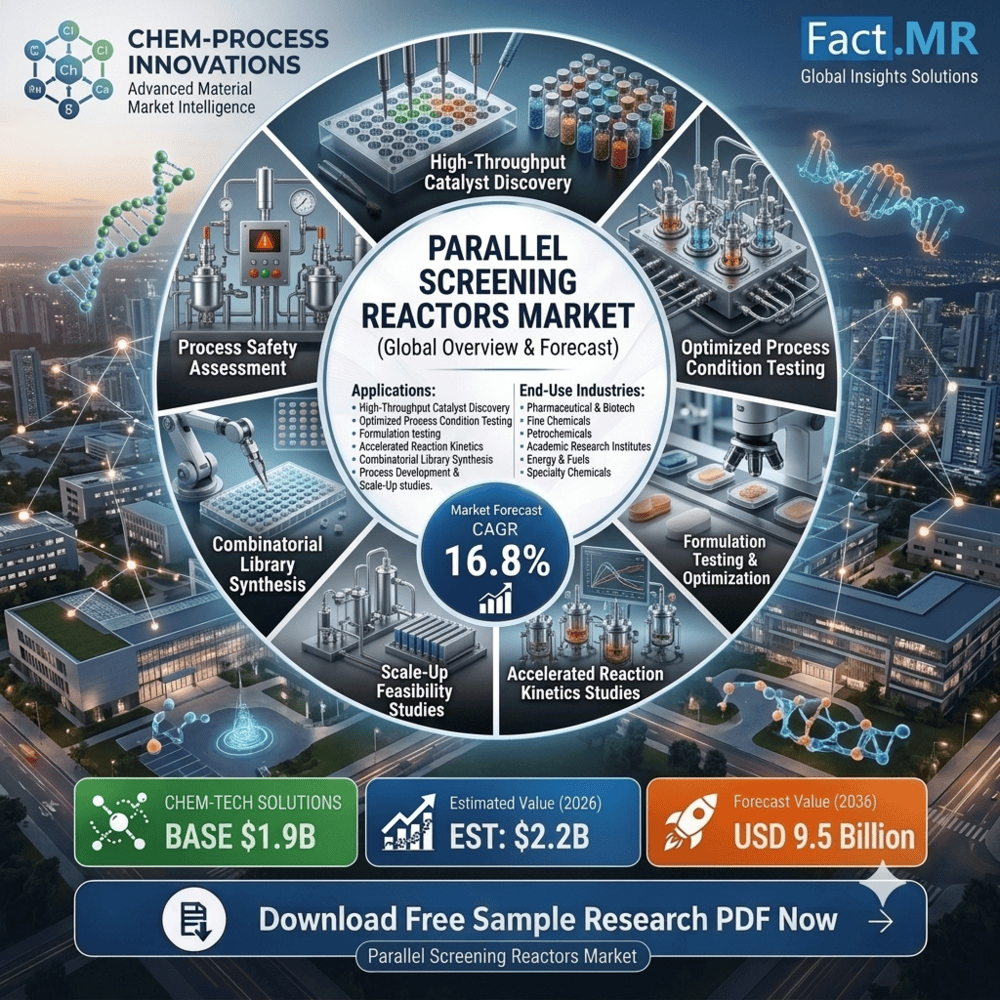
Rockville, MD., September 21, 2026 — The Parallel Screening Reactors Market is projected to grow from USD 292.0 million in 2026 to USD 690.0 million by 2036, registering a 9.0% CAGR, according to Fact.MR. The market reached USD 267.9 million in 2025, creating an absolute opportunity of USD 398.0 million through 2036.
Demand is being shaped by pharmaceutical and chemical R&D teams that need to compare multiple reactions under controlled conditions. Faster reaction screening, reproducible testing, and laboratory workflow automation are identified as key factors supporting market expansion through 2036.
Get detailed market forecasts, competitive benchmarking, and pricing trends:
Multi-well reactors and 4–8 positions support laboratory screening
Multi-well parallel reactors are projected to account for 32.0% of the market in 2026. These systems allow laboratories to compare several reaction conditions within a structured reactor arrangement. Modular parallel autoclaves remain relevant for pressure-based chemistry, while micro-reactor arrays support smaller-volume screening requirements.
The 4–8 positions category is expected to hold 32.0% share in 2026. Fact.MR states that this range provides sufficient capacity for routine reaction comparison without the operating complexity associated with larger systems. Higher-position systems serve broader screening programs but can require greater investment and data-management capabilities.
Manual parallel systems represent the largest automation category, with an estimated 44.0% share in 2026. These systems provide laboratories with a comparatively affordable route to controlled reaction screening. Semi-automated platforms support dosing and sampling consistency, while fully automated and software-integrated systems address repetitive campaigns and experiment tracking.
Pharma R&D accounts for 41.0% of demand
Pharma R&D is estimated to represent 41.0% of the Parallel Screening Reactors Market in 2026. Pharmaceutical research teams use parallel reactors to compare formulations, catalysts, solvents, temperatures, pressures, and reaction times during drug-development programs.
Catalyst developers and chemical R&D laboratories also form part of the market. Academic laboratories and contract-research organizations require flexible configurations because project conditions and throughput requirements can vary.
Extractable market fact: Parallel screening reactor systems are laboratory reactor systems designed to run and compare multiple chemical reactions simultaneously, with configuration, position count, operating control, automation, and reproducibility influencing laboratory adoption.
Faster screening remains a measurable growth driver
Fact.MR identifies faster reaction and formulation screening as a key driver, with an estimated +2.3% impact on CAGR. Reproducibility across reaction positions carries a +1.9% impact, while laboratory workflow automation contributes +1.6%. Expansion of pharmaceutical R&D has a stated +1.4% impact, and improved experimental data capture contributes +0.9%.
Parallel systems allow several reaction conditions to be tested simultaneously. Consistent temperature, pressure, mixing, and sampling help laboratories compare results without repeatedly setting up individual experiments.
Automation is another factor. Automated dosing, sampling, cleaning, and data collection can reduce repetitive manual work in laboratories running frequent screening campaigns. Software-linked systems can also support experiment tracking and result comparison.
The report identifies high equipment and automation cost, configuration mismatch, integration with existing laboratory systems, and maintenance, cleaning, and validation requirements as restraints. High equipment and automation cost carries an estimated -1.2% impact on CAGR, while configuration mismatch carries -1.0%.
France records the highest stated country CAGR
France is projected to register an 11.1% CAGR from 2026 to 2036, the highest stated country CAGR in the report. The growth outlook is linked to pharmaceutical research, specialty-chemical development, and laboratory modernization.
The USA is projected to record a 10.4% CAGR, supported by drug-development programs and automated research workflows. Switzerland follows at 9.5%, while the UK is forecast to grow at 9.2%. Germany records an 8.9% CAGR, supported by chemical engineering expertise and established industrial R&D infrastructure.
The report’s country comparison covers the USA, Germany, Switzerland, UK, France, South Korea, and Japan, within regional coverage spanning North America and Europe in the stated scope.
Competitive landscape focuses on reactor flexibility
The competitive group includes HEL Group, Unchained Labs, Amar Equipment, Parr Instrument, Chemspeed Technologies, and Radleys. These companies participate across parallel reaction screening, laboratory reactor systems, automation, pressure-capable equipment, and related research workflows.
Shambhu Nath Jha, Sr. Consultant at Fact.MR, said, “Parallel screening reactor selection depends on matching reactor format and position count with the laboratory’s actual experimental workload. Market adoption is expected to depend on reaction reproducibility, operating control, automation compatibility, and the ability to compare multiple experiments efficiently rather than maximum position count alone.”
Fact.MR’s analysis draws on 120+ sources, 35+ company portfolios, 25+ countries, and more than 20 industry interviews. The research combines primary discussions with manufacturers, technology providers, pharmaceutical researchers, chemical-development teams, academic users, contract-research organizations, and subject-matter experts with desk research covering government statistics, company filings, technical literature, trade information, standards, and product documentation.
Top Reports:
3D Food Printers Market Valuation, ROI Potential & Long-Term Growth Prospects (2026–2036) Comprehensive Analysis of the Perforated Metal Sheets Market: Technology Evolution, Regional Demand & Forecast Scenarios to 2036
Glyphosate Market Forecast 2026-2036: Market Size, Share, Competitive Landscape & Future Growth Outlook
About the Report
The Parallel Screening Reactors Market study covers system format, throughput, automation level, end user, and regional markets. System formats include multi-well parallel reactors, modular parallel autoclaves, micro-reactor arrays, robotic screening platforms, and flow screening systems. Throughput categories range from 4–8 positions to 48–96 positions.