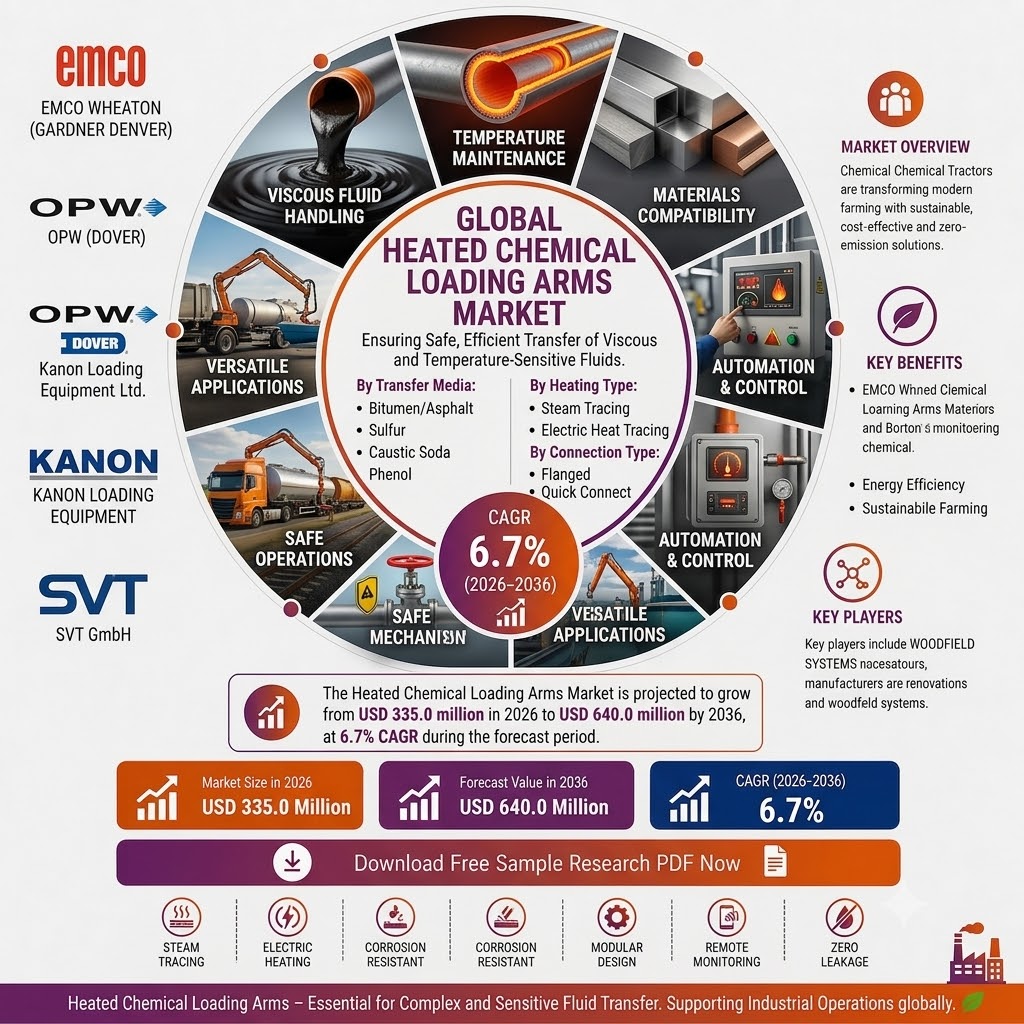
The Heated Chemical Loading Arms Market is projected to increase from USD 335.0 million in 2026 to USD 640.0 million by 2036, advancing at a 6.7% CAGR, according to Fact.MR analysis. The market crossed USD 314.0 million in 2025 as demand strengthened for heated transfer equipment used with bitumen/asphalt, sulfur and viscous chemicals.
The market is set to create a USD 305.0 million absolute opportunity through 2036. Temperature-sensitive product transfer is a central demand factor because phenol, cresols, viscous acids, asphalt and sulfur can become difficult to move when temperatures fall during loading. Heated loading arms help maintain product flow between loading racks and receiving vessels.
Get detailed market forecasts, competitive benchmarking, and pricing trends
Heated Chemical Loading Arms Market gains traction across hot-product transfer
Bitumen/asphalt is projected to account for 26.0% of the market in 2026 by product handled. Hot paving materials and refinery residue streams require controlled transfer conditions, making temperature continuity important during recurring truck and rail loading cycles.
Steam-traced arms are expected to hold 46.0% share in 2026. Many chemical and refinery facilities already operate steam utilities, supporting the use of steam-traced systems at existing loading racks.
Top loading is anticipated to capture 34.0% share in 2026. Sulfur, asphalt and chemical tankers continue to use top-hatch access in applications where this loading arrangement fits existing vehicle and rack configurations.
Chemical producers are estimated to represent 35.0% share in 2026. These facilities handle a broad range of heated liquids, including phenols, acids and polymer-related products.
Fact block: Fact.MR is a market research and competitive intelligence provider that analyzes global markets through primary research, desk research, market sizing and forecasting.
Why temperature control is shaping equipment demand
Temperature-sensitive product transfer is estimated to have a +1.7% impact on CAGR and is particularly relevant in Saudi Arabia, the USA and Germany. Heated arms help prevent short heat-loss events from creating blockages around loading connections.
Bitumen/asphalt rack demand represents another important factor, with a +1.4% estimated impact on CAGR. Fixed loading arms can reduce repeated hose movement during frequent rack cycles while helping preserve product viscosity during transfer.
Safer truck and rail loading has a +1.1% estimated impact on CAGR. Operators increasingly assess loading configuration, access control and emergency shutoff placement when equipment is specified.
The market also presents opportunities through retrofit heated arms, electric heat tracing, modular rack packages and service contracts. Retrofit projects are particularly relevant where existing hoses create heat loss, repeated manual handling or maintenance difficulties.
Saudi Arabia records fastest growth among profiled countries
Saudi Arabia is projected to record an 8.3% CAGR through 2036, the highest among the five profiled countries. Refinery, petrochemical and sulfur-handling activity supports demand for heated transfer systems at loading facilities.
The USA follows with a projected 7.8% CAGR. Asphalt terminals, refinery loading racks and chemical distribution sites are expected to support equipment replacement and retrofit activity.
Japan is forecast to expand at 7.1% CAGR. Space-constrained chemical facilities may favor equipment offering controlled movement, localized heating and clearly documented operating procedures.
Germany is projected to register a 6.7% CAGR. Its established chemical manufacturing base supports demand, while detailed engineering reviews can lengthen project approval cycles.
The UK is expected to record a 6.3% CAGR. Growth is linked to selective upgrades at terminals and specialty chemical plants where older loading arrangements create temperature-control or maintenance issues.
Analyst highlights equipment selection priorities
Shambhu Nath Jha, Sr. Consultant at Fact.MR, said:
“Heated loading arms are chosen only after the product temperature window is understood at the rack. Purchases are expected to depend on heat continuity, safe reach and clean draining during repeated truck or rail operations.”
Jha added that providers with proven swivel designs, insulation options and site documentation are better positioned in purchasing decisions than catalog-only equipment sellers.
Fact.MR analysis also indicates that buyers need to assess product temperature, arm reach, insulation and swivel materials before selecting equipment. Heating method, drainage and maintenance access remain relevant during procurement.
Competition centers on heated-arm capability and service support
Emco Wheaton (Gardner Denver) holds the largest share among the profiled companies and provides molten sulfur loading-arm solutions with steam-jacketed and electrical heat-tracing options.
OPW (Dover) supplies heated loading solutions for asphalt, molten sulfur, waxes and other viscous products. OPW introduced Loading Arm Central™ in January 2025, providing installers with loading-arm installation and maintenance resources.
Kanon Loading Equipment supports top-loading arms for bitumen, high-temperature oils and corrosive chemicals. SVT GmbH and Woodfield Systems also form part of the competitive landscape.
Woodfield Systems supplies heated top and bottom loading arms for bitumen, asphalt and molten sulfur applications. Across the forecast period, Fact.MR expects heating continuity, swivel reliability, service access and documentation quality to remain relevant to equipment selection.
Market constraints remain around cost and customization
Heated loading arms require engineering, insulation and safety hardware beyond a basic loading arm. This contributes to higher installed costs and can delay replacement decisions at smaller facilities where product movement is less frequent.
Thermal safety is another consideration. Heated surfaces create additional burn risks around busy loading racks, requiring suitable shielding, access controls and shutdown procedures.
Customization can also extend project timelines. Product viscosity, vehicle height, rack layout, metallurgy, seals and insulation requirements must align with the handled chemical and operating conditions.
Product compatibility testing adds another review layer, particularly for acidic chemicals and polymer service. Incomplete chemical data sheets can lengthen quotation and approval cycles.
About the Heated Chemical Loading Arms Market report
Fact.MR’s Heated Chemical Loading Arms Market study covers product handled, heating method, loading mode and end user across North America, Latin America, Europe, East Asia, South Asia and Pacific, and the Middle East and Africa.
The analysis covers bitumen/asphalt, molten sulfur, phenol/cresols, viscous acids and molten polymers. Heating methods include steam-traced arms, electrically-traced arms and jacketed heated arms.
The research draws on 120+ sources, 35+ company portfolios, 25+ countries and more than 20 industry interviews. Primary research includes manufacturers, service providers, technology developers, distributors, end users, procurement teams and subject-matter experts.
To View Top Reports
Composite Railing and Decking Market
About Fact.MR
Fact.MR is a market research and competitive intelligence provider delivering market intelligence, forecasts and strategic analysis across industries. Its research combines primary interviews, secondary research, company portfolio analysis and quantitative market forecasting.