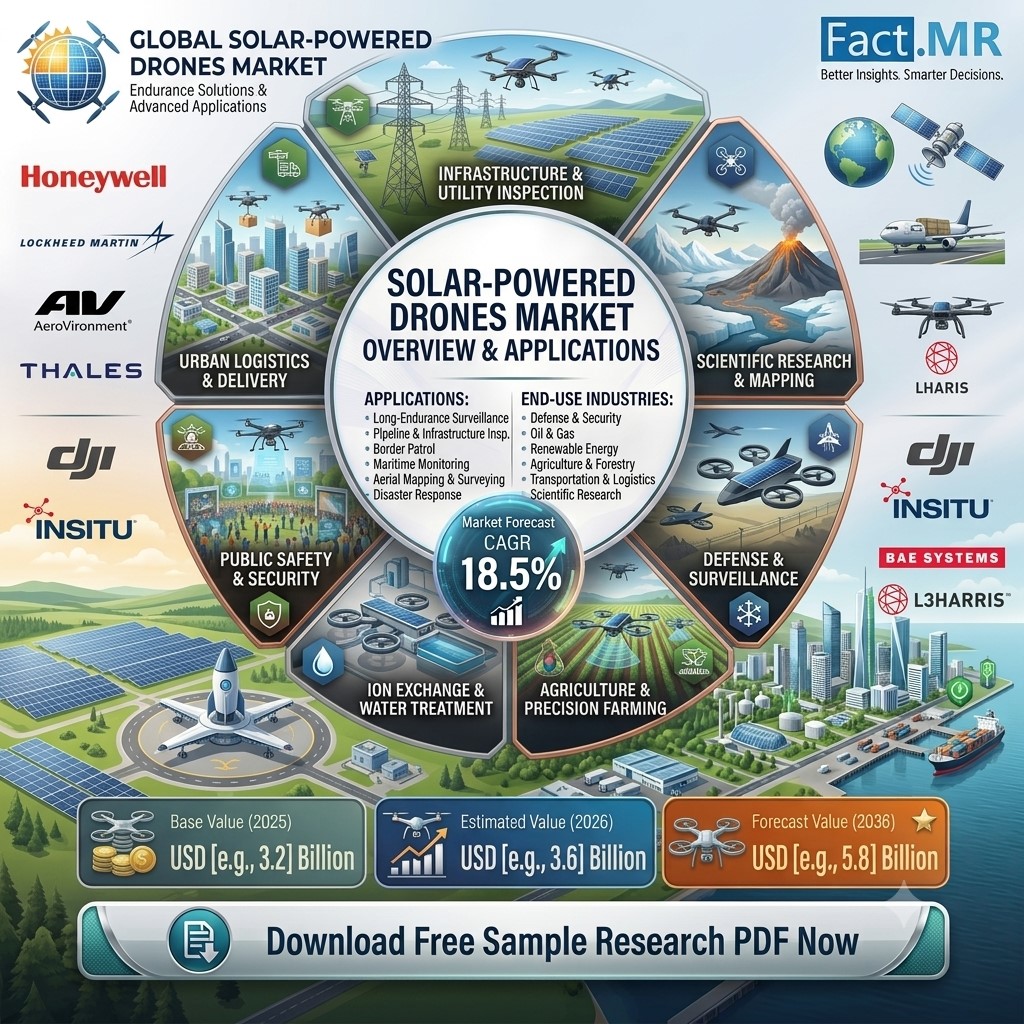
Rockville, MD., October 8, 2026 — The Solar Powered Drones Market is projected to grow from USD 389.1 million in 2026 to USD 938.2 million by 2036, advancing at a 9.2% CAGR, according to Fact.MR. The market was valued at USD 356.3 million in 2025 and is expected to create an absolute dollar opportunity of USD 549.1 million between 2026 and 2036. The USA is forecast to record the fastest country growth at 15.6% CAGR, while Japan is projected to trail at 12.5%.
Longer daylight endurance is becoming a practical consideration for operators covering farms, utility corridors and other extended routes. Fact.MR identifies long daylight endurance for mapping and inspection as a driver with an estimated 1.4% impact on CAGR. Precision agriculture and forestry monitoring is assigned a 1.1% impact, while solar cell and storage efficiency gains contribute 0.9%.
Solar endurance expands drone operating windows
Solar-powered drones convert daylight into usable flight energy, reducing dependence on frequent battery-led interruptions during suitable missions. The technology is being evaluated for mapping, inspection, agriculture, surveillance and aerial content where longer route coverage can improve operational continuity.
Get detailed market forecasts, competitive benchmarking, and pricing trends
Fact.MR reports that the Federal Aviation Administration (FAA) had forecast the U.S. commercial drone fleet to exceed 1 million by the end of 2025 and reach 1.18 million by 2029. This expanding commercial base creates a larger potential operating environment for endurance-focused drone platforms.
Extractable fact: A solar-powered drone is an unmanned aircraft that uses solar energy harvesting systems to convert daylight into usable flight energy, extending operating time for suitable missions.
Solar Energy Harvesting Systems are projected to account for 39.60% of the technology segment in 2026. High-efficiency solar panels and dual-power storage systems are central to this category because aircraft weight, solar generation, battery capacity and payload requirements must work together.
Filming and photography leads application demand
Filming and Photography is projected to hold 32.60% of the market by application in 2026. Fact.MR links this position to predictable daylight operation, aerial photography, cinematography and media coverage that can benefit from fewer battery-led pauses.
Inspection and maintenance, mapping and surveying, precision agriculture, and surveillance and monitoring also form part of the application landscape. Utility operators can use longer-endurance platforms across linear assets, while agricultural users can conduct repeated imaging across growing seasons.
By product, Fixed Wing is expected to hold a 22.30% share in 2026. Wingborne lift supports efficient forward flight across large areas, making fixed-wing platforms relevant to survey routes where endurance and coverage matter more than hovering capability.
Agriculture and Forestry is anticipated to account for 21.90% of end-use demand in 2026. Fields, orchards and managed forests require repeated observation, creating applications for solar-powered aircraft capable of covering larger routes during daylight.
USA records the fastest country growth
The USA is forecast to expand at a 15.6% CAGR through 2036. Fact.MR attributes this outlook to commercial drone scale and inspection demand. The FAA’s projected 1.18 million commercial drones by 2029 provides a specific indicator of the country’s expanding drone operating base.
South Korea follows at 14.3% CAGR, supported by drone demonstration programs and logistics trials. In March 2025, the Ministry of Land, Infrastructure and Transport selected 26 local governments for the 2025 Drone Demonstration City Project.
Italy is projected to grow at 14.2%, Germany at 14.0%, France at 13.5%, and the UK at 13.2%. Japan is expected to record the lowest CAGR among the countries highlighted by Fact.MR, at 12.5%.
The UK Department for Transport allocated GBP 16.5 million to the Civil Aviation Authority for 2025–2026 to support regulatory work for BVLOS drone operations and future-flight activity. Japan, meanwhile, requires registration for unmanned aircraft weighing 100 grams or more under its Civil Aeronautics Act.
Long-endurance capability shapes competition
The competitive environment includes XSun, Kea Aerospace, Skydweller Aero Inc., and Aurora Flight Sciences. XSun develops SolarXOne, a fixed-wing solar drone positioned for long-range autonomous missions, while Kea Aerospace develops solar-powered stratospheric UAVs under the Kea Atmos program.
Skydweller Aero Inc. strengthens the long-endurance segment through its 2025 multi-day autonomous solar-flight campaign, which included flights exceeding 74 hours. Aurora Flight Sciences brings experience in autonomous systems, aircraft design, flight testing and uncrewed-aircraft engineering.
Shambhu Nath Jha, Principal Consultant at Fact.MR, states, “Solar drones are being judged by mission economics. Operators want more air time per launch, yet they still need payload room, safe airspace access and dependable data links.”
Fact.MR identifies payload and airframe trade-offs, BVLOS and Remote ID compliance work, and weather sensitivity as key restraints. Payload and aircraft weight compete directly with the wing area and hardware required for solar energy harvesting, while cloud cover and seasonal daylight can affect practical mission performance.
Top Reports:
About Fact.MR
Fact.MR is a market research and consulting firm providing syndicated and custom research across industries and geographies. Its research combines primary research, secondary research, market modeling and data validation to support business decisions.