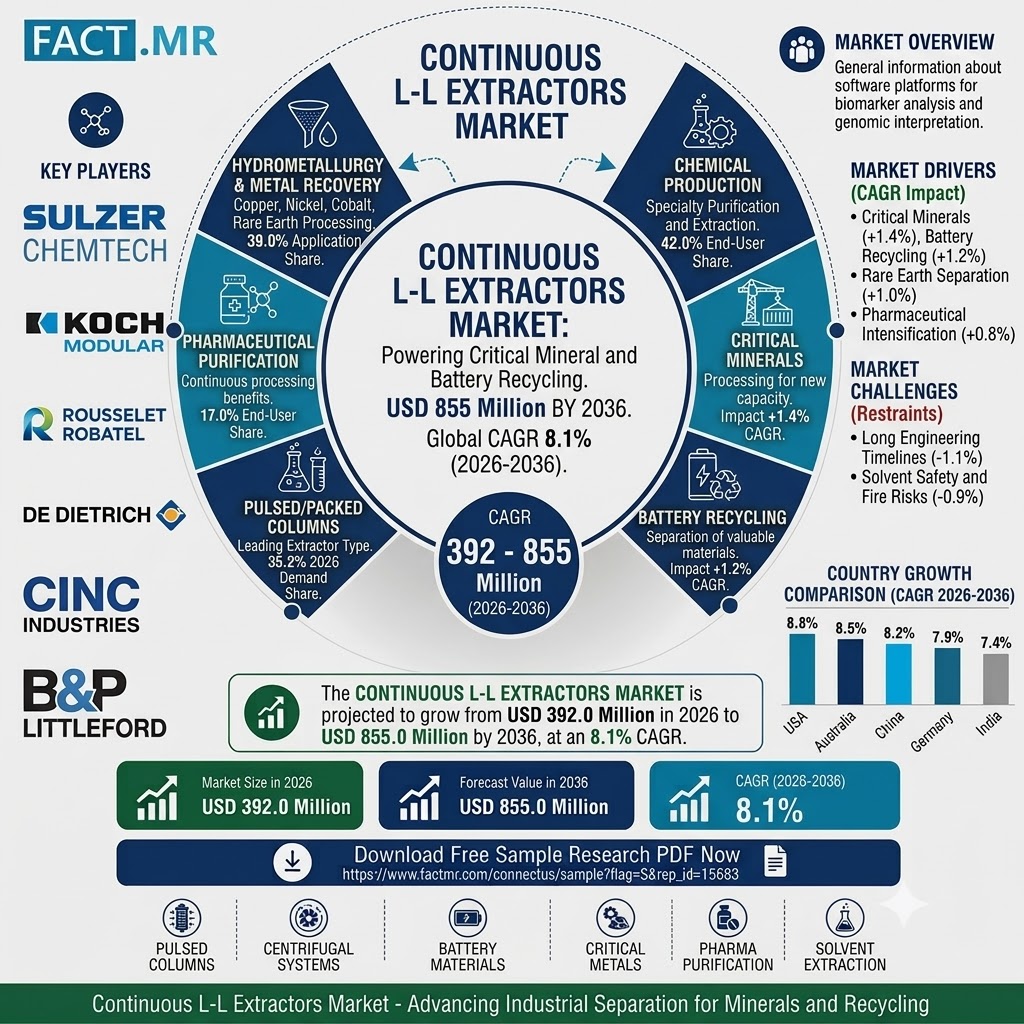
Continuous L-L Extractors Market rises from USD 392 million in 2026 to USD 855 million by 2036 at an 8.1% CAGR, driven by critical minerals and recycling.
September 21, 2026 — The global Continuous L-L Extractors Market is projected to reach USD 855 million by 2036, rising from USD 392 million in 2026 at an 8.1% CAGR, according to Fact.MR. The market was valued at approximately USD 362.6 million in 2025, with hydrometallurgy, pharmaceutical purification and petrochemical extraction supporting the installed equipment base.
The forecast represents a USD 463 million absolute opportunity through 2036. Critical-mineral processing, battery recycling and rare earth separation are creating new extraction requirements, while replacement of aging mixer-settler batteries is supporting demand for modern column and centrifugal systems.
Get detailed market forecasts, competitive benchmarking, and pricing trends:
Fact.MR is a market research and consulting firm that provides syndicated and customized market intelligence across global industries.
Continuous L-L Extractors Market growth follows new processing capacity
The market is being shaped by projects where continuous solvent extraction becomes part of the plant flowsheet. Critical-mineral and battery-material projects can require extraction equipment once their process designs depend on continuous liquid-liquid separation.
Rare earth processing is another demand area. Closely related elements often require repeated extraction stages for selective separation, making extractor selection part of the wider processing design.
Battery recycling adds a different requirement. Commercial systems must handle variable leach solutions, which makes pilot testing on representative feeds relevant before equipment is specified for a full circuit.
The pharmaceutical sector has its own equipment priorities. Continuous extraction can be considered where batch processing restricts throughput or extends product residence time, while containment and validation requirements influence the selected contactor.
Pulsed/packed columns hold 35.2% of 2026 demand
Pulsed/packed columns account for 35.2% of 2026 demand by extractor type, according to Fact.MR. The segment benefits from high theoretical stage counts and a compact continuous footprint without moving parts contacting the process phases.
Rotating disc contactors are used where agitation can improve mass transfer. Centrifugal extractors serve pharmaceutical and other high-value applications where short residence time and lower solvent inventory matter. Mixer-settler batteries remain relevant in legacy and uranium circuits.
By driving mechanism, gravity-based columns account for 42.0% of 2026 demand. Their density-driven countercurrent flow avoids mechanical energy input for phase movement. Centrifugal systems, with a 20.0% share, are positioned for applications where residence time and solvent hold-up need to be reduced.
Hydrometallurgy and metal recovery represent the leading application segment at 39.0% of demand. Copper, nickel, cobalt, zinc, uranium and rare earth processing routes can use solvent extraction as a purification stage.
Chemical producers represent 42.0% of end-user demand. Metals and mining account for 17.0%, while pharmaceutical manufacturers also hold 17.0%, reflecting their requirements for continuous purification and higher-specification equipment.
Analyst highlights the need for real-feed testing
Shambhu Nath Jha, Sr. Consultant at Fact.MR, said:
“A continuous extractor is chosen around the chemistry of the feed. Buyers need to establish phase behavior first, then test the contactor at the throughput their plant requires. That sequence matters because a design that works with a clean test solution can behave differently with an actual leach liquor or process stream.”
He added:
“A design that works with a clean test solution can behave differently with an actual leach liquor or process stream.”
The report identifies pilot extraction trials as a practical consideration for project developers because real-feed phase behavior can differ from synthetic test work. Suppliers can also differentiate through stage-efficiency documentation and scale-up support.
United States leads country growth at 8.8% CAGR
The United States is projected to record an 8.8% CAGR from 2026 to 2036, supported by federal processing investment. Australia follows at 8.5%, China at 8.2%, Germany at 7.9%, and India at 7.4%.
The United States Department of Energy issued a March 2026 funding opportunity of up to USD 500 million for critical-material processing and battery recycling. Projects using solvent extraction within their process design can create downstream equipment requirements.
Australia’s rare earth and battery mineral projects support an 8.5% CAGR, while China’s established separation capacity supports an 8.2% CAGR. Germany’s pharmaceutical and specialty chemical purification activity supports 7.9% growth, while India’s processing ambitions support a 7.4% CAGR.
Supplier competition centers on process fit
The competitive environment includes Sulzer Chemtech, Koch Modular, Rousselet Robatel, De Dietrich Process Systems, CINC Industries, and B&P Littleford.
Sulzer Chemtech provides extraction technology for hydrometallurgical metal recovery. Its OptimEXT system is based on a Kühni column and supported by pilot testing, providing a specific example of the scale-up support associated with extraction circuit development.
Suppliers compete around stage efficiency, pilot validation, application references and equipment suitability for individual process duties. Modular extraction skids also present an opportunity for recyclers that plan to increase capacity in stages.
Market outlook
Fact.MR estimates that the Continuous L-L Extractors Market will expand from USD 392 million in 2026 to USD 855 million in 2036, creating USD 463 million in absolute opportunity over the forecast period.
Critical minerals processing carries an estimated +1.4% impact on CAGR, battery recycling plants +1.2%, rare earth separation investment +1.0%, pharmaceutical purification intensification +0.8%, and mixer-settler modernization +0.6%, according to the supplied market analysis.
Long engineering timelines, solvent fire and safety requirements, alternative separation technologies, and reagent supply constraints remain factors that can affect project conversion and equipment adoption.
Top Report :
About Fact.MR
Fact.MR is a market research and consulting firm providing market intelligence, syndicated research and customized analysis across industries and geographic markets. Its research covers market sizing, forecasts, competitive analysis, segmentation and strategic insights for business decision-making.