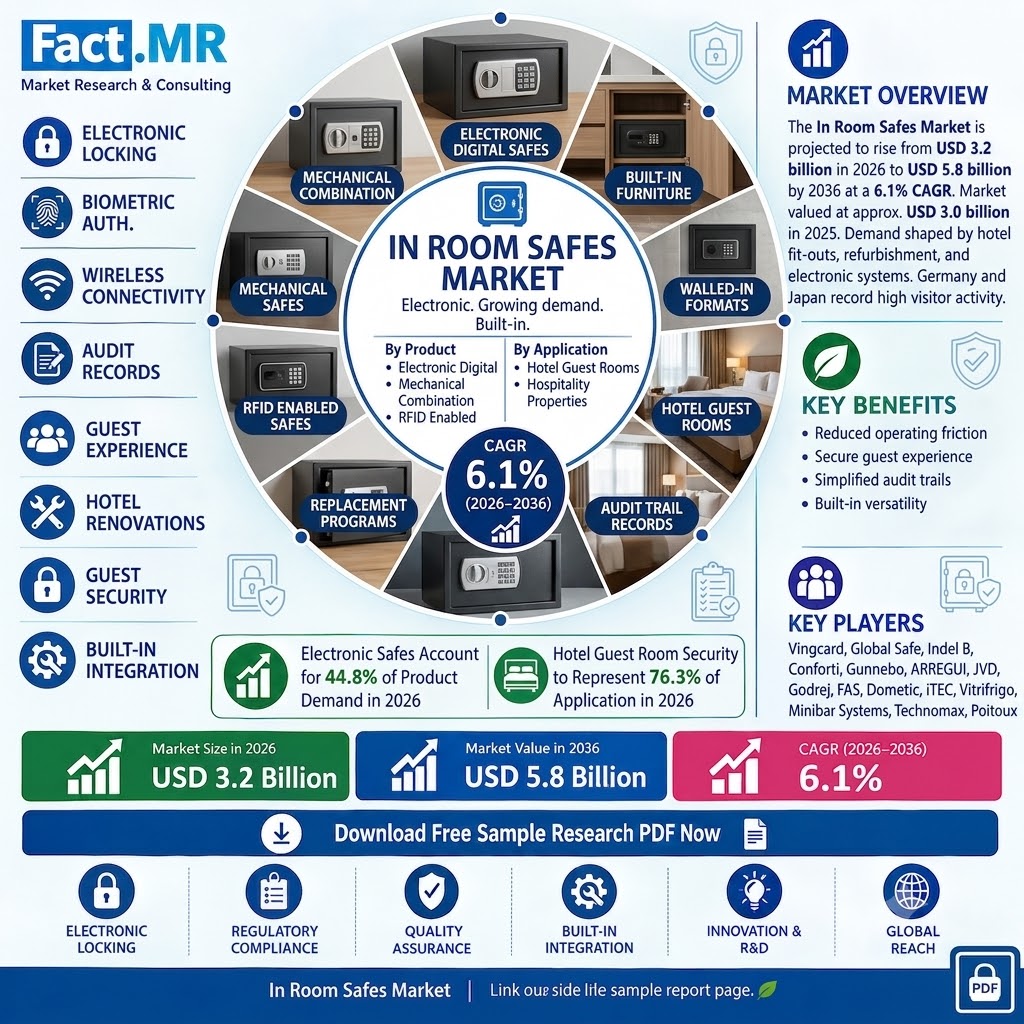
The In Room Safes Market is projected to rise from USD 3.2 billion in 2026 to USD 5.8 billion by 2036 at a 6.1% CAGR.
September 22, 2026 — The In Room Safes Market is forecast to reach USD 5.8 billion by 2036, increasing from USD 3.2 billion in 2026 at a 6.1% CAGR, according to Fact.MR. The market was valued at approximately USD 3.0 billion in 2025, with an absolute opportunity of USD 2.6 billion expected between 2026 and 2036.
Hotel room fit-outs, refurbishment programs and electronic access systems are shaping demand. Germany recorded 497.5 million guest overnight stays in 2025, while Japan recorded 42.7 million international visitor arrivals during the same year. Higher accommodation activity creates recurring requirements for room equipment that can be installed, reset and serviced across hotel properties.
Get detailed market forecasts, competitive benchmarking, and pricing trends:
Electronic Safes Account for 44.8% of Product Demand
Electronic Digital Safes are projected to account for 44.8% of Product in 2026, making them the largest product segment covered by Fact.MR. Guest-set access codes, audit records and controlled emergency opening support hotel operating procedures where access must be reset between occupancies.
Vingcard’s Elsafe Sentinel provides an insider-level example of the functionality influencing product selection. The system records up to 500 audit events, provides a low-battery warning and carries UL-1037 certification. These functions give hotel staff a defined process for reviewing access events and restoring service when guests forget their codes.
The Hotel Guest Room Security segment is projected to represent 76.3% of Application in 2026. One property can install the same safe across a large share of its room inventory, creating repeated purchases during new openings and renovation programs.
Hospitality Industry Remains the Largest End-Use Segment
The Hospitality Industry is projected to account for 63.5% of End Use in 2026. Hotel chains and independent properties purchase safes through room-equipment specifications, replacement programs and refurbishment projects.
Global Safe Corporation is a [Company] that supplies electronic hotel safes and installation configurations for hospitality properties. Global Safe Corporation states that its safes are installed in more than 400,000 hotel rooms, with options covering closets, drawers, recessed walls and floor-bolted installations.
That installed base shows why serviceability matters. A malfunctioning room safe can require front-desk intervention, while battery alerts, audit records and controlled override procedures can support faster staff response.
Shambhu Nath Jha, Principal Consultant at Fact.MR, said, “Demand for in-room safes is tied to hotel room fit-outs and replacement cycles. Electronic models reduce operating friction by combining guest-set access with audit records and controlled emergency opening.”
He added, “Built-in formats fit the way hotel rooms are specified and renovated. Suppliers that can support chain specifications, installation and local service are better aligned with repeat procurement through 2036.”
Built-In Integration Holds a 69.7% Share
Built In Furniture Integration is projected to represent 69.7% of Formulation in 2026. Drawer, closet and wall-mounted configurations allow hotel designers to use existing furniture or unused room space without materially changing room layouts.
Electronic Locking Technology also leads its category, with a projected 51.2% share of Technology in 2026. Reprogrammable access and event records fit properties where temporary guest access and staff recovery are routine requirements.
Direct OEM Sales account for 57.4% of Distribution Channel in 2026. Hotel groups and property developers can specify safe dimensions, mounting methods, locking systems, finishes, warranty terms and emergency-access procedures before a batch is delivered.
Germany Leads Country Growth Through 2036
Germany is forecast to expand at a 7.0% CAGR from 2026 to 2036, the highest CAGR among the five countries highlighted by Fact.MR. The Federal Statistical Office of Germany recorded 497.5 million guest overnight stays in 2025, including 413.7 million domestic guest nights.
Brazil follows with a projected 6.4% CAGR. Brazil received approximately 9.3 million international tourists in 2025, representing a 37.1% increase from 2024. The growth supports room investment across gateway cities and resort locations.
The USA is forecast to expand at 5.8% CAGR. The National Travel and Tourism Office expects international arrivals to reach 70.5 million in 2026, compared with 68.3 million in 2025.
The UK is projected to grow at 5.2% CAGR, with VisitBritain forecasting 45.5 million inbound visits in 2026. Japan follows at 4.6% CAGR, after recording 42.7 million international visitor arrivals in 2025, up 15.8% from 2024.
Top Reports :
Replacement Cycles Shape Supplier Strategy
Hotel openings and room renovation programs are identified as a +1.3% impact on CAGR, while electronic locking and audit functionality carry a +1.0% impact. Built-in cabinet and drawer formats contribute a +0.7% impact, according to the supplied Fact.MR analysis.
Long replacement cycles carry a -0.9% impact on CAGR, while budget sensitivity in economy properties has a -0.7% impact. Battery and override maintenance requirements represent a further -0.5% impact.
The market includes Electronic Digital Safes, Mechanical Combination Safes and RFID Enabled Safes across accommodation applications. Coverage also includes electronic locking, biometric authentication and wireless connectivity within the defined taxonomy.
Key companies profiled include Vingcard (ASSA ABLOY), Global Safe Corporation, Indel B, Conforti, Gunnebo AB, ARREGUI, JVD, Godrej Security Solutions, FAS, Dometic, iTEC, Vitrifrigo, Minibar Systems, Technomax, Poitoux and Stockinger Bespoke Safes.
About Fact.MR
Fact.MR is a market research and consulting firm providing syndicated and custom research across industries and geographic markets. Its market studies examine market size, segmentation, competitive activity, regional trends and forecast developments using primary and secondary research.