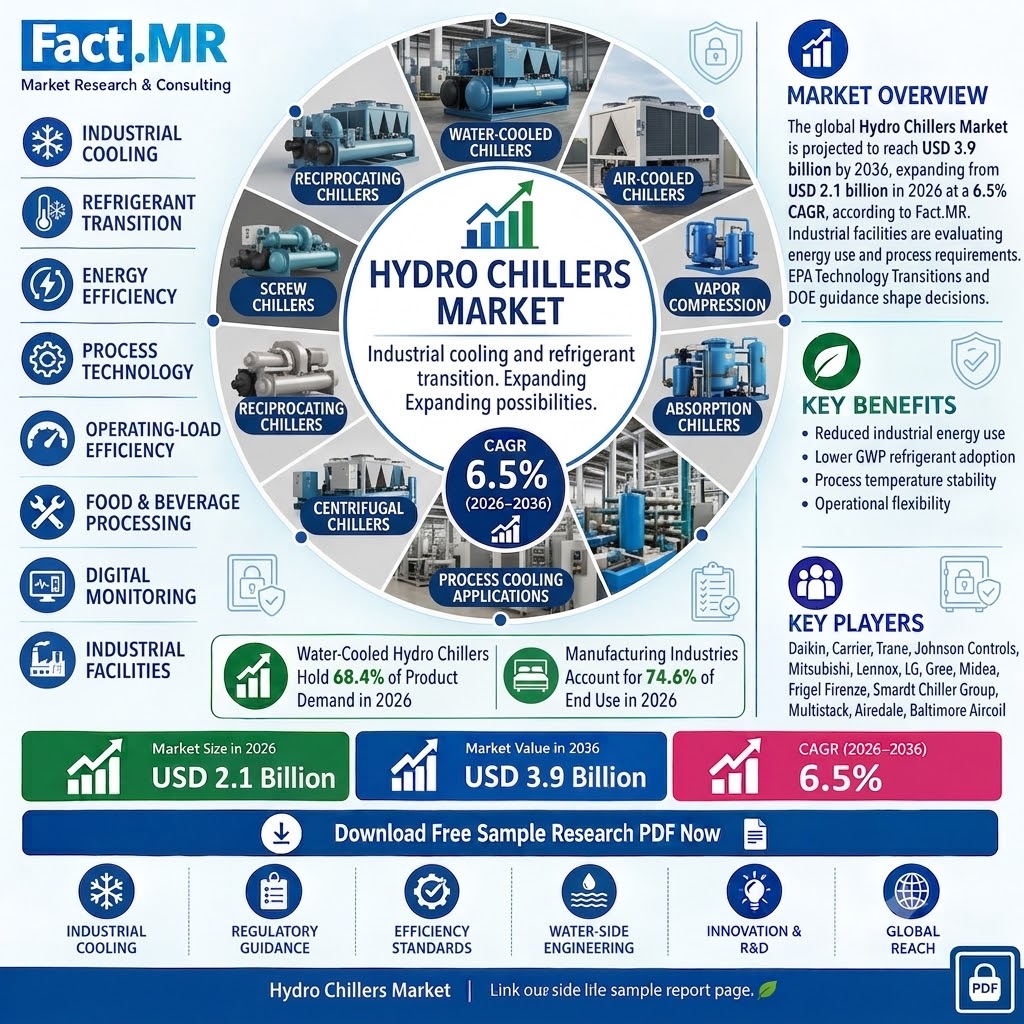
Hydro Chillers Market is projected to grow from USD 2.1 billion in 2026 to USD 3.9 billion by 2036 at a 6.5% CAGR, driven by industrial cooling and refrigerant transition.
September 22, 2026 — The global Hydro Chillers Market is forecast to reach USD 3.9 billion by 2036, expanding from USD 2.1 billion in 2026 at a 6.5% CAGR, according to Fact.MR. The market was valued at approximately USD 2.0 billion in 2025, with an absolute opportunity of USD 1.8 billion expected between 2026 and 2036.
Industrial facilities are evaluating chiller replacement around energy use, process temperature requirements and refrigerant rules. U.S. Department of Energy guidance distinguishes full-load and part-load efficiency for electric chillers, while U.S. Environmental Protection Agency Technology Transitions rules set a GWP limit of 700 for specified stand-alone industrial process chillers from January 2026.
Get detailed market forecasts, competitive benchmarking, and pricing trends:
Industrial Cooling Demand Shapes Hydro Chillers Market
Industrial process cooling represents 41.7% of application demand in 2026, while manufacturing industries account for 74.6% of end use, according to Fact.MR. Process equipment and production fluids generate heat during operation, creating recurring demand for controlled cooling capacity.
Water-Cooled Hydro Chillers hold 68.4% of product demand in 2026. These systems fit facilities with sustained thermal loads and suitable condenser-water infrastructure. The configuration also requires attention to water treatment and heat-transfer surface maintenance, with AHRI guidance addressing condenser-water treatment and tube maintenance.
Vapor Compression Technology accounts for 53.2% of technology demand in 2026. AHRI Standards 550/590 and 551/591 provide performance-rating frameworks for water-chilling packages using the vapor-compression cycle, giving buyers a basis for comparing capacity, efficiency and part-load performance.
Water-Based Cooling Systems represent 62.9% of formulation demand, while Direct Sales account for 45.8% of distribution channels in 2026. Chiller purchases often require site-specific engineering because capacity, leaving-water temperature, refrigerant selection and heat-rejection methods must correspond with plant conditions.
“Hydro chiller demand will be shaped by operating-load efficiency, refrigerant transition and the need to keep industrial processes within defined temperature ranges,” said Shambhu Nath Jha, Principal Consultant at Fact.MR. “Water-cooled systems remain relevant where plants have steady thermal loads and suitable water-side infrastructure.”
Hydro Chillers Market Value Analysis
Fact.MR is a market research and consulting company that provides market intelligence, forecasts and industry analysis across global markets.
A key insider detail in the assessment is the USD 1.8 billion absolute opportunity expected between 2026 and 2036. This figure represents the additional market value projected across the forecast period.
Refrigerant transition is also influencing equipment specifications. EU Regulation 2024/573 introduces additional stationary-chiller restrictions from January 2027, while EPA requirements already affect specified chiller categories in the United States. Buyers therefore need to consider refrigerant availability and future serviceability alongside equipment efficiency.
Food and beverage processing adds another demand channel. The Associação Brasileira da Indústria de Alimentos (ABIA) reported that Brazil’s food and beverage industry produced 288 million tonnes in 2025. Higher production throughput can increase cooling requirements for products, equipment and plant utilities.
Digital monitoring is another developing opportunity. The UK Energy Technology List includes performance criteria for packaged chillers, while connected controls can record energy consumption and operating time. Such data can help facility teams identify inefficient loading and maintenance issues.
“Efficiency has to be connected to the actual duty cycle,” said Shambhu Nath Jha, Principal Consultant at Fact.MR. “For industrial buyers, that means looking beyond nominal capacity and considering how the chiller will perform during real production hours.”
Germany Leads Country Growth Through 2036
Germany is forecast to expand at a 7.5% CAGR from 2026 to 2036, followed by Brazil at 6.8%, the USA at 6.2%, the UK at 5.5%, and Japan at 4.9%, according to the Fact.MR assessment.
Germany combines industrial energy-efficiency requirements with movement toward natural refrigerants. The Umweltbundesamt notes that natural-refrigerant systems can operate efficiently and that the Kälte-Klima-Richtlinie supports qualifying stationary refrigeration and air-conditioning systems using non-halogenated refrigerants.
In Brazil, industrial cooling demand is linked with the country’s large food-processing base. In the USA, DOE efficiency guidance and EPA refrigerant requirements affect replacement decisions. The UK Energy Technology List covers water-cooled high-temperature process chillers up to 2,000 kW, while Japan’s Fluorocarbon Emissions Control Act maintains lifecycle obligations for covered equipment using fluorocarbons.
Competitive Landscape
Key companies profiled in the Hydro Chillers Market include Daikin Industries, Ltd.; Carrier Global Corporation; Trane Technologies plc; Johnson Controls International plc; Mitsubishi Electric Corporation; Lennox International Inc.; LG Electronics; Gree Electric Appliances; Midea Group; Frigel Firenze S.p.A.; Smardt Chiller Group; Multistack International Limited; Airedale International Air Conditioning; and Baltimore Aircoil Company.
Competition is shaped by chiller architecture, refrigerant strategy, efficiency at full and part load, controls integration and service capability. Water-side engineering remains particularly relevant for water-cooled installations.
Top Reports :
About Fact.MR
Fact.MR is a market research and consulting firm providing syndicated and custom research across industries and geographic markets. Its research covers market sizing, forecasting, segmentation, competitive analysis and industry trends.