Rockville, MD., October 8, 2026 — The Delayed Coker Unit Process Technology Market is projected to increase from USD 1.7 billion in 2026 to USD 2.8 billion by 2036, advancing at a 5.1% CAGR, according to Fact.MR. The market crossed USD 1.6 billion in 2025 and is expected to create an absolute dollar opportunity of USD 1.1 billion through 2036. Germany is forecast to record the fastest growth among the five countries covered at 5.9% CAGR, while Japan is projected to trail at 3.8%.
The market is shaped by refinery residue upgrading requirements, coke drum replacement cycles, fuel quality management and integrated coke-handling systems. Refinery operators increasingly require technologies that convert heavy refinery residues into lighter streams and petroleum coke while maintaining operating reliability.
Get detailed market forecasts, competitive benchmarking, and pricing trends
Refinery residue conversion supports delayed coker technology demand
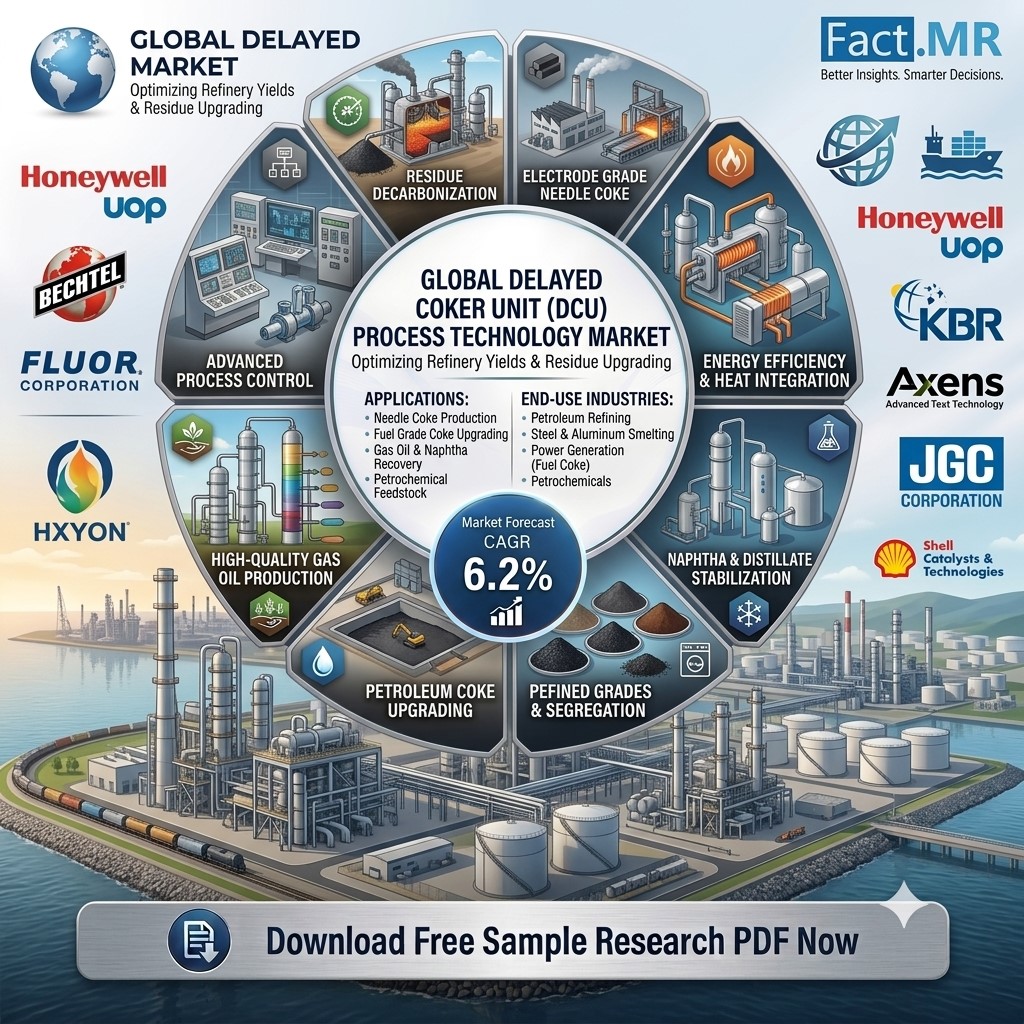
Delayed coker unit process technology covers systems, technology licenses and equipment packages used to thermally crack heavy refinery residue into lighter streams and petroleum coke. The market includes delayed coking drum systems, furnace and heater systems, fractionation systems, coke handling systems, process automation, decoking controls and emissions-control systems.
Refinery operators need higher residue conversion where crude slates leave more vacuum residue and heavy bottoms after primary processing. Coke drums and severe-service valves also face recurring thermal stress, creating requirements for reliable equipment, replacement cycles and turnaround support.
Extractable fact: A delayed coker unit is a refinery process system that thermally cracks heavy residue into lighter petroleum streams and petroleum coke.
The largest product segment is delayed coking drum systems, projected to account for 76.8% of the market in 2026. Petroleum refining leads applications with a 43.7% share, while oil refineries represent 69.4% of end-use demand.
Delayed coking drum systems hold the leading share
Delayed coking drum systems are expected to hold 76.8% share in 2026 because the drums define the core operating cycle involving thermal cycling and coke formation. Single- and multi-drum systems are selected around throughput requirements and cycle flexibility.
Petroleum refining is projected to account for 43.7% of the market by application in 2026. Delayed coking serves as a refinery-bottoms upgrading route, shifting heavy streams into lighter products through residue conversion and controlled processing.
Thermal cracking technology is estimated to hold 58.2% share in 2026. High-temperature cracking and controlled residence-time systems support conversion performance, while hydraulic and mechanical decoking technologies support coke removal during operations.
Direct EPC contracts are forecast to capture 72.6% share by distribution channel. Large delayed coker projects require site engineering, technology licensing alignment and shutdown coordination, making direct engineering and turnkey contracts important for refinery projects.
Germany records the highest country CAGR
Germany is projected to expand at 5.9% CAGR through 2036, the highest rate among the five countries covered. Germany’s refinery base supports demand for residue-conversion and upgrading technologies. The Federal Ministry for Economic Affairs and Climate Action reported nearly 89 million tonnes of mineral oil processing capacity across 12 refineries in 2025.
Brazil follows at 5.4% CAGR. The Agência Nacional do Petróleo, Gás Natural e Biocombustíveis reported that petroleum derivative production reached 2.2 million barrels per day in 2025, equivalent to around 86.4% of installed refining capacity. Petrobras also announced planned maintenance shutdown investments at Reduc covering delayed coking and hydrotreatment units in 2026.
The USA is forecast to record 4.9% CAGR through 2036. The U.S. Energy Information Administration reported operable delayed coking capacity of 2,635,145 barrels per stream day as of January 1, 2026.
The UK is projected to grow at 4.3% CAGR, while Japan is expected to register 3.8%. The UK growth outlook reflects specialist refinery activity and fuel-security considerations. Japan’s Petroleum Association reported 19 refineries with 3,110,400 barrels per day of designed crude-oil processing capacity at the end of March 2025.
Competitive landscape
Key companies profiled in the Delayed Coker Unit Process Technology Market include Honeywell UOP, Bechtel Corporation, Lummus Technology, Wood PLC, Worley Limited, Sulzer Ltd., China National Petroleum Corporation (CNPC), SUPCON Technology CO., LTD., MOGAS Industries, and Technip Energies N.V.
Honeywell UOP, Bechtel Corporation and Lummus Technology are profiled for process technology, licensing and refinery integration. Bechtel Corporation lists ThruPlus delayed coking technology within its Energy Technologies and Solutions portfolio, while Lummus Technology supports delayed coking through Chevron Lummus Global and connected coke-handling work.
Sulzer Ltd. contributes separation internals, pump services and turnaround support. Worley Limited provides refinery bottoms analysis and project execution capabilities. China National Petroleum Corporation (CNPC), SUPCON Technology CO., LTD., MOGAS Industries and Technip Energies N.V. add regional process, automation, valve and integration capabilities.
Shambhu Nath Jha, Principal Consultant at Fact.MR, states, “Delayed coking decisions are tied to refinery configuration as much as growth spending. Plant operators are expected to weigh coke drum life, heater fouling and coke handling reliability before approving major packages.”
Fact.MR’s analysis draws on more than 120 sources, 35+ company portfolios, 25+ countries and more than 20 industry interviews. The methodology combines primary research, desk research, market sizing and forecasting with data validation against public industry and company information.
Top Reports:
- MLDW Technology Market
- Odour-Control Technology for High-PCR HDPE Market
- Blow Fill Seal Technology Market
About Fact.MR
Fact.MR is a market research and consulting firm providing syndicated and custom research across industries and geographies. Its research combines primary interviews, secondary research, market modeling and data validation to support business decisions.