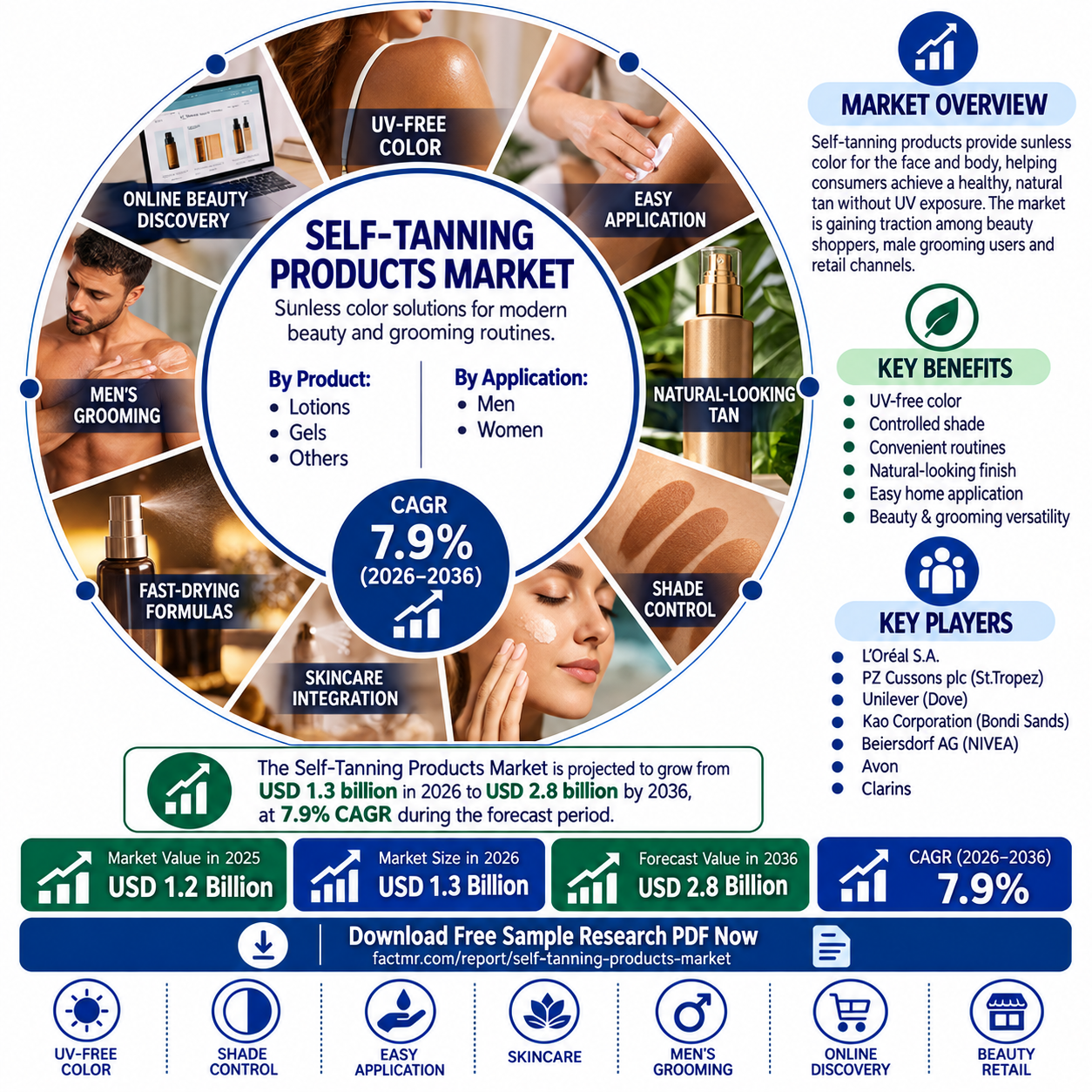
The global self-tanning products market is estimated at USD 1.3 billion in 2026 and is projected to reach USD 2.8 billion by 2036, expanding at a 7.9% CAGR during the forecast period. Fact.MR estimates an absolute dollar opportunity of USD 1.5 billion between 2026 and 2036, supported by rising preference for UV-free beauty routines, expanding male grooming adoption, broader retail access, and growing demand for convenient sunless color products.
Get detailed market forecasts, competitive benchmarking, and pricing trends
Lotions lead the product landscape
Lotions are expected to account for 46.3% of the self-tanning products market in 2026, making them the leading product segment. Their familiarity with everyday body-care routines and relatively simple application gives consumers greater control over color development.
Gradual tan lotions appeal to users seeking incremental color, while instant tan lotions serve occasion-based demand where visible results are preferred. Gels are also gaining attention, particularly among consumers looking for faster drying and lower-residue formats. Clear gels can reduce concerns around color transfer, while tinted gels help users monitor application coverage.
Men represent the leading application segment
Men are projected to account for 63.9% of the market by application in 2026. Self-tanning is increasingly being incorporated into body grooming, fitness routines, holiday preparation, and occasion-based personal care.
The segment favors products positioned around easy application, low transfer, fast drying, and natural-looking results. Face tanning products are also creating opportunities across both men and women, with drops, serums, and lightweight textures making self-tanning easier to combine with everyday skin-care routines.
Germany, Brazil, and the USA create strong country-level opportunities
Germany is projected to register an 8.7% CAGR through 2036, supported by established beauty retail channels and regulated cosmetic product presentation. Gradual tanning lotions and gels can benefit from placement alongside conventional body-care products in drugstores and supermarkets.
Brazil is expected to expand at a 7.9% CAGR, with retail recovery and mass-channel product trials supporting market development. Clear gels and transfer-resistant lotions are positioned to benefit from demand for quick-drying products.
The USA is forecast to advance at a 7.1% CAGR, supported by large retail channels and growing attention to UV-risk messaging. The U.K. and Japan are projected to record CAGRs of 6.4% and 5.6%, respectively, with online beauty discovery and preferences for controlled finishes influencing adoption.
Mass retail strengthens product visibility
Supermarkets and hypermarkets are anticipated to account for 56.1% of the market in 2026. Self-tanning products benefit from shelf placement alongside body lotions, sunscreen, and seasonal beauty ranges, helping retailers capture impulse purchases and routine replenishment.
Online channels remain important for education-led purchasing. Product tutorials, shade comparisons, user reviews, and application guidance allow consumers to assess expected results before purchasing, particularly when selecting face and body tanning products.
UV-free beauty routines reshape market priorities
UV-free color routines remain a key demand driver as consumers seek a tanned appearance without deliberately increasing exposure to ultraviolet radiation. Beauty brands are responding with gradual lotions, clear gels, transfer-resistant products, and other formats designed to simplify application and improve consistency.
Male grooming is another growth factor. Products emphasizing low residue, fast dry-down, and natural-looking color can fit more easily into established grooming routines. At the same time, digital beauty content is helping first-time users understand shade selection, application timing, and expected color development.
Face tanning and transfer-resistant formats open new opportunities
Face tanning serums and drops represent a growing opportunity because smaller doses allow users to control shade intensity while combining tanning with daily skin-care routines. These formats are particularly relevant in markets where consumers prefer subtle and gradual color development.
Clear gels and transfer-resistant formulations offer another avenue for product differentiation. Quick-drying textures can support adoption in warmer climates, where clothing transfer may discourage repeat purchases. Online shade education, verified user images, and review content can further reduce uncertainty among new users.
Analyst Perspective
Shambhu Nath Jha, Principal Consultant at Fact.MR, states, “Self-tanning demand is becoming more practical and less seasonal. Shoppers are expected to reward products that reduce streaks, odor and transfer while fitting everyday body-care habits. Brands with clear shade ladders, retailer education and reliable texture performance should defend repeat purchase.”
Competitive landscape
Competition in the self-tanning products market is centered on formulation performance, shade credibility, product convenience, and distribution reach. Leading companies include L’Oréal S.A., PZ Cussons plc (St.Tropez), Unilever (Dove), Kao Corporation (Bondi Sands), Beiersdorf AG (NIVEA), Avon, and Clarins.
Established beauty and personal-care companies benefit from broad retail networks and existing consumer relationships, while specialist self-tanning brands compete through shade selection, texture innovation, application convenience, and consumer education.
Market Snapshot
Market Size, 2026: USD 1.3 Billion
Projected Market Size, 2036: USD 2.8 Billion
CAGR, 2026–2036: 7.9%
Absolute Dollar Opportunity: USD 1.5 Billion
Leading Product: Lotions, 46.3% share in 2026
Leading Application: Men, 63.9% share in 2026
Leading Distribution Channel: Supermarkets and hypermarkets, 56.1% share in 2026
Fastest-Growing Country: Germany, 8.7% CAGR
Key Companies: L’Oréal S.A., PZ Cussons plc (St.Tropez), Unilever (Dove), Kao Corporation (Bondi Sands), Beiersdorf AG (NIVEA), Avon, and Clarins.
To View Top Reports
Sweat-Resistant Natural Pigment Systems Market
Potable Water Testing Services Market
About Fact.MR
Fact.MR is a market research and consulting company providing market intelligence, competitive analysis, and forecasting across global industries. Its research covers emerging technologies, evolving consumer trends, industrial developments, and changing business environments. Fact.MR delivers data-driven insights designed to support strategic planning, investment decisions, and market-entry initiatives.