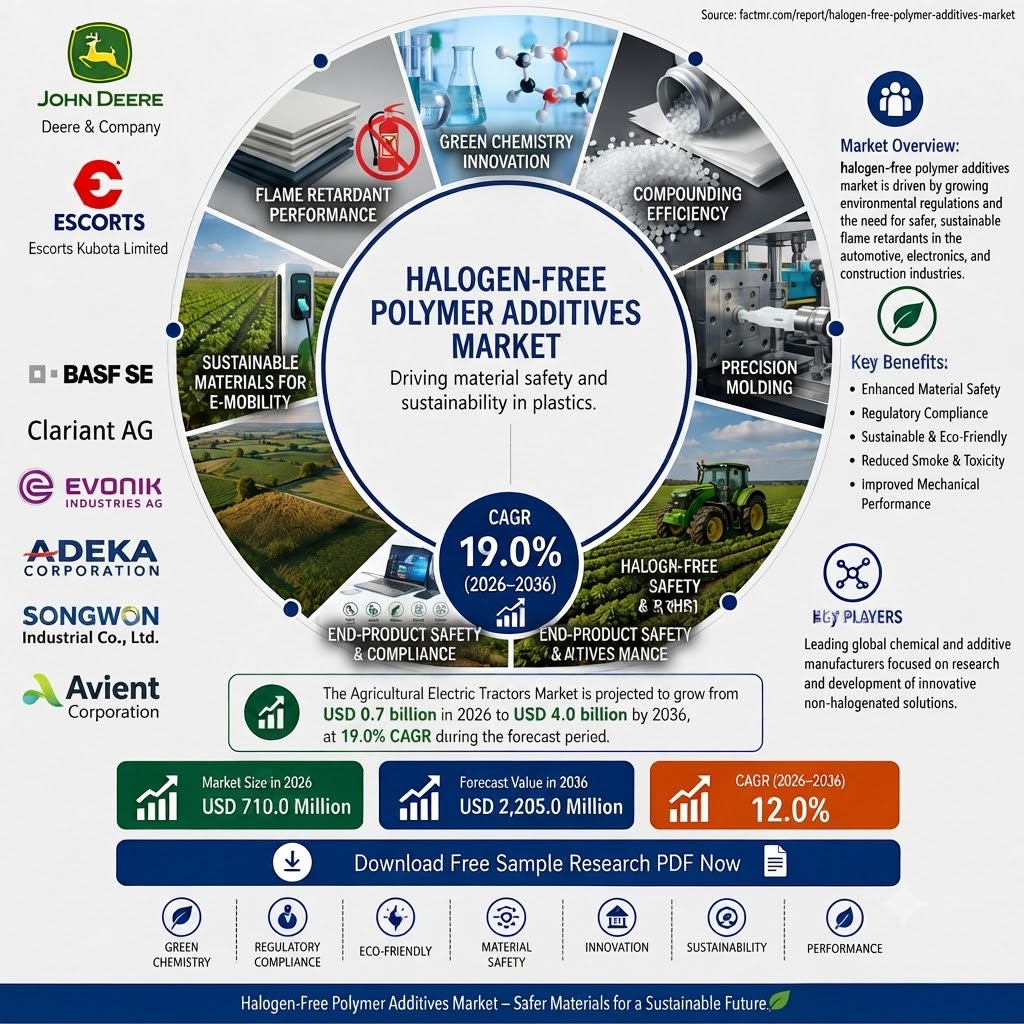
The global halogen-free polymer aids market is estimated at USD 710.0 million in 2026 and is projected to reach USD 2,205.0 million by 2036, expanding at a 12.0% CAGR during the forecast period. Fact.MR estimates an absolute dollar opportunity of USD 1,495.0 million between 2026 and 2036, supported by tighter low-smoke requirements for wire and cable applications, growing e-mobility production, and increasing demand for non-halogenated polymer formulations.
Halogen-free polymer aids help improve processing, stability, flame performance, and surface quality in polymer compounds without relying on halogenated systems. Demand is rising as cable compounders, automotive material teams, and industrial manufacturers seek formulations that combine fire performance with extrusion quality and processing efficiency.
Get detailed market forecasts, competitive benchmarking, and pricing trends
Processing aids lead the product landscape
Processing aids account for 36.0% share of the market in 2026, making them the leading product category. Their role in reducing die build-up, improving flow, and maintaining surface finish is particularly important for filled halogen-free compounds, where higher additive loading can create processing challenges.
Polyolefins represent 38.0% share by polymer, supported by widespread use in cable jackets, flexible compounds, and industrial goods. The shift toward low-smoke materials is increasing the need for additives that preserve line speed and processing consistency while meeting formulation requirements.
Wire and cable applications create strong demand
Wire and cable applications account for 37.0% share in 2026, supported by low-smoke and halogen-free specifications across building, energy, and transportation wiring. Polymer aids help manufacturers balance fire performance with extrusion quality during long production runs.
Flow improvement represents 35.0% share by function, reflecting the importance of maintaining processability when mineral fillers and flame-retardant chemistries increase melt resistance.
USA, Germany, and Japan create strong country-level opportunities
The USA is projected to grow at a 13.2% CAGR through 2036, supported by plastics investment and increasing demand for e-mobility wiring materials. Germany follows at 12.6% CAGR, driven by electrical equipment demand and engineering-plastic qualification requirements.
Japan is forecast to expand at 11.8% CAGR, supported by automotive and electronics manufacturing. France is expected to grow at 11.3% CAGR, while Brazil is projected to advance at 10.8% CAGR through 2036.
E-mobility and low-smoke specifications reshape formulation priorities
Low-smoke wire and cable requirements, e-mobility connectors, and the shift toward antimony-free flame-retardant systems are key growth drivers. Automotive applications increasingly require non-halogenated materials for connectors, terminal blocks, inverter systems, and motor components where electrical and thermal safety are critical.
PFAS-free polymer processing aids are also gaining attention in polyolefin extrusion. Manufacturers are increasingly evaluating additives based on fire testing, smoke behavior, processing windows, and compatibility with individual polymer families.
Analyst Perspective
Shambhu Nath Jha, Principal Consultant at Fact.MR, states, “Halogen-free polymer aids are moving from a compliance choice to a processing decision. Compounders are expected to ask for additives that reduce fire risk while protecting line speed and scrap control. Suppliers that pair formulation support with test data for PBT and elastomers are better placed in cable and e-mobility programs.”
New material requirements open market opportunities
The transition toward electric vehicles is creating opportunities for suppliers of halogen-free polymer aids as manufacturers qualify materials for high-voltage electrical components. Connectors, terminal blocks, control units, and other electrical parts require materials that can provide flame performance without compromising dimensional and electrical properties.
Packaging and industrial applications also offer growth potential as processors seek improved flow, surface quality, and thermal stability. However, formulation cost, qualification complexity, and the need for application-specific testing remain important considerations for market participants.
Competitive landscape
The halogen-free polymer aids market includes suppliers competing through flame-retardant performance, processing efficiency, formulation support, product documentation, and application-specific technologies.
Key companies profiled by Fact.MR include BASF SE, Clariant AG, Evonik Industries AG, ADEKA CORPORATION, SONGWON Industrial Co., Ltd., and Avient Corporation.
BASF SE participates through non-halogenated flame-retardant engineering plastics for electrical and e-mobility applications, while Clariant AG offers non-halogenated flame retardants and polymer-processing aids. Evonik Industries AG contributes polymer-processing additive technologies, and ADEKA CORPORATION supplies halogen-free flame-retardant solutions. SONGWON Industrial Co., Ltd. and Avient Corporation also participate through polymer stabilizers, flame-retardant additives, and non-halogenated material technologies.
Market Snapshot
The halogen-free polymer aids market is valued at USD 710.0 million in 2026 and is forecast to reach USD 2,205.0 million by 2036 at a 12.0% CAGR. Processing aids account for 36.0% share, polyolefins represent 38.0%, flow improvement holds 35.0%, and wire and cable applications account for 37.0% of the market in 2026.
The detailed Halogen-Free Polymer Aids Market report by Fact.MR provides forecasts through 2036, covering product type, polymer type, function, application, regional markets, country-level trends, competitive landscape, regulatory considerations, and emerging opportunities.
To View Related Reports
Ultra-High Purity Electronics Grade PEEK Market
Electronic Speed Controller (ESC) for Drones and UAVs Market
About Fact.MR
Fact.MR is a market research and consulting company providing market intelligence, competitive analysis, and forecasting across global industries. Its research covers emerging technologies, evolving consumer trends, industrial developments, and changing business environments. Fact.MR delivers data-driven insights designed to support strategic planning, investment decisions, and market-entry initiatives.