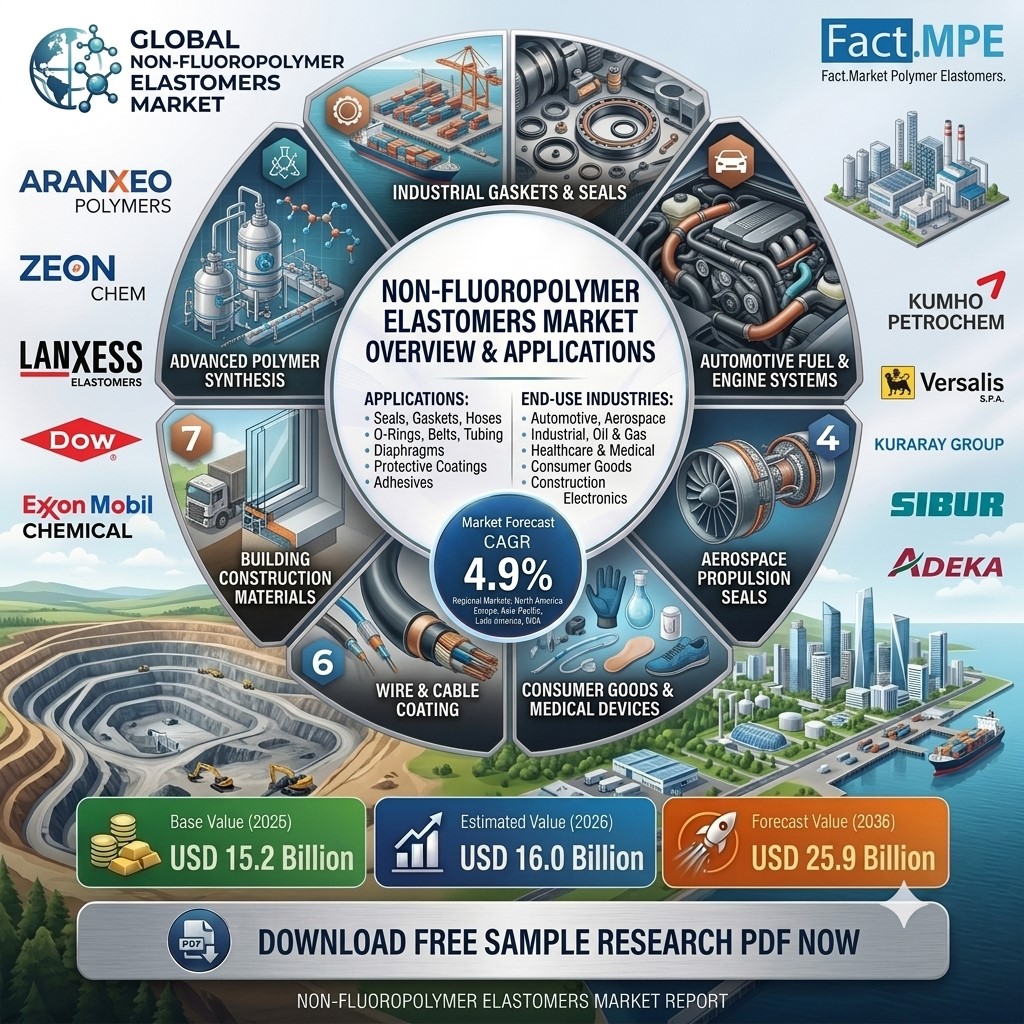
Rockville, MD., October 7, 2026 — The Non-Fluoropolymer Elastomers Market is projected to increase from USD 8.7 billion in 2026 to USD 13.9 billion by 2036, expanding at a 4.8% CAGR, according to Fact.MR. The market crossed USD 8.3 billion in 2025 and is expected to create a USD 5.2 billion absolute opportunity between 2026 and 2036. The USA is forecast to record the fastest growth among the listed countries at 4.5% CAGR, while Japan is expected to register the lowest at 3.1%.
Automotive manufacturers remain the largest end-use group, accounting for an estimated 58.70% share in 2026. Automotive applications themselves represent 76.20%, while Ethylene Propylene Diene Monomer (EPDM) Elastomers lead the product segment with 44.80%. These figures show why compound qualification, sealing performance and material consistency remain central to demand.
Get detailed market forecasts, competitive benchmarking, and pricing trends
Automotive sealing keeps elastomer demand closely tied to qualification
The Non-Fluoropolymer Elastomers Market covers EPDM, NBR, silicone and SBR rubber-like materials used across automotive, industrial, construction, electrical and electronics applications. The assessment excludes fluoropolymers, fluoroelastomers and PTFE-based systems.
Automotive sealing is a major demand channel. Weatherseals, hoses and fluid-handling components require materials that maintain performance under heat, vibration and environmental exposure. Once a compound enters an approved vehicle program, material changes can require validation before production use.
The Federal Reserve Board reported in August 2026 that U.S. plastics and rubber products output was 2.2% higher in July 2026 than a year earlier. The Office for National Statistics also reported in August 2026 that Great Britain construction output increased 0.3% in the second quarter of 2026 from the previous quarter.
Extractable fact: Dow Inc. is a non-fluoropolymer elastomer supplier whose NORDEL™ EPDM portfolio serves automotive weatherseals, powertrain sealing and gasketing, wire and cable, and building and construction applications.
EPDM holds 44.80% product share
Ethylene Propylene Diene Monomer (EPDM) Elastomers are projected to account for 44.80% of the market in 2026. Fact.MR links the position to EPDM’s use in weatherseals, hoses and building profiles, where outdoor durability and sealing performance are required.
Automotive Applications are expected to hold 76.20% share. The segment includes sealing-system and fluid-handling applications. Automotive Manufacturers are forecast to represent 58.70% of end-use demand as engineering specifications and validation protocols determine which elastomer compounds enter production programs.
Compounding Technology is projected to capture 33.60% share in 2026. Filler integration and additive dispersion affect heat aging, tensile performance, extrusion quality and molding consistency, making compound design an important part of material qualification.
High Performance Elastomer Formulations are expected to account for 69.40% share. Direct Industrial Sales lead the distribution landscape at 52.80%, supported by qualification records, technical service and repeat OEM supply programs.
USA leads country growth at 4.5% CAGR
The USA is projected to expand at 4.5% CAGR through 2036. Fact.MR associates this growth with automotive, construction and industrial sealing demand. The U.S. Census Bureau reported in August 2026 that privately owned housing units authorized by building permits stood at a seasonally adjusted annual rate of 1.443 million in July 2026.
The United Kingdom follows at 4.2% CAGR. The Department for Transport reported in April 2026 that 528,000 zero-emission vehicles were registered for the first time in 2025, providing a measurable backdrop for vehicle-related material demand.
Germany is forecast to grow at 3.7%. Destatis reported in August 2026 that real manufacturing orders increased 3.1% month on month in June 2026. France is projected at 3.2%, with INSEE reporting that transport equipment output rose 3.3% in April 2026.
Japan is expected to expand at 3.1% CAGR, the lowest among the five listed countries. Japan’s Statistics Dashboard recorded 417,153 new vehicle sales in July 2026, supporting continued requirements for automotive sealing, hose and component applications.
Competitive landscape
Key companies profiled include Dow Inc., Kraton Corporation, ENEOS Materials Corporation, Covestro AG, Zeon Corporation and Lion Elastomers. The competitive set spans EPDM, NBR, HNBR, silicone, SBR and adjacent elastomer platforms.
Dow Inc. supplies NORDEL™ EPDM for automotive and construction applications. ENEOS Materials Corporation carries the former JSR elastomer business and supplies synthetic rubbers including SBR, NBR and EPDM. Zeon Corporation serves higher-performance rubber applications through its Zetpol® HNBR portfolio. Lion Elastomers supplies EPDM, specialty EPDM, SBR and specialty SBR products.
Shambhu Nath Jha, Principal Consultant at Fact.MR, said, “Non-fluoropolymer elastomer demand is becoming less about generic rubber volume and more about compound approval discipline. Automotive and industrial users are expected to favor materials that pass heat aging, oil resistance and compression-set tests over full product life. Suppliers that connect polymer consistency, compound design and application support are better placed to retain qualified business.”
Fact.MR’s analysis draws on 120+ sources, 35+ company portfolios, 25+ countries and more than 20 industry interviews. The research combines primary discussions with manufacturers, distributors, end users and subject-matter experts with government statistics, company filings, technical studies and industry data.
Top Reports:
Laparoscopic Gynecological Procedures Market
Transdermal Skin Patches Market
About Fact.MR
Fact.MR is a market research and consulting firm providing syndicated and custom research across industries and geographies. Its research combines primary interviews, secondary research, market modeling and data validation to support business decisions.