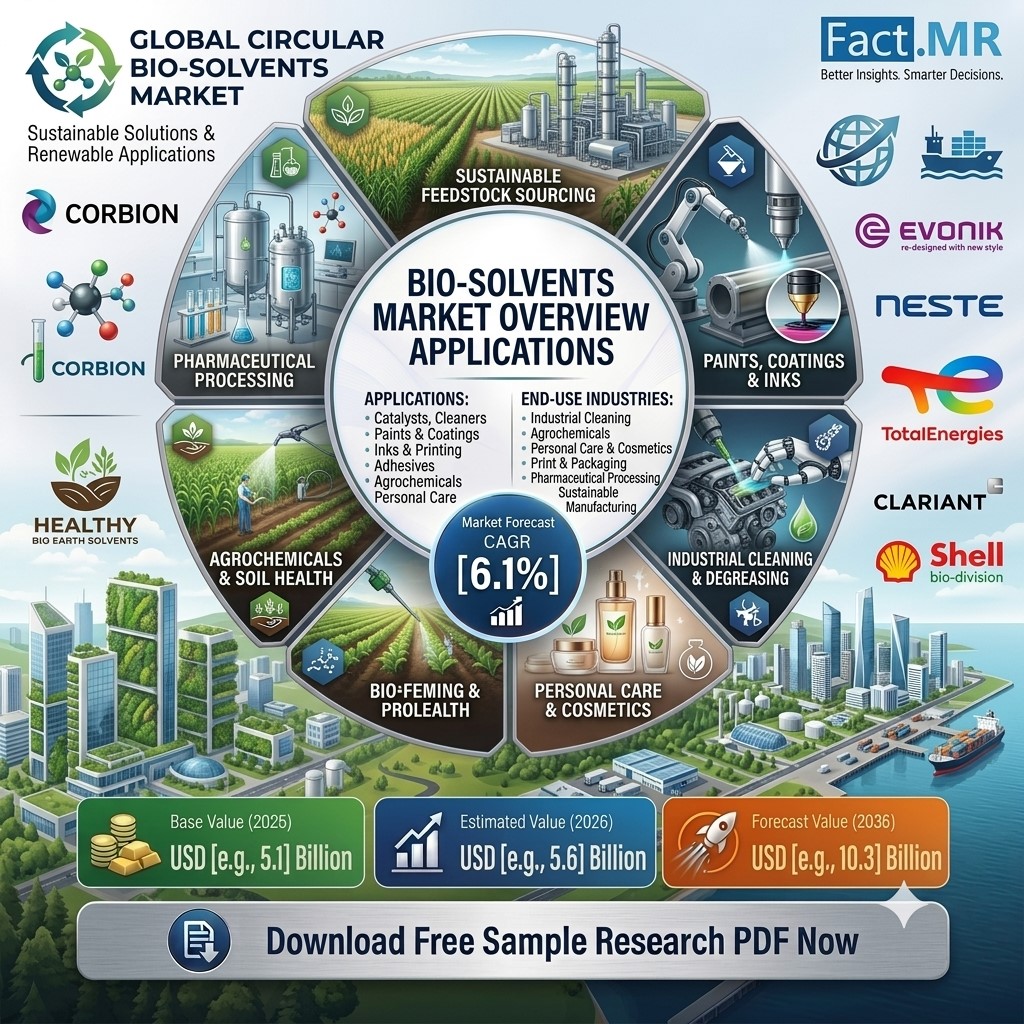
Rockville, MD., October 7, 2026 — The Circular Bio-Solvents Market is projected to rise from USD 4.6 billion in 2026 to USD 9.8 billion by 2036, registering a 7.9% CAGR, according to Fact.MR. The market was valued at USD 4.3 billion in 2025 and is expected to create an absolute dollar opportunity of USD 5.2 billion between 2026 and 2036.
The market is expanding as coating producers, cleaning formulators and adhesive manufacturers shift selected formulas toward renewable solvent systems. Low-VOC reformulation, renewable-carbon documentation and industrial cleaning solvent substitution are among the factors identified by Fact.MR as supporting adoption.
Get detailed market forecasts, competitive benchmarking, and pricing trends
Renewable solvent systems gain ground in industrial formulations
Circular bio-solvents are renewable or circular solvents used in industrial formulations to reduce dependence on fossil-based solvent routes. The market covers bioethanol, biobutanol, lactate esters, fatty acid esters, bio-ketones, terpene solvents and renewable hydrocarbons used in coatings, cleaning products, adhesives, sealants and printing inks.
Paint and coating manufacturers remain the largest end-use group. Fact.MR estimates that this segment will account for 68.2% of market share in 2026. Solvent selection directly affects odor, drying behavior and product approval files, making formulation performance a central consideration during substitution.
The U.S. Census Bureau reported manufacturing shipments of USD 4,279 million for paints, coatings and adhesives in May 2026, providing a current indicator of the production base relevant to solvent demand.
Extractable fact: Circular bio-solvents are renewable or circular solvents used to reduce fossil solvent dependence in coatings, cleaning products, adhesives, sealants and printing inks.
Bio-based alcohol solvents hold the leading product share
Bio-Based Alcohol Solvents are projected to account for 64.5% of the market by product in 2026. Ethanol and butanol platforms are familiar to formulators and are already used across coating and cleaning systems.
Paints & Coatings Applications are expected to represent 36.7% of demand by application. Solvents support resin dissolution, application flow and drying, while formulation choices must also address VOC requirements.
Fermentation Technology is forecast to hold 52.4% of the market by technology in 2026. Fact.MR attributes this position to established routes for producing alcohols, acids and downstream ester solvents from renewable feedstocks.
High Purity Solvent Formulations are projected to account for 61.3% by formulation. Consistent evaporation, odor and impurity control remain important where solvents are used in specialty coatings and electronics applications.
Direct Industrial Sales are expected to represent 42.6% of distribution in 2026. Large industrial buyers often require samples, safety documentation and technical support before approving replacement solvents.
Germany records the fastest country growth
Germany is forecast to register an 8.1% CAGR through 2036, the highest among the five countries covered in the report. Fact.MR links this growth with Germany’s chemical manufacturing depth and coating-emission controls.
A July 2026 Destatis release reported that producer prices for basic chemicals were 12.9% higher in June 2026 than a year earlier. Continued chemical-input cost exposure gives manufacturers an additional reason to review formulation economics and alternative solvent routes.
The USA follows with a projected 7.8% CAGR. The report points to the country’s large coatings production base and attention to VOC rules. The U.S. Environmental Protection Agency stated in January 2026 that national automobile-refinish coating VOC limits were estimated to reduce emissions by 31.9 thousand tons per year.
The UK is expected to grow at 7.4% CAGR. Defra reported in February 2026 that UK non-methane volatile organic compound emissions fell to 748 thousand tonnes in 2024, while solvent-related sources remained relevant to national emissions.
France is projected to advance at 6.6%, supported by construction finishing and coating-product regulation. Italy records the lowest country CAGR at 5.8%, with chemical input pressure and solvent-emission management shaping formulation reviews.
Low-VOC reformulation creates near-term opportunity
Fact.MR estimates that low-VOC coating reformulation could contribute approximately 1.2 percentage points of CAGR impact. Renewable-carbon documentation is assigned a 1.0 percentage-point impact, while industrial cleaning solvent substitution carries a 0.8 percentage-point impact.
Mass-balance and bio-attributed solvent portfolios represent another opportunity, with an estimated 0.9 percentage-point CAGR impact. Lactate ester use in cleaning and specialty applications is assigned 0.7 percentage points.
The market also faces constraints. Fact.MR estimates a 0.6 percentage-point negative CAGR impact from the cost gap against petroleum solvents. Performance validation in coatings and adhesives carries a 0.5 percentage-point impact, while feedstock and purification consistency carries 0.4 percentage points.
Competitive landscape
Key companies profiled in the Circular Bio-Solvents Market include BASF SE, Dow Inc., Archer Daniels Midland Company, Cargill, Inc., Corbion N.V., Solvay S.A., Clariant AG, Croda International and Vertec BioSolvents Inc.
BASF participates in sustainable coatings through specialty additives and biomass-balanced chemistry. In July 2026, BASF expanded its architectural coatings portfolio with three certified biomass-balanced additives. Corbion supplies PURASOLV® lactate-ester solvents, while Solvay offers its glycerin-derived Augeo® bio-based solvent range.
Cargill supplies Agri-Pure™ bio-solvents for applications including coatings. Vertec BioSolvents focuses directly on renewable solvent substitution for paints, coatings, inks and industrial cleaning.
Shambhu Nath Jha, Principal Consultant at Fact.MR, said, “Circular bio-solvents are evaluated on more than renewable content. Formulators ask whether the solvent carries resin, evaporates predictably and passes VOC review inside an existing product file.”
Fact.MR’s assessment draws on more than 120 sources, 35+ company portfolios, 25+ countries and more than 20 industry interviews. The methodology combines primary research, desk research, market sizing, forecasting and data validation.
Top Reports:
Off-Road Hub Bearing Units Market
Plate and Frame Filter Press Market
About Fact.MR
Fact.MR is a market research and consulting firm providing syndicated and custom research across industries and geographies. Its research combines primary interviews, secondary research, market modeling and data validation to support business decisions.