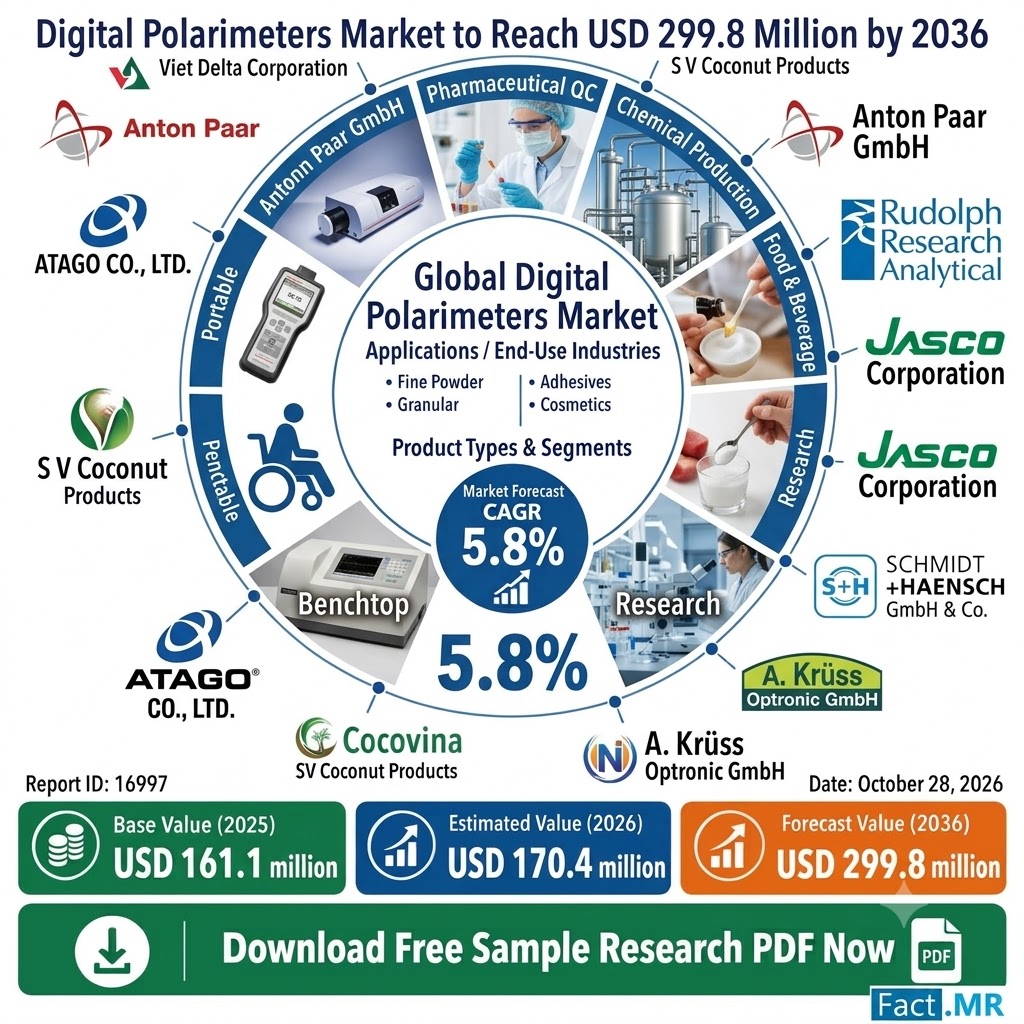
October 28, 2026 The global digital polarimeters market is projected to reach USD 299.8 million by 2036, rising from USD 170.4 million in 2026, according to Fact.MR. The market, valued at USD 161.1 million in 2025, is forecast to expand at a compound annual growth rate (CAGR) of 5.8% over the 2026–2036 period. Demand for accurate optical-rotation measurements in pharmaceutical quality control, chemical production and research laboratories is supporting the adoption of digital instruments.
The market is expected to add USD 129.4 million in value over the forecast period. Pharmaceutical manufacturers need reliable methods to assess optically active substances, while chemical producers use polarimetry to check batch consistency. Digital displays and automated measurement also help laboratories reduce manual reading errors and maintain repeatable testing procedures.
Get detailed market forecasts, competitive benchmarking, and pricing trends: https://www.factmr.com/connectus/sample?flag=S&rep_id=16997
Digital Polarimeters Market Growth Supported by Pharmaceutical Testing
Pharmaceutical quality control remains a central application for digital polarimeters. The U.S. Food and Drug Administration’s Center for Drug Evaluation and Research approved 46 novel drugs in 2025. Separately, United States Pharmacopeia General Chapter <781> identifies optical rotation as a criterion for assessing the identity and purity of certain optically active pharmaceutical materials.
Fact.MR estimates that pharmaceuticals will account for 38.2% of digital polarimeters market revenue in 2026. Laboratories are expected to represent 45.0% of demand, reflecting the instruments’ role in routine quality-control testing and specialized analytical work.
Chemical manufacturers also use polarimeters to verify optical activity and maintain batch consistency. Food and beverage testing contributes to demand where optical rotation measurements support the analysis of sugars and selected ingredients. Research institutions use the technology to investigate chiral compounds and chemical reactions.
Benchtop Instruments Lead Product Demand
Benchtop digital polarimeters are forecast to account for 62.4% of the market by product type in 2026. Their fixed installation supports controlled measurement conditions, repeatable sample handling and integration into established laboratory procedures.
Portable digital polarimeters represent the remaining 37.6% of the product category. These instruments serve users who require mobility or conduct testing outside conventional laboratory environments. Buyers typically assess measurement accuracy, temperature control, operating requirements and sample compatibility before selecting equipment.
Laboratories are projected to hold a 45.0% end-user share in 2026. Contract-testing facilities, analytical laboratories and pharmaceutical quality-control departments use polarimeters for applicable optical-rotation measurements. Research institutes and industrial users contribute additional demand, although their equipment requirements and testing volumes differ.
Germany Leads Country-Level Growth Through 2036
Germany is projected to record the fastest growth among the five countries analyzed by Fact.MR, with a 6.7% CAGR from 2026 to 2036. Its established pharmaceutical and chemical industries support demand for routine optical-rotation testing. IQVIA ranked Germany third among the world’s pharmaceutical markets in 2025, with a market value of USD 77.0 billion.
Brazil follows at a projected 6.1% CAGR. IQVIA valued Brazil’s pharmaceutical market at USD 35.9 billion in 2025, representing 13.2% growth in constant dollars. Expanding pharmaceutical activity creates opportunities for instrument suppliers and distributors offering local calibration and technical support.
The United States is forecast to grow at a 5.5% CAGR, slightly below the global rate. Its pharmaceutical market reached USD 906.5 billion in 2025, according to the supplied IQVIA data. Established manufacturing and laboratory operations support instrument replacement, calibration and requalification.
The United Kingdom is projected to expand at a 4.9% CAGR, supported by pharmaceutical and university testing. Japan is expected to record a 4.4% CAGR, reflecting its mature pharmaceutical sector and established laboratory base. The 19th edition of the Japanese Pharmacopoeia took effect on April 10, 2026, providing a relevant regulatory reference for laboratories following applicable testing methods.
Instrument Accuracy and Support Shape Competitive Priorities
Competition in the digital polarimeters market includes specialist manufacturers offering instruments for pharmaceutical, chemical and research applications. Key companies identified in the Fact.MR analysis include Anton Paar GmbH, Rudolph Research Analytical, JASCO Corporation, SCHMIDT + HAENSCH GmbH & Co., A. Krüss Optronic GmbH and ATAGO CO., LTD.
Product features vary across suppliers. Anton Paar GmbH offers the MCP series, with models spanning the MCP 100 to MCP 5500 range and options including Peltier temperature control and pharmaceutical qualification documentation. Rudolph Research Analytical supplies Autopol V Plus and VI models alongside quartz control plates. JASCO Corporation’s P-2000 series covers ultraviolet to near-infrared wavelengths and supports field upgrades.
A specific product detail illustrates the focus on measurement speed: A. Krüss Optronic GmbH states that its P8000 family can measure in approximately one second, with optional Peltier temperature control. Such features can matter to laboratories balancing throughput with repeatability. Fact.MR does not provide company-level market shares in the supplied analysis.
Fact.MR Analyst Commentary
Shambhu Nath Jha, Principal Consultant at Fact.MR, said, “Digital polarimeters fill an essential niche in analytical measurement. Buyers weigh accuracy, repeatability, operating ease, sample handling and data management against cost. Pharmaceutical quality control stays a core application, while chemical, food and beverage, and research laboratories extend the range of uses.”
For instrument manufacturers, the findings point to a practical priority: demonstrate how equipment performs under the buyer’s actual testing conditions. Clear application guidance, calibration support, operator training and dependable after-sales service can help laboratories maintain consistent measurement procedures. Upfront instrument costs and recurring calibration requirements remain barriers for some prospective buyers.
The full [LINK: Digital Polarimeters Market report] from Fact.MR provides additional analysis of market segmentation, country forecasts, demand drivers, restraints and the competitive landscape.
Market fact block: Fact.MR is a market research and consulting firm that provides industry analysis, market sizing and forecasts to support business and investment decisions.
View Related Reports :
Field-Mount Temperature Transmitters Market
Low-voltage AC Contactor Market
About Fact.MR
Fact.MR is a market research and consulting firm providing market intelligence, industry analysis and strategic insights across a range of sectors. Its research combines primary interviews, desk research, market modelling and data validation to assess market performance, competitive positioning and future growth opportunities.