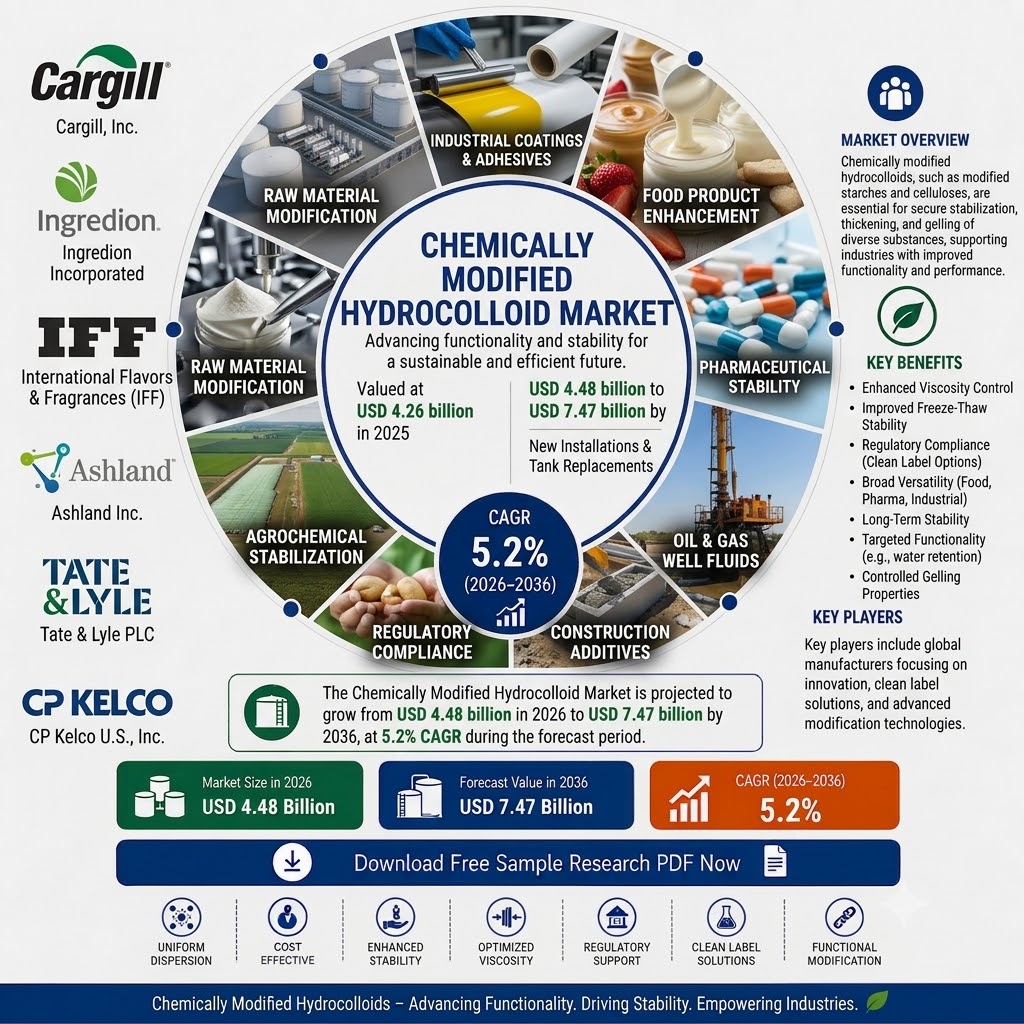
The global chemically modified hydrocolloid market is projected to grow from USD 4.48 billion in 2026 to USD 7.47 billion by 2036, expanding at a compound annual growth rate (CAGR) of 5.2%, according to Fact.MR. The market was valued at USD 4.26 billion in 2025. Demand is being supported by food manufacturers seeking reliable thickening and stabilization solutions, alongside pharmaceutical and personal care producers requiring ingredients with predictable functional performance.
Chemically modified hydrocolloids are used to adjust viscosity, retain water, improve texture and stabilize formulations. Their ability to support product consistency makes them relevant across a range of manufacturing processes. As product specifications become more application-specific, buyers are placing greater emphasis on ingredient performance under actual processing, storage and formulation conditions.
Get detailed market forecasts, competitive benchmarking, and pricing trends
Food and Beverage Applications Lead Demand
Food and beverages are expected to account for 42.3% of the chemically modified hydrocolloid market in 2026, making this the leading application segment. Manufacturers use these ingredients to manage thickness, mouthfeel, suspension and stability in products such as sauces, dairy items, bakery products and beverages.
By product type, cellulose derivatives are projected to hold a 35.2% share in 2026. Their role in viscosity control, moisture retention and formulation stability supports their use across different applications. By function, thickening is expected to represent 36.8% of market demand, reflecting the need to achieve consistent flow and texture in finished products.
Plant-derived materials are forecast to account for 52.1% of the market in 2026. This leading source category reflects the importance of plant-origin inputs in hydrocolloid formulations, although suitability depends on the ingredient’s functional properties and intended application.
Regional Outlook: Germany Leads Growth
Germany is projected to register the fastest growth among the countries covered, with a CAGR of 6.0% through 2036. Demand from food manufacturers for ingredients that maintain texture, viscosity and stability across processed products is supporting market development.
Brazil is expected to record a 5.5% CAGR, followed by the United States at 4.9%. The United Kingdom market is forecast to expand at 4.4%, while Japan is projected to grow at 3.9% over the same period. Food processing activity, pharmaceutical formulation requirements and demand for consistent ingredient performance are relevant factors shaping these country markets.
Analyst Perspective
Shambhu Nath Jha, Principal Consultant at Fact.MR, states, “Chemically modified hydrocolloids serve a practical role in formulations that require consistent texture, viscosity and stability. Suppliers that demonstrate performance under actual processing conditions and provide clear quality documentation are better positioned to meet the needs of food, pharmaceutical and personal care manufacturers.”
Competitive Landscape
The chemically modified hydrocolloid market includes established ingredient suppliers with portfolios spanning food formulations, specialty ingredients and functional systems. Key companies profiled by Fact.MR include Cargill, Incorporated; Ingredion Incorporated; International Flavors & Fragrances Inc. (IFF); Ashland Inc.; and Tate & Lyle PLC.
Competition is shaped by functional performance, formulation compatibility, regulatory compliance and supply reliability. Suppliers that provide application-specific technical support and demonstrate consistent ingredient quality can strengthen their position among food, pharmaceutical and personal care manufacturers.
Market Snapshot
- Market size (2025): USD 4.26 billion
- Estimated market size (2026): USD 4.48 billion
- Forecast market size (2036): USD 7.47 billion
- CAGR (2026–2036): 5.2%
- Leading product type: Cellulose derivatives (35.2% share in 2026)
- Leading application: Food and beverages (42.3% share in 2026)
- Leading function: Thickening (36.8% share in 2026)
- Leading source: Plant-derived materials (52.1% share in 2026)
To View Related Reports
Live Biotherapeutic Products & Microbiome CDMO Market
About Fact.MR
Fact.MR is a market research and competitive intelligence provider delivering market intelligence, competitive analysis, and forecasting across global industries. Its research helps businesses evaluate market demand, understand competitive developments, and identify growth opportunities.