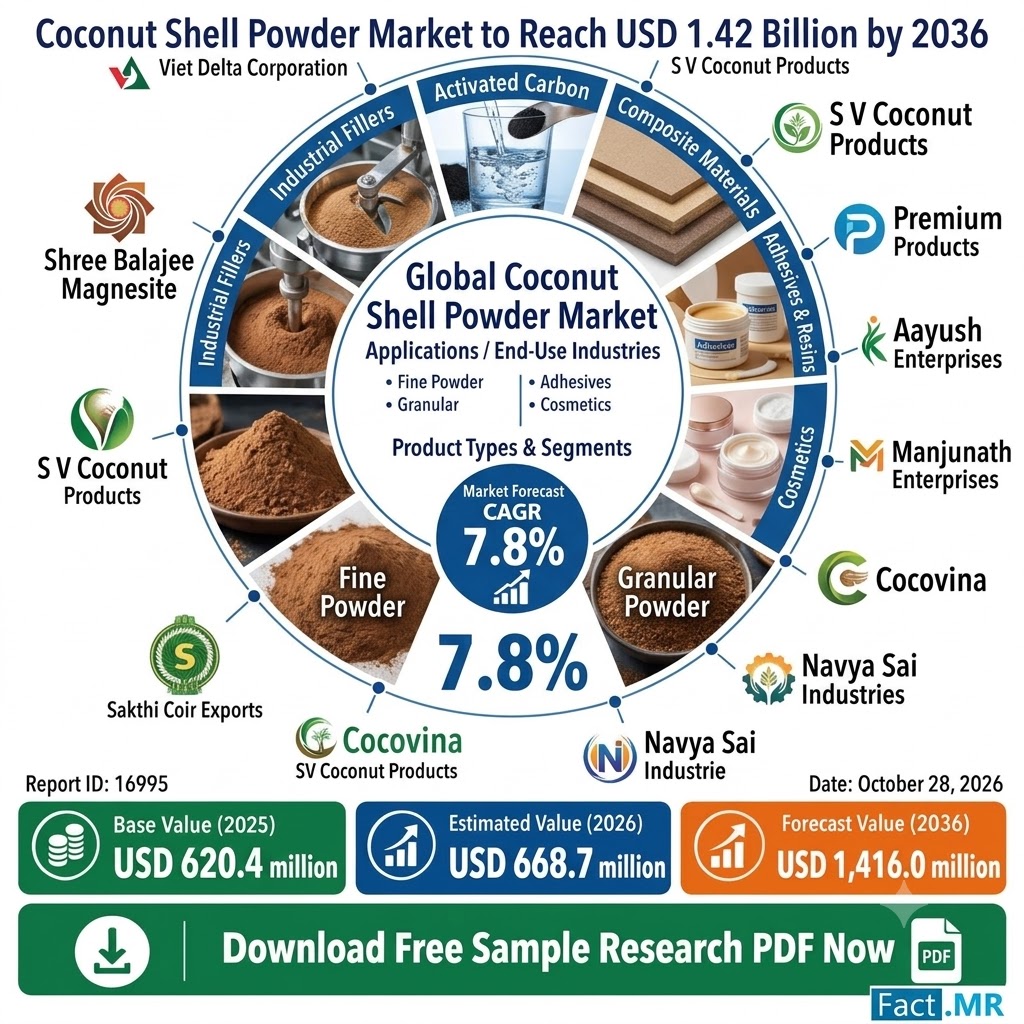
The global coconut shell powder market is projected to reach USD 1,416.0 million by 2036, up from USD 668.7 million in 2026, according to Fact.MR. The market, valued at USD 620.4 million in 2025, is forecast to expand at a compound annual growth rate (CAGR) of 7.8% between 2026 and 2036. The outlook reflects continued demand from established industrial applications, alongside closer scrutiny of material consistency and supply reliability.
The market is expected to add USD 747.3 million in revenue over the forecast period. Industrial buyers increasingly require predictable moisture levels and particle distribution before approving coconut shell powder for repeated production use. For processors, commercial success will depend on meeting these requirements while managing competition for mature coconut shells from charcoal and activated carbon producers.
Get detailed market forecasts, competitive benchmarking, and pricing trends: https://www.factmr.com/connectus/sample?flag=S&rep_id=16995
Coconut Shell Powder Market Growth Depends on Industrial Grade Consistency
The coconut shell powder market serves manufacturers using processed coconut shells as a raw material in fillers, resins and other industrial applications. Its commercial scope distinguishes untreated shell powder from finished activated carbon, charcoal products and other downstream materials.
Fine Powder represents 61.3% of the market by product type in 2026, making it the leading segment. This position reflects the importance of controlled particle characteristics in industrial formulations. However, achieving a nominal particle size is only part of the requirement. Variations in moisture content or particle distribution between deliveries can change how a powder performs during mixing and processing.
The Activated Carbon application accounts for 34.2% of the market in 2026. This category reflects demand associated with downstream conversion, where processing requirements differ from those of direct filler applications. Manufacturers must establish whether their production processes require shell particles, charcoal or another prepared feedstock before finalizing procurement specifications.
Specialty Stores hold a 38.4% share of sales channels in 2026. Specialist distributors can support industrial customers by supplying clearly identified grades in smaller quantities for product trials. Once a formulation passes qualification, consistent replenishment becomes essential to maintaining production standards.
Feedstock Competition Creates Pressure on Coconut Shell Powder Suppliers
Raw material access remains a key commercial consideration. Coconut shells also serve competing processing markets, including charcoal and activated carbon production. According to Fact.MR’s analysis, this competition can increase input costs and reduce the advantage of selling powder primarily on price.
Processors therefore need to consider feedstock procurement alongside milling capacity. Agreements that secure suitable mature shells can help reduce exposure to changing input availability. Cleaning, drying and storage practices also influence the amount of usable material obtained from incoming supplies.
Application requirements add another layer of complexity. Adhesive and resin manufacturers need powder that performs consistently in approved formulations, while carbon processors evaluate inputs against conversion requirements. A generic product strategy may not satisfy both customer groups.
Research also highlights the need for application-specific testing. A 2026 study by Lala and colleagues in Discover Applied Sciences examined coconut shell material used with E-glass in epoxy resins and reported increased water absorption as shell content rose during immersion tests. The finding supports careful evaluation of formulation performance rather than assuming that higher filler loading will always improve the finished material.
Country Forecasts Identify Germany and Brazil as Growth Markets
Fact.MR projects different growth rates across five profiled national markets between 2026 and 2036.
Germany is forecast to record an 8.7% CAGR, the highest among the countries assessed. Demand opportunities are linked to industrial qualification requirements, where suppliers must demonstrate that renewable raw materials can meet established production specifications.
Brazil follows at an 8.0% CAGR. Its market outlook places emphasis on organizing suitable feedstock collection and improving preparation standards so processors can deliver consistent industrial material.
The United States is projected to grow at a 7.2% CAGR. Buyers seeking dependable supply options will need documented specifications and reliable delivery arrangements, particularly where raw material costs fluctuate.
The United Kingdom is forecast to expand at a 6.5% CAGR, while Japan is expected to register a 5.7% CAGR. In these markets, specialist distribution and the transition from initial product trials to repeat manufacturing orders remain important commercial considerations.
Analyst Commentary: Qualification Determines Repeat Purchasing
Shambhu Nath Jha, Lead Consultant at Fact.MR, said:
“Coconut shell powder is easy to describe as a low-cost renewable input; it is much harder to supply as a dependable industrial ingredient. Once a customer has qualified a filler, inconsistent moisture or particle distribution can quickly erase a small price saving. That favours processors able to hold specifications across deliveries, even without the largest milling capacity.”
Jha added that experimental applications require careful commercial evaluation.
“Published formulations may justify trials, but recurring revenue begins only when a finished product passes the manufacturer’s operating tests. Undifferentiated powder will remain exposed to competing shell outlets and freight costs; better-controlled grades have a more defensible place in customer procurement.”
Coconut Shell Powder Market Competitive Landscape
Fact.MR profiles ten companies in its assessment of the coconut shell powder market: Viet Delta Corporation, Shree Balajee Magnesite, S V Coconut Products, Premium Products, Aayush Enterprises, Kumaran Coir, Manjunath Enterprises, Cocovina, Sakthi Coir Exports and Navya Sai Industries.
The competitive assessment emphasizes product specifications, processing discipline and dependable replenishment. Suppliers that maintain grade consistency across deliveries may be better positioned to secure repeat orders than producers relying primarily on available milling capacity or low initial prices.
Potential opportunities include qualified shell-powder grades for low-load composite applications, organized recovery of suitable mature shells and regional inventories of clearly specified products. These opportunities remain subject to customer testing, production requirements and feedstock economics.
For manufacturers considering renewable filler materials, the immediate priority is to verify whether a particular grade meets the intended application’s technical requirements. Commercial adoption depends on repeatable manufacturing performance, not simply the renewable origin of the input.
View Related Reports :
Fire, Smoke, and Toxicity Retardant (FST) Composite Resin Market
About Fact.MR
Fact.MR is a market research and consulting firm that provides industry analysis, market sizing, competitive assessments and forecasts to help businesses evaluate market developments and commercial opportunities. Its research combines primary interviews, desk research and market estimation methods to assess demand patterns, competitive activity and factors influencing industry growth.