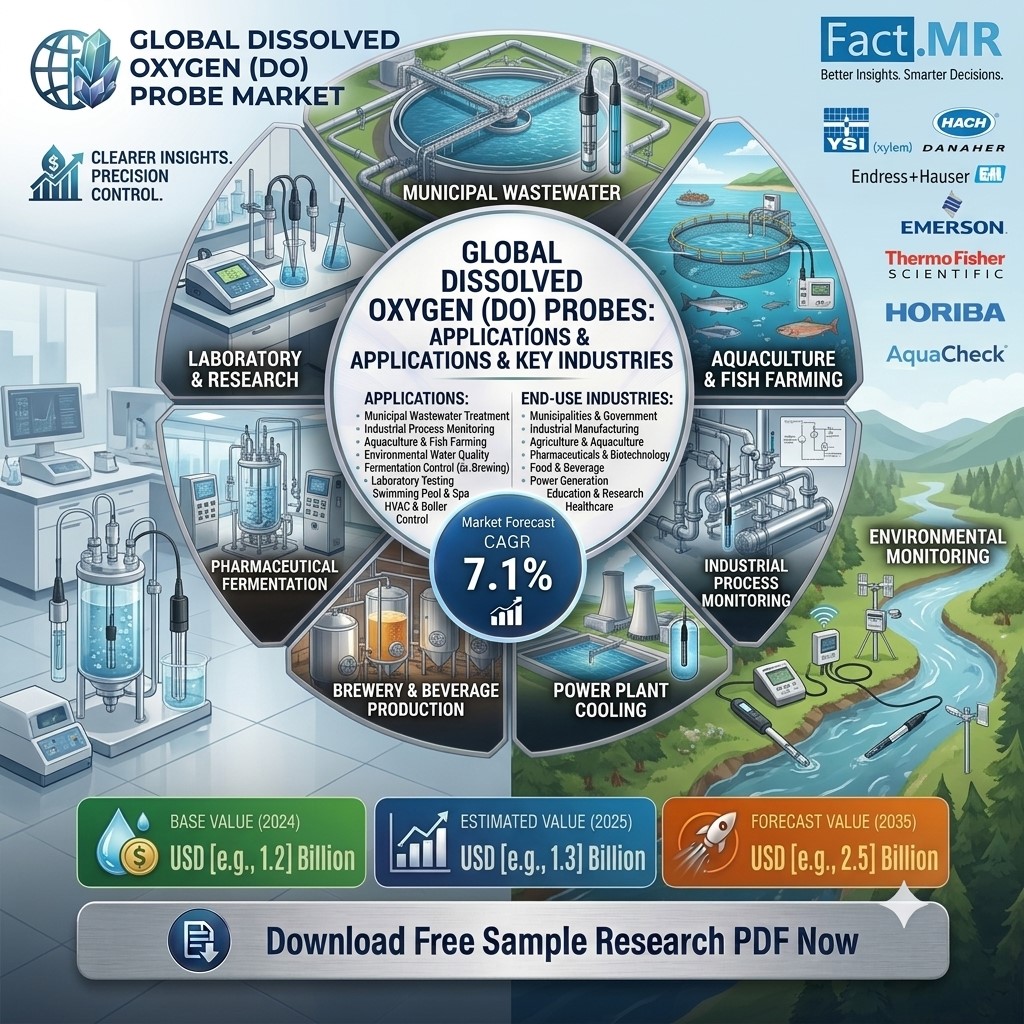
Rockville, MD., October 28, 2026 — The global Dissolved Oxygen Probe Market is projected to increase from USD 474.4 million in 2026 to USD 834.4 million by 2036, expanding at a 5.8% CAGR, according to Fact.MR. The market was valued at USD 448.3 million in 2025 and is expected to generate an absolute dollar opportunity of USD 360.0 million between 2026 and 2036. The United States leads country growth at 6.5% CAGR, while Germany records the lowest projected growth among the five countries analyzed, at 4.2%.
Growing demand for continuous water-quality monitoring is shaping the market. Aquaculture farms require accurate oxygen readings to manage aeration, while wastewater treatment facilities depend on oxygen measurements to maintain biological treatment performance. Environmental agencies also use dissolved oxygen probes to assess aquatic ecosystems and monitor changes in water conditions.
Get detailed market forecasts, competitive benchmarking, and pricing trends
Water Quality Regulations Support Dissolved Oxygen Probe Market Growth
Water-quality monitoring requirements are creating opportunities for manufacturers of optical and electrochemical dissolved oxygen probes.
On April 23, 2025, the U.S. Environmental Protection Agency published its revised Field Measurement of Dissolved Oxygen procedure, LSASDPROC-106-R6. The document outlines measurement methods for surface water and treated wastewater, providing technical guidance for environmental monitoring activities.
Industrial automation is another important factor. In April 2025, Emerson announced its Rosemount 490A digital optical dissolved oxygen sensor with Modbus connectivity. The product supports integration with monitoring and control systems used in water treatment and industrial processes.
Extractable fact: A dissolved oxygen probe is a measurement sensor that determines oxygen concentration in water or process liquids, supporting environmental monitoring, aquaculture management, and industrial process control.
According to Fact.MR, continuous water-quality monitoring programmes contribute an estimated 1.8 percentage points to the market’s forecast CAGR. Greater adoption in aquaculture contributes another 1.2 percentage points.
Optical Dissolved Oxygen Probes Lead with 58.7% Market Share
Optical dissolved oxygen probes are expected to account for 58.7% of the market in 2026. Their lower maintenance requirements make them suitable for applications involving frequent measurements and continuous monitoring.
Unlike many electrochemical probes, optical models do not require electrolyte replacement. This reduces routine servicing requirements for operators managing water-quality monitoring equipment.
Aquaculture represents the leading application segment, accounting for 38.2% of demand in 2026. Fish farms depend on dissolved oxygen readings to manage aeration and respond to oxygen depletion.
Environmental agencies are projected to hold 31.4% of the market by end user in 2026. These organisations monitor rivers, lakes, and coastal waters to assess ecosystem conditions and identify changes in oxygen availability.
Shambhu Nath Jha, Principal Consultant at Fact.MR, states:
“Demand for dissolved oxygen probes is set to grow as aquaculture, environmental monitoring and wastewater treatment require consistent oxygen readings. Optical probes are gaining ground due to their lower maintenance needs, while electrochemical models remain important for routine testing. Over the coming years, wider adoption of continuous monitoring and automated process control will create steady opportunities.”
United States Leads Country Growth at 6.5% CAGR
Country-level forecasts indicate different growth opportunities across established industrial markets and developing aquaculture applications.
- United States — 6.5% CAGR: Federal water-quality programmes and continuous monitoring support demand. The U.S. Geological Survey identifies dissolved oxygen as an established parameter in environmental water-quality assessments.
- Japan — 5.9% CAGR: Environmental assessment and industrial process monitoring support adoption. Japan’s Ministry of the Environment published its FY2024 public-water and groundwater monitoring results on March 27, 2026.
- Brazil — 5.0% CAGR: Aquaculture operations require dependable oxygen measurements for production-water management. A BNDES-supported project developed through Embrapa’s BRS Aqua initiative demonstrated equipment measuring dissolved oxygen alongside other water-quality parameters.
- United Kingdom — 4.6% CAGR: Receiving-water monitoring supports demand. During the 2025–2030 investment period, water companies in England are beginning to install continuous monitors at priority locations.
- Germany — 4.2% CAGR: Established wastewater treatment facilities and industrial monitoring systems create opportunities for instrument replacement and equipment upgrades.
These forecasts reflect differences in monitoring infrastructure, aquaculture requirements, and industrial measurement practices.
Competitive Landscape: Leading Dissolved Oxygen Probe Manufacturers
The dissolved oxygen probe market includes established water-analysis specialists and industrial instrumentation companies.
Key manufacturers identified by Fact.MR include:
- Hach Company
- Thermo Fisher Scientific Inc.
- Xylem Inc.
- Hanna Instruments Inc.
- HORIBA, Ltd.
- Mettler-Toledo International Inc.
- Jenco Instruments, Inc.
- Endress+Hauser
- Hamilton Company
- ABB
- KROHNE Messtechnik GmbH
- Sensorex Corporation (a Halma company)
- In-Situ Inc.
- DKK-TOA Corporation
- DwyerOmega (Omega Engineering)
Hach Company supplies optical sensing solutions for water and process applications. Xylem Inc. competes through its YSI brand, while Thermo Fisher Scientific Inc. provides measurement products for field and laboratory applications.
Endress+Hauser, ABB, and KROHNE serve industrial instrumentation requirements. Hamilton Company focuses on bioprocess analytics.
Manufacturers compete through measurement stability, calibration requirements, maintenance costs, and compatibility with existing monitoring systems. Fact.MR does not disclose individual company market shares.
Connected Monitoring Creates Opportunities Through 2036
Integration with remote monitoring and automated aeration systems represents an important development opportunity.
Fact.MR estimates that connecting dissolved oxygen probes with telemetry and automated aeration contributes approximately 0.7 percentage points to forecast CAGR.
However, equipment costs remain a purchasing consideration. Calibration requirements, sensor fouling, and limited technical expertise can also restrict adoption, particularly among smaller operators.
The report draws on more than 120 sources, over 35 company portfolios, coverage of more than 25 countries, and over 20 industry interviews.
Top Reports:
Field-Mount Temperature Transmitters Market
Low-voltage AC Contactor Market
About Fact.MR
Fact.MR is a market research and consulting firm providing syndicated research and custom market intelligence across industries. Its research combines primary interviews, secondary analysis, market forecasting, and data validation to support business decisions.