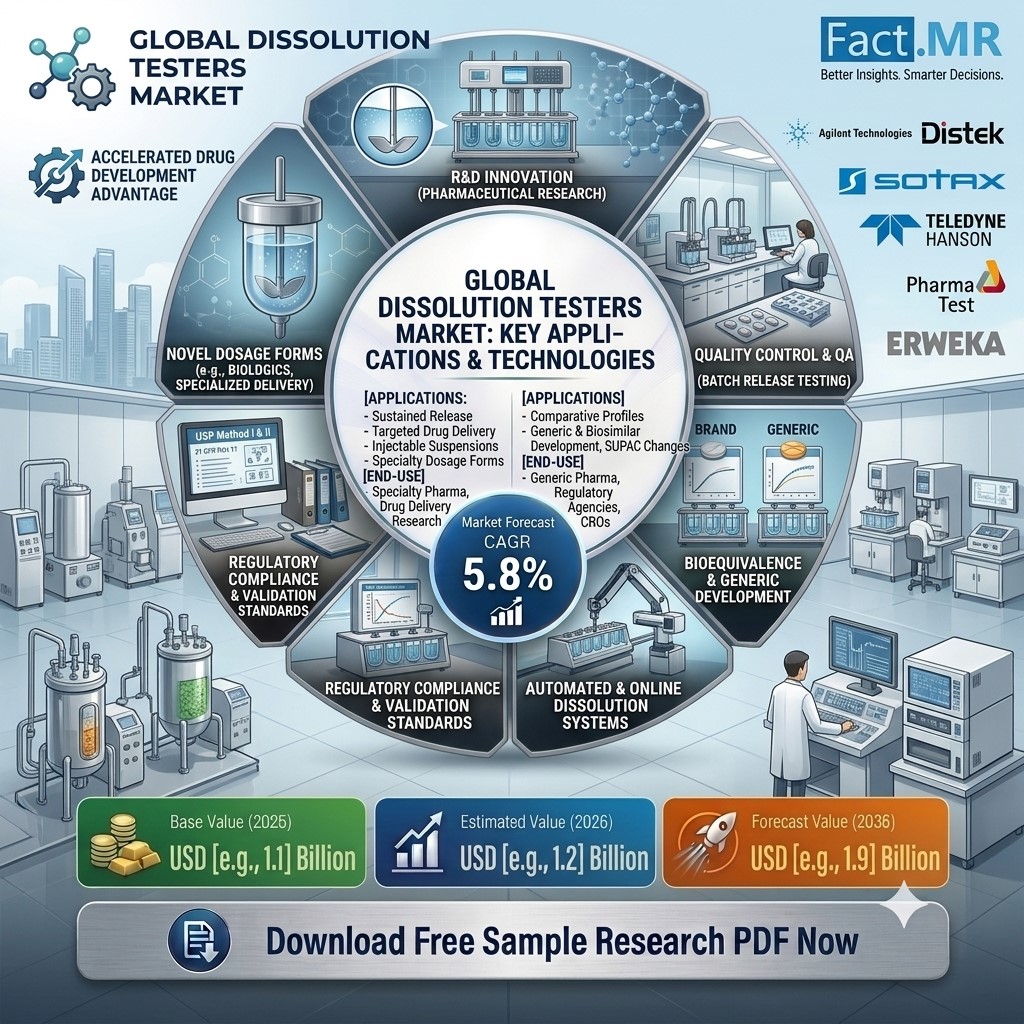
Rockville, MD., October 28, 2026 — The global Dissolution Testers Market is projected to increase from USD 381.3 million in 2026 to USD 718.5 million by 2036, expanding at a 6.5% CAGR, according to Fact.MR. The market was valued at approximately USD 357.9 million in 2025 and is expected to generate an absolute dollar opportunity of USD 337.2 million between 2026 and 2036.
Japan is projected to record the highest country growth at 6.4% CAGR, while the United Kingdom is expected to register the lowest growth among the five countries analyzed, at 4.7%. Demand is supported by pharmaceutical quality-control requirements, generic drug development and increasing investment in automated laboratory equipment.
Automated dissolution testers are expected to account for 68.5% of market revenue in 2026, reflecting the growing importance of repeatable testing procedures and reduced manual handling. Pharmaceutical industry applications represent 61.5% of demand, while pharmaceutical companies account for 52.8% of end-user revenue.
Get detailed market forecasts, competitive benchmarking, and pricing trends
Pharmaceutical Quality Control Supports Dissolution Testers Market Growth
Dissolution testers measure the rate and extent of active pharmaceutical ingredient release from tablets, capsules and other suitable dosage forms under controlled conditions. Pharmaceutical manufacturers use these instruments to evaluate formulation performance and verify batch consistency before commercial release.
The need for reliable testing remains closely connected with pharmaceutical development standards.
In January 2025, the World Health Organization published guidance addressing biopharmaceutics classification system-based biowaivers. The guidance supports the use of comparative dissolution evidence in eligible pharmaceutical applications.
The U.S. Food and Drug Administration also conducted its Fiscal Year 2025 Generic Drug Science and Research Initiatives Public Workshop on June 3–4, 2025, covering scientific and regulatory research priorities relevant to generic drug development.
These developments reinforce the importance of reliable dissolution testing in pharmaceutical research and product assessment.
Extractable Fact: Dissolution testers are laboratory instruments that measure drug-release performance under controlled conditions. They support pharmaceutical formulation development, comparative dissolution studies and manufacturing quality-control activities.
Automated Dissolution Testers Lead with 68.5% Market Share
Automated dissolution testers are projected to capture 68.5% of the global market in 2026, according to Fact.MR.
These instruments simplify repetitive testing procedures through automated sampling, scheduled test sequences and digital data recording. Laboratories processing large sample volumes can reduce manual intervention while maintaining consistent operating conditions.
Manual dissolution testers remain relevant for smaller laboratories with limited testing requirements and equipment budgets.
The pharmaceutical industry leads application demand with a 61.5% share in 2026. Manufacturers rely on dissolution testing throughout formulation development and routine batch-release assessment.
Pharmaceutical companies account for 52.8% of end-user demand. Contract research organizations and academic research institutes represent additional customers, particularly for formulation studies and analytical research.
Japan Leads Country Growth at 6.4% CAGR
Fact.MR identifies Japan as the fastest-growing country among the five markets analyzed, followed by Germany and the United States.
- Japan — 6.4% CAGR: Pharmaceutical laboratories prioritize analytical consistency and automated testing systems. Demand is supported by formulation research and routine drug-quality assessment.
- Germany — 6.0% CAGR: Established pharmaceutical manufacturing and laboratory infrastructure support equipment purchases. Manufacturers emphasize testing reliability and compatibility with existing methods.
- United States — 5.6% CAGR: Generic drug development and regulatory research support demand for dissolution testing. Pharmaceutical manufacturers and contract research organizations require dependable analytical equipment.
- Brazil — 5.2% CAGR: Domestic pharmaceutical production supports demand for quality-control instruments. Equipment affordability and technical-service availability influence purchasing decisions.
- United Kingdom — 4.7% CAGR: Established pharmaceutical research laboratories continue to require dissolution testing, although equipment replacement cycles and budget considerations can limit new purchases.
These country forecasts reflect differences in pharmaceutical production activity, laboratory investment and existing testing infrastructure.
Competitive Landscape: Leading Dissolution Tester Manufacturers
Competition in the Dissolution Testers Market includes established laboratory instrument manufacturers offering automated systems, manual equipment and technical support.
Key companies profiled by Fact.MR include:
- SOTAX AG
- Agilent Technologies, Inc.
- Distek, Inc.
- Teledyne Hanson (Teledyne LABS)
- Electrolab (India) Pvt. Ltd.
- ERWEKA GmbH
- Pharma Test Apparatebau AG
- Labindia Analytical Instruments Pvt. Ltd.
- Logan Instruments Corp.
- Pion Inc.
SOTAX AG provides modular dissolution testing systems and laboratory automation solutions. Agilent Technologies, Inc. offers 708-DS dissolution apparatus and sampling equipment.
Distek, Inc. supplies OLERA dissolution testing systems, while Teledyne Hanson provides dissolution apparatus and related laboratory accessories.
ERWEKA GmbH offers manual and automated instruments. Electrolab and Labindia Analytical Instruments serve pharmaceutical laboratories with dissolution testing equipment.
Manufacturers compete on testing reliability, automation capabilities and compatibility with established laboratory procedures. Calibration services and technical support also influence equipment selection.
Analyst Perspective and Market Opportunities
Shambhu Nath Jha, Principal Consultant at Fact.MR, stated:
“Demand for dissolution testers is expected to grow as pharmaceutical companies strengthen quality checks and expand formulation research. Over the coming years, automated systems offering flexible testing options and reliable data handling are poised to attract greater investment.”
Fact.MR identifies automated laboratory workflows as an important commercial opportunity. Its analysis assigns automated systems for high-volume pharmaceutical laboratories an estimated +1.1 percentage-point contribution to market CAGR, while software and data-management capabilities contribute approximately +0.8 percentage points.
High initial equipment costs remain a purchasing constraint. Laboratories must also consider calibration, maintenance and personnel training throughout an instrument’s operating life.
For manufacturers, equipment reliability and dependable after-sales service remain central to long-term customer relationships.
Top Reports:
Field-Mount Temperature Transmitters Market
Low-voltage AC Contactor Market
About Fact.MR
Fact.MR is a market research and consulting firm providing syndicated and customized industry research. Its studies combine primary interviews, secondary research and market forecasting to support business decisions across global industries.