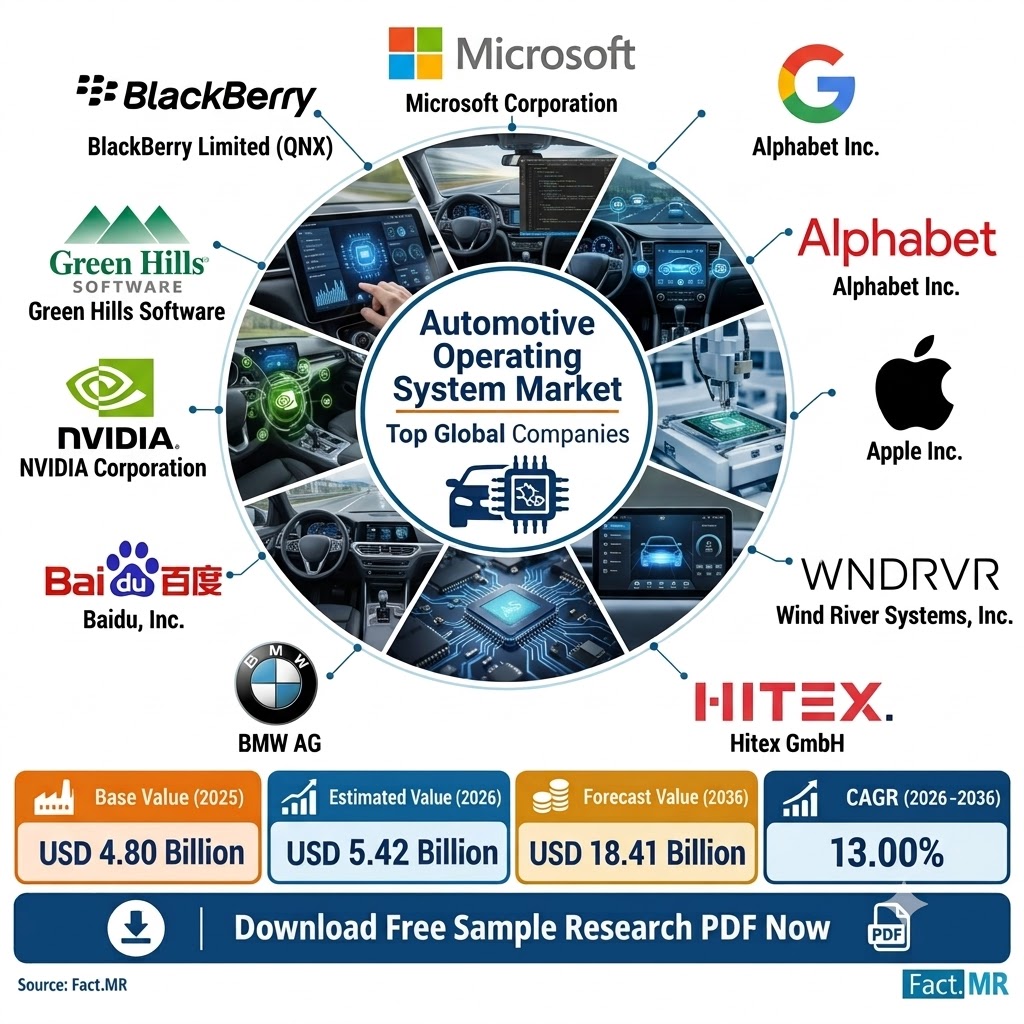
The global automotive operating system market is projected to grow from USD 5.42 billion in 2026 to USD 18.41 billion by 2036, registering a compound annual growth rate (CAGR) of 13.0%, according to Fact.MR. The market was valued at USD 4.80 billion in 2025, while the incremental opportunity between 2026 and 2036 amounts to approximately USD 12.99 billion.
The transition from distributed electronic control units (ECUs) to centralized computing architectures is changing how automakers select and integrate vehicle software. Operating systems must increasingly coordinate infotainment, advanced driver assistance systems (ADAS), powertrain functions and connected services while managing workloads with different performance and safety requirements.
Cybersecurity and software lifecycle management are also shaping procurement decisions. UNECE WP.29 cybersecurity requirements, including Regulation No. 155, are relevant to connected-vehicle compliance strategies. Meanwhile, AUTOSAR-based software architectures and over-the-air update capabilities are influencing operating system specifications for new vehicle platforms.
Get detailed market forecasts, competitive benchmarking, and pricing trends:
Where growth is fastest
Fact.MR identifies several national markets with different growth drivers, from automotive software development to vehicle safety integration.
- India – CAGR 15.6%: Expansion of electric vehicle fleets, automotive software development capabilities and localized operating system initiatives are supporting demand.
- China – CAGR 14.9%: Autonomous vehicle programmes, connected-car technology and domestic automotive software development are contributing to market growth.
- Brazil – CAGR 13.1%: Vehicle software modernization and the integration of operating systems into vehicle safety systems are creating opportunities.
- United States – CAGR 12.7%: Automotive software innovation, artificial intelligence integration and collaboration between automakers and technology companies are supporting adoption.
- Germany – CAGR 12.1%: Automotive engineering capabilities, AUTOSAR-based architectures and functional safety requirements are influencing operating system development.
- United Kingdom – CAGR 11.8%: Automotive technology investment and software development initiatives are supporting demand for flexible vehicle software platforms.
- Japan – CAGR 11.3%: Automakers’ focus on reliability, real-time processing and integration with advanced driver assistance functions is shaping procurement.
What leads the market
Real-time processing requirements and expanding in-vehicle digital features are influencing the balance between operating system types and applications.
- Real-time operating systems (RTOS): 42.0% share in 2026. RTOS platforms lead the operating system type category because vehicle functions with strict timing requirements need predictable task scheduling and execution.
- Infotainment: 35.0% share in 2026. Infotainment is the leading application sub-segment identified in the report, reflecting the importance of in-vehicle digital interfaces and connected features.
Fact.MR also identifies Linux-based systems as a fast-growing sub-segment. Their open-source development model and broad software ecosystem make them relevant to infotainment and connected services, where flexibility and development speed are important considerations.
The hurdle
Development costs, certification timelines and integration complexity remain significant barriers. Automotive operating systems must work with existing electronic architectures while meeting programme-specific performance, cybersecurity and functional safety requirements.
These demands can increase engineering costs and make late-stage platform changes difficult. The report notes that RTOS-based safety-critical development can involve certification timelines of 18 to 24 months, making early architecture and supplier decisions important to vehicle programme planning.
Cybersecurity vulnerabilities also require continued attention throughout a vehicle’s software lifecycle. Secure boot, encrypted communications and controlled software updates must be considered alongside the initial operating system selection.
Industry investment and recent developments
Automotive software investment is increasingly focused on safety-certified platforms, connected services and operating systems that can support multiple workloads on shared computing hardware.
The report identifies the following developments:
- January 2024 – BlackBerry QNX: The launch of the QNX Sound platform extended QNX’s capabilities into vehicle audio management and acoustic customization.
- October 2023 – Qt Group and Mercedes-Benz: The companies announced a strategic partnership to develop the MB.OS framework using Qt 6, illustrating automaker investment in proprietary software platforms.
- June 2023 – Polestar and Xingji Meizu: The companies collaborated on custom operating systems for Chinese electric vehicles, reflecting interest in localized software and smart-cockpit experiences.
The companies profiled in the Fact.MR report are BlackBerry Limited (QNX), Microsoft Corporation, Alphabet Inc., Apple Inc., Wind River Systems, Inc., Hitex GmbH, BMW AG, Baidu, Inc., NVIDIA Corporation and Green Hills Software.
These companies participate in different parts of the market, including real-time operating systems, infotainment platforms, cloud-connected vehicle services, autonomous driving technologies and embedded software.
Analyst perspective
Fact.MR’s published analysis highlights a potential shift toward a smaller number of operating system platforms securing a greater share of new vehicle programme specifications. Automakers developing proprietary software stacks face development costs and competition for engineering talent, which can make external platform licensing an alternative.
The analysis also identifies hypervisor-based architectures as a way to run different operating systems on shared hardware while separating safety-critical workloads from less critical functions. This approach may help manufacturers consolidate computing hardware without treating every vehicle application as having the same timing and certification requirements.
Note: The report page does not provide a separately attributed, verbatim analyst quotation. The preceding paragraphs summarize its published analysis and are not presented as a direct quote.
What this means for automotive OEMs and software suppliers
- Select operating system partners early. Align platform selection with the vehicle development schedule, safety requirements and certification needs. Late changes can introduce integration work and threaten programme timelines.
- Evaluate shared-computing architectures. Assess whether hypervisor-based designs can consolidate hardware while preserving the separation required between safety-critical and non-critical workloads. Validate the approach against each vehicle programme’s technical requirements.
- Plan for software maintenance from the start. Evaluate cybersecurity updates, over-the-air deployment, integration with existing systems and long-term supplier support alongside licensing costs. Maintain sufficient internal engineering capability to manage interfaces between external operating systems and proprietary applications.
Report coverage
Fact.MR’s Automotive Operating System Market report examines market size and forecasts, operating system types, vehicle applications, passenger and commercial vehicles, regional growth, competitive positioning and the factors shaping automotive software procurement through 2036.
Top Trending Reports:
USA Turbidity Equipment Industry Analysis Size and Share Forecast Outlook 2025 to 2035
Agricultural Film Industry Analysis in the USA
Agricultural Sprayers Industry Analysis in the USA
Aerial Robot Market Analysis in the USA
About Fact.MR
Fact.MR is a market research and consulting firm providing market intelligence, industry analysis and forecasts across automotive, technology, chemicals, consumer goods and other industrial sectors. Its research examines market size, growth drivers, competitive dynamics and strategic opportunities to support business planning and investment decisions.