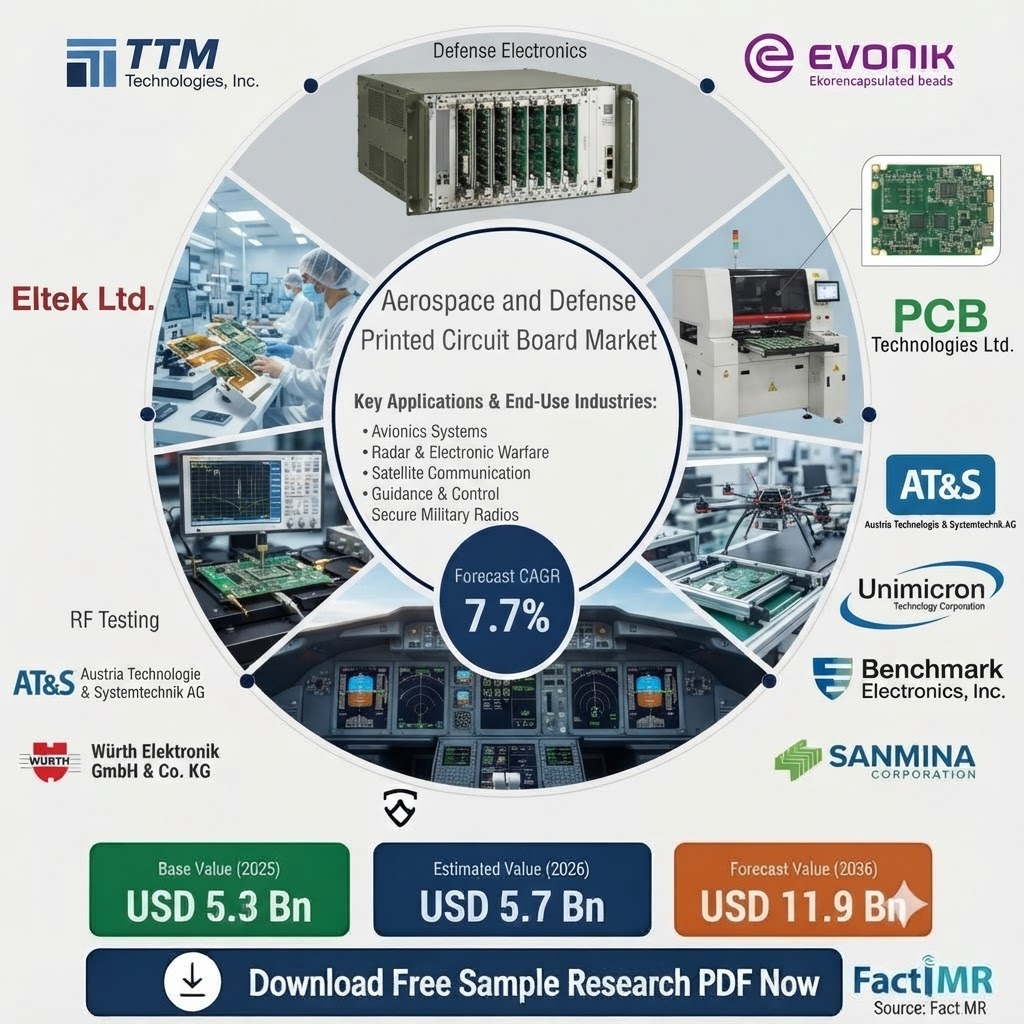
The global aerospace and defense printed circuit board market is projected to increase from USD 5.7 billion in 2026 to USD 11.9 billion by 2036, expanding at a 7.7% CAGR. The market reached USD 5.3 billion in 2025, with an absolute dollar opportunity of USD 6.2 billion expected between 2026 and 2036. Growth is being supported by rising electronics intensity across defense platforms, including radar, electronic warfare, mission computing, secure communications, and autonomous systems. In April 2026, Australia’s Department of Defence allocated A$425 billion over a decade through its Integrated Investment Program, prioritizing integrated air and missile defense, autonomous systems, counter-UAS, and secure multi-orbit satellite communications.
Get detailed market forecasts, competitive benchmarking, and pricing trends:
Global Segment Leaders
- High-Reliability Multilayer PCB — 36.0% share in 2026: Leads the Board Category segment because it balances routing density with established and reproducible qualification processes.
- Military Aircraft — 40.0% share in 2026: Leads the Aircraft Platform segment as flight-control, radar, electronic warfare, mission computing, and communications electronics concentrate within military aircraft.
- Defense — 46.0% share in 2026: Dominates the End-use Sector segment because defense acquisition programs carry substantial electronics volumes, qualification requirements, and traceability obligations.
- High-Reliability PCB Fabrication — 39.0% share in 2026: Leads Manufacturing Technology because defense buyers prioritize traceable, process-controlled fabrication and reliable production evidence.
Country-Level Performance
| Country | CAGR (2026–2036) | Key Growth Driver |
| USA | 8.6% | TTM Technologies opened a 215,000-square-foot Ultra-HDI facility in Syracuse in June 2026 following a USD 130 million investment. |
| France | 8.2% | France’s 2024–2030 Military Programming Law provides EUR 413.3 billion for the armed forces, supporting modernized platforms and electronic systems. |
| Japan | 7.9% | Japan’s Ministry of Defense secured about JPY 100 billion for the SHIELD unmanned-assets project in the FY2026 draft budget. |
| UK | 7.5% | The UK Ministry of Defence announced a GBP 5 billion technology investment in June 2025 for drones, laser weapons, and defense innovation. |
| Canada | 7.2% | Canada’s 2024 policy added CAD 8.1 billion over five years and CAD 73 billion over 20 years for defense capabilities. |
| Australia | 6.9% | Australia’s April 2026 Integrated Investment Program allocated A$425 billion over a decade and prioritized missile defense, autonomous systems, and secure satellite communications. |
| South Korea | 6.6% | The Republic of Korea stated in June 2026 that the military would acquire more than 20,000 drones and train 500,000 operators. |
Regional Context
The United States, France, and Japan represent the fastest-growing country markets in the supplied forecast, with CAGRs of 8.6%, 8.2%, and 7.9%, respectively. Growth is tied to domestic production capacity, sovereign procurement frameworks, large defense budgets, and autonomous or electronic warfare programs.
The UK and Canada form the next growth tier, with CAGRs of 7.5% and 7.2%. Their markets are supported by defense technology investment, airworthiness and assurance requirements, Arctic reliability, interoperability, and long-term sustainment priorities.
Australia and South Korea record CAGRs of 6.9% and 6.6%. Australia’s demand is linked to sovereign access and support across a geographically dispersed operating environment, while South Korea benefits from compressed development cycles, domestic electronics capabilities, and expanding unmanned-system procurement.
The full report covers North America, Latin America, Western Europe, Eastern Europe, East Asia, South Asia and Pacific, and the Middle East & Africa, with the supplied scope identifying the seven profiled countries plus more than twenty-five additional countries.
Competitive Landscape
Competition is divided among mission-critical PCB fabricators, scaled advanced interconnect platforms, and integrated or managed-supply providers. TTM Technologies, Advanced Circuits, Eltek, and PCB Technologies compete through traceability, high-reliability processes, and advanced board constructions. Unimicron, AT&S, and Würth Elektronik compete through HDI, flex, rigid-flex, RF, and industrialized process capabilities, while Benchmark Electronics, Sanmina, and NCAB Group add design support, assembly adjacency, and sourcing continuity.
Key recent developments include TTM Technologies opening its Ultra-HDI manufacturing facility in Syracuse in June 2026 following a USD 130 million investment, and Raytheon’s January 2026 multi-year LTAMDS agreement with TTM Technologies covering RF assemblies, electronic hardware, and printed circuit boards with a potential value of USD 200 million. Eltek also received purchase orders totaling USD 12.2 million in February 2026, while NCAB Group acquired Board Shark PCB in the United States in June 2026.
Top Trending Reports:
About Fact MR
Fact MR is a leading provider of market research and consulting services, offering syndicated and customized research across industries including aerospace, defense, electronics, and industrial goods.