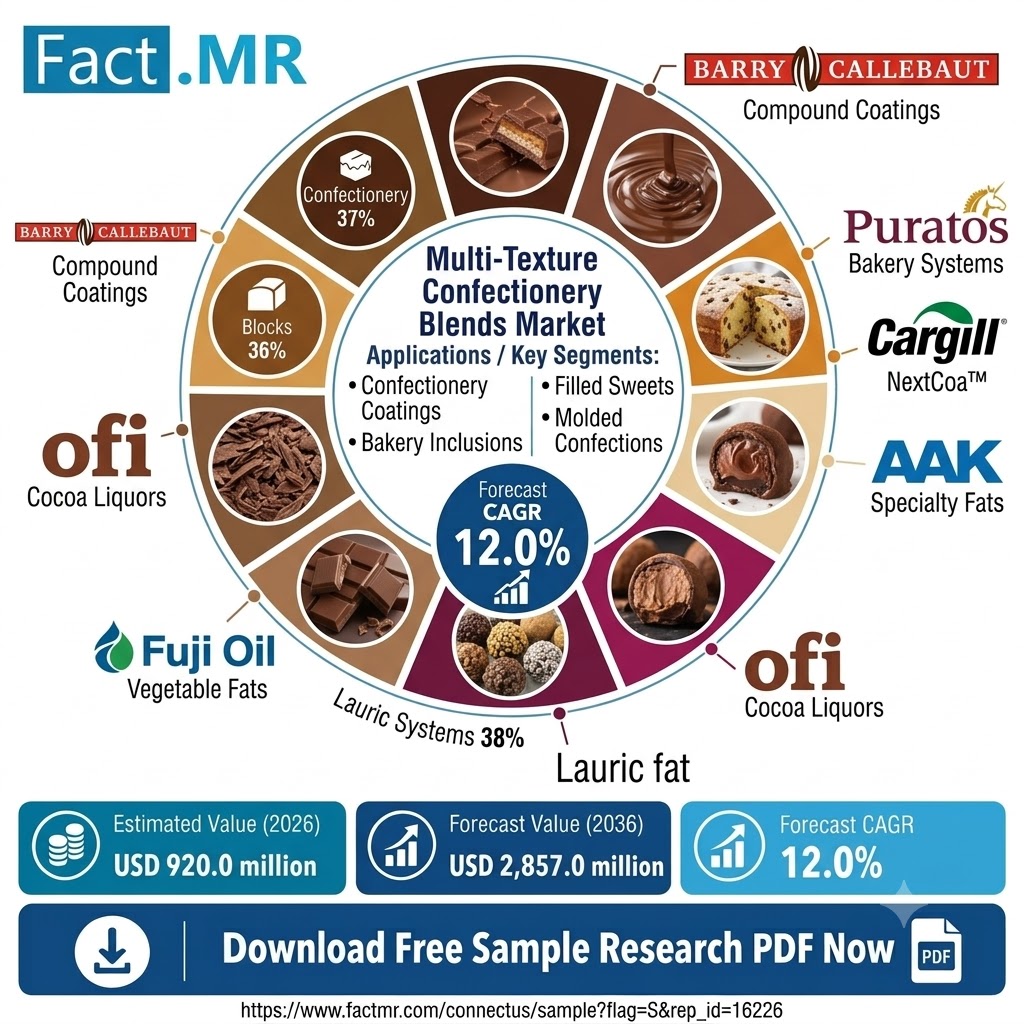
NEWARK, Del., October 7, 2026 — The Multi-Texture Confectionery Blends Market is projected to reach USD 2,857.0 million by 2036, rising from USD 920.0 million in 2026 at a 12.0% CAGR, according to Fact.MR. The market was valued at USD 821.4 million in 2025, creating an absolute opportunity of USD 1,937.0 million between 2026 and 2036.
Demand is being shaped by confectionery coatings, bakery inclusions and filled-sweet applications. Manufacturers are focusing on set time, bite, melt behavior and heat stability as products move through storage, transport and retail conditions. The U.S. Bureau of Labor Statistics reported on August 12, 2026, that U.S. sugar and sweets prices were 7.4% higher year over year in July 2026, adding another reason for manufacturers to review formulations.
Fact.MR is a market research company that analyzes multi-texture confectionery blends across fat system, function, application and form. The assessment draws on more than 120 sources, 35+ company portfolios, 25+ countries and more than 20 industry interviews.
Get detailed market forecasts, competitive benchmarking, and pricing trends: https://www.factmr.com/connectus/sample?flag=S&rep_id=16226
Multi-Texture Confectionery Blends Market Gains From Heat Stability
Heat stability is projected to account for 41.0% of the market by function in 2026. Manufacturers use heat-stable blends where coatings and filled pieces may encounter warmer transport or retail conditions. A blend that resists softening can help maintain shell integrity and reduce deformation.
Lauric systems are expected to lead the fat-system segment with a 38.0% share in 2026. Lauric systems provide fast set and hard bite in compound coatings, while non-lauric systems remain relevant where cocoa butter compatibility is central to flavor and melt behavior.
Confectionery is anticipated to represent 37.0% of the application segment in 2026. Molded sweets, coated snacks and filled bars remain direct uses, while bakery applications add demand for coatings and filling systems that retain texture after baking and cooling.
Blocks are estimated to hold 36.0% share of the form segment in 2026. Industrial users can store, melt and meter blocks through established equipment. Flakes, liquid and powdered formats address different handling and processing requirements.
Shambhu Nath Jha, Principal Consultant at Fact.MR, said, “The commercial issue is no longer only chocolate flavor. Manufacturers are paying closer attention to how coatings break, how fillings release flavor and how blends behave after storage.”
He added, “It’s about the process too. Suppliers that combine fat crystallization control, cocoa application knowledge and line-trial support are expected to gain preference.”
Reformulation Pressure Creates New Opportunities
U.S. food expenditure provides a large commercial backdrop for ingredient and formulation activity. USDA Economic Research Service reported in June 2026 that total U.S. food spending reached USD 2.51 trillion in 2025, including USD 1.10 trillion in food-at-home spending and USD 1.41 trillion in food-away-from-home spending.
Fact.MR estimates that heat-stable compound coatings could contribute approximately 1.6% to CAGR impact. Cocoa cost and formula flexibility carry an estimated 1.4% impact, while layered bakery and snack formats are associated with an estimated 1.1% impact.
Multi-layer bars and filled pieces represent an opportunity with an estimated 1.2% CAGR impact. Premium flavor control is estimated at 0.9%, while ambient bakery coatings carry an estimated 0.8% impact.
Sensory validation remains a constraint. Fact.MR estimates that the sensory gap versus cocoa butter could have a -0.8% impact on CAGR. Qualification time on coating lines carries a -0.6% impact because viscosity, flow and set behavior must match plant conditions.
Regional Growth Remains Broad
The USA is projected to record a 13.2% CAGR through 2036, the highest among the five highlighted markets. Germany follows at 12.6%, Japan at 11.8%, France at 11.3%, and Brazil at 10.8%.
USDA Economic Research Service reported the USD 2.51 trillion U.S. food-spending figure in June 2026. Germany produced 12.8 kilograms of chocolate per capita in 2024, according to Destatis data published in December 2025.
Japan’s Statistics Bureau reported a 2025 food consumer price index of 125.8 in January 2026. In France, INSEE reported an index value of 147.76 for December 2025 for the manufacture of cocoa, chocolate and sugar confectionery, based on 2021 = 100.
Brazilian National Supply Company, Conab, reported in August 2026 that Brazil was expected to produce 42.89 million tonnes of sugar during the 2026/27 crop year.
Competition Centers on Fat Systems and Application Support
Key companies profiled by Fact.MR include Barry Callebaut AG, Puratos NV/SA, Cargill, Incorporated, AAK AB, ofi and Fuji Oil Co., Ltd.
Barry Callebaut AG offers compound coatings and fillings for confectionery, bakery and ice cream applications. Puratos NV/SA participates through chocolate, filling and bakery systems. Cargill, Incorporated offers NextCoa™ confectionery alternatives and coating solutions.
AAK AB supplies specialty fats for chocolate and confectionery applications. ofi launched three deZaan single-origin cocoa liquors in February 2026, while Fuji Oil Co., Ltd. develops vegetable fats for chocolate and hard butters.
The report covers North America, Latin America, Western Europe, Eastern Europe, East Asia, South Asia & Pacific, and Middle East & Africa. The forecast period runs from 2026 to 2036.
View Related Reports :
About Fact.MR
Fact.MR is a market research and consulting firm providing market intelligence across industries and geographic markets. The Multi-Texture Confectionery Blends Market assessment combines primary interviews with manufacturers, service providers, technology developers, distributors, end users and subject-matter experts with desk research covering government statistics, company information, technical studies and industry data.
The analysis uses a hybrid top-down and bottom-up approach based on confectionery application demand, fat-system mix, function share, form share, country adoption and provider portfolio review.