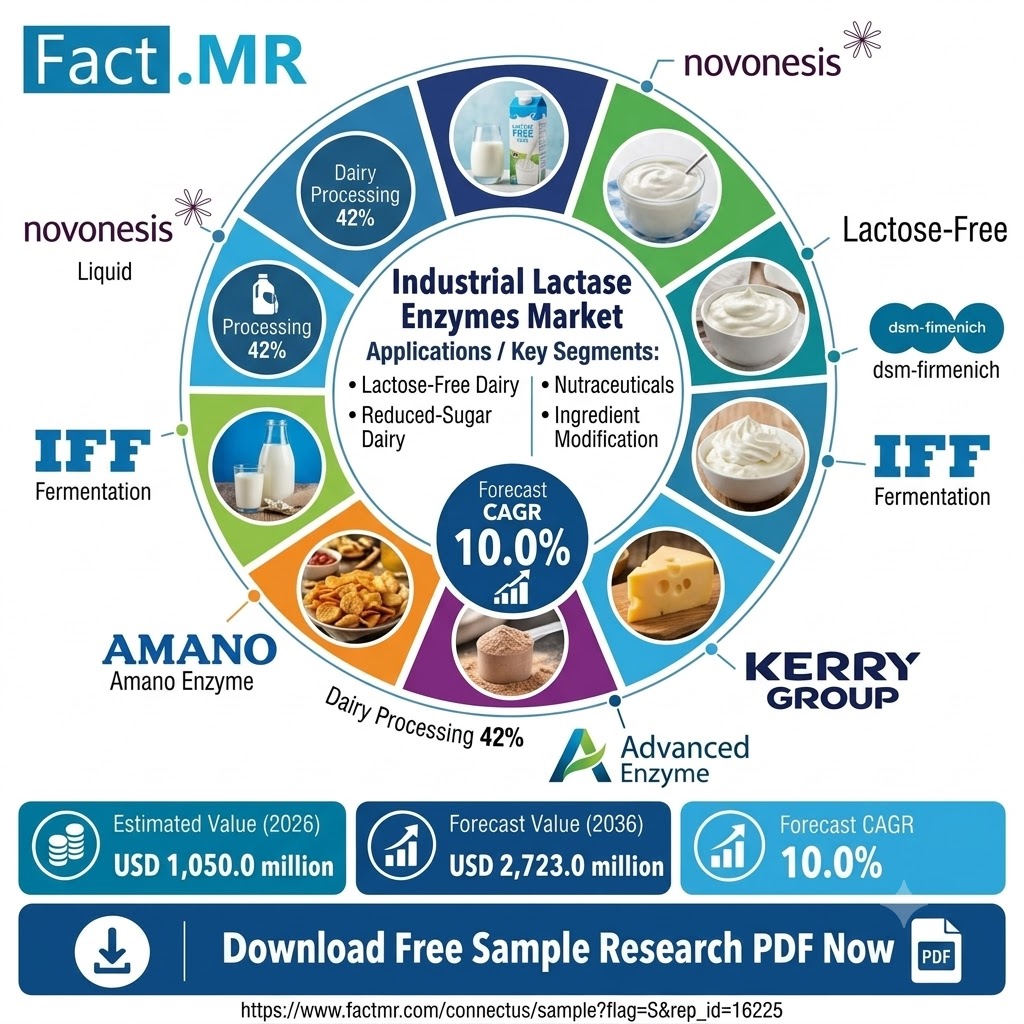
NEWARK, Del., October 7, 2026 — The Industrial Lactase Enzymes Market is forecast to reach USD 2,723.0 million by 2036, rising from USD 1,050.0 million in 2026 at a 10.0% CAGR, according to Fact.MR. The market was valued at USD 954.6 million in 2025, creating an absolute opportunity of USD 1,673.0 million between 2026 and 2036.
The answer to why demand is rising is closely tied to industrial dairy processing. Dairy processors use lactase for lactose hydrolysis in milk, yogurt, cream and related dairy streams, while food ingredient manufacturers apply the enzyme to modify sweetness and solids behavior. Nutraceutical formulators also assess enzyme activity, dosage form and documentation when selecting suppliers.
Get detailed market forecasts, competitive benchmarking, and pricing trends: https://www.factmr.com/connectus/sample?flag=S&rep_id=16225
Fact.MR is a market research company that analyzes industrial lactase enzymes across source, form, function, application and geography. The report draws on more than 120 sources, 35 company portfolios, 25 countries and more than 20 industry interviews.
Industrial Lactase Enzymes Market Growth Is Led by Dairy Applications
Dairy processing is estimated to account for 42.0% of the Industrial Lactase Enzymes Market in 2026. Lactose-free milk, yogurt and UHT products remain directly connected to industrial lactase use, while reduced-sugar formulation adds another application pathway.
Hydrolysis is anticipated to hold 38.0% share in 2026. Lactase performs the direct conversion of lactose into glucose and galactose. EFSA described β-galactosidase as EC 3.2.1.23 in June 2026 and stated that the enzyme catalyses lactose hydrolysis, releasing galactose and glucose.
Liquid is projected to represent 41.0% share in 2026. Dairy processors can dose liquid lactase into tanks and processing lines, including in-line aseptic systems. Novonesis lists Saphera® as a bacterial lactase available in liquid format and identifies in-line aseptic dosing among supported processes.
Microbial lactase is expected to lead the source segment with 44.0% share in 2026. Industrial fermentation provides producers with a route toward consistent enzyme activity and scalable production. Novonesis positions Saphera® for lactose-free milk and yogurt and states that the product can achieve less than 0.01% residual lactose.
Shambhu Nath Jha, Principal Consultant at Fact.MR, said, “The commercial test for industrial lactase is no longer limited to whether it breaks lactose.”
He added, “Dairy processors are expected to compare residual lactose, dosing flexibility, process time and sweetness outcomes before switching suppliers.”
Regulatory Data and Dairy Economics Shape Adoption
The market is expanding alongside lactose-free dairy line development and reduced-sugar formulation work. Fact.MR estimates that lactose-free dairy line expansion could contribute approximately 1.6% to CAGR impact, while reduced-sugar formulation in milk and yogurt carries an estimated 1.2% impact.
Food enzyme approvals remain a constraint. On June 9, 2026, EFSA published a safety assessment covering beta-galactosidase from Bacillus licheniformis strain NZYM-BT for three food-manufacturing processes following an application to extend use to two additional processes.
Residual lactose validation also adds cost because enzyme dose, temperature, processing time and product composition can affect the final lactose level.
The United States is projected to record the fastest growth among the five highlighted countries, with an 11.0% CAGR through 2036. USDA National Agricultural Statistics Service reported in April 2026 that U.S. milk production increased 2.6% in 2025 to 232 billion pounds.
Germany follows at 10.5%. Eurostat reported in November 2025 that Germany accounted for 18.8% of EU drinking milk production in 2024. Japan is forecast to grow at 9.8%, France at 9.4%, and Brazil at 9.0%.
Brazilian Institute of Geography and Statistics reported in March 2026 that raw milk acquisition in Brazil reached 27.51 billion liters in 2025. In France, Agreste reported in June 2026 that cow milk collection increased 1.2% year over year in April 2026.
Industrial Lactase Enzymes Market Opportunities Through 2036
Fact.MR identifies low-lactose and lactose-free UHT dairy as an opportunity with an estimated 1.1% CAGR impact. GOS and fiber-linked lactase applications carry an estimated 0.8% impact, while immobilized enzymes for controlled processing carry an estimated 0.5% impact.
The competitive landscape includes Novonesis, dsm-firmenich, IFF, Amano Enzyme Inc., Kerry Group plc and Advanced Enzyme Technologies Limited. dsm-firmenich participates through Maxilact enzymes, while IFF offers BONLACTA and NURICA lactase systems. Kerry Group plc operates an enzyme manufacturing hub in Carrigaline, Ireland.
The report covers North America, Latin America, Western Europe, Eastern Europe, East Asia, South Asia & Pacific, and Middle East & Africa. Its quantitative assessment uses USD million and covers the 2026–2036 forecast period.
View Related Reports :
About Fact.MR
Fact.MR is a global market research and consulting firm providing market intelligence across industries and geographic markets. Its Industrial Lactase Enzymes Market assessment combines primary interviews with manufacturers, service providers, technology developers, distributors, end users and subject-matter experts with desk research covering government statistics, regulatory publications, company information, technical studies and industry data.
The analysis uses a hybrid top-down and bottom-up approach covering dairy processing demand, enzyme form mix, source qualification, application intensity, country adoption and provider portfolio review.