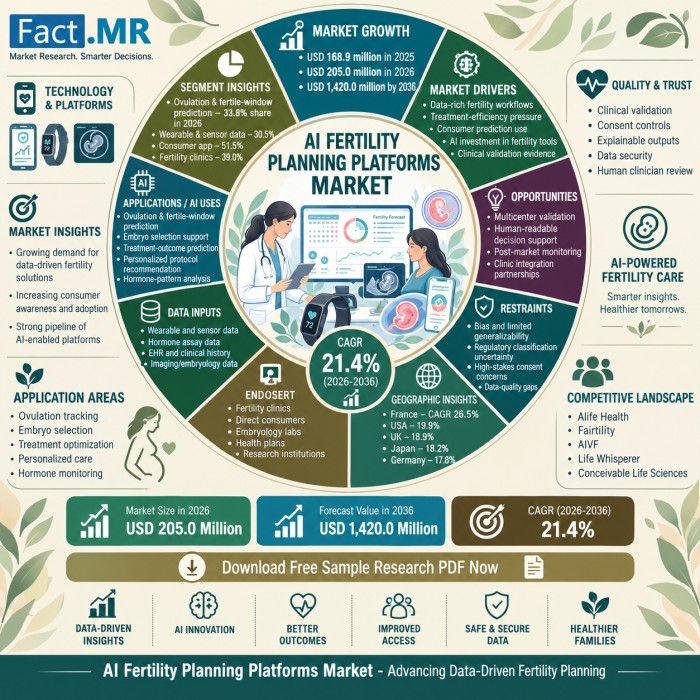
Rockville, Maryland — October 6, 2026: Demand for AI fertility planning platforms is accelerating as fertility-care providers and consumers increasingly use data-rich digital tools to support cycle interpretation, treatment planning, and clinical decision-making. Fact.MR estimates the market at USD 205.0 million in 2026, with revenues forecast to reach USD 1.42 billion by 2036, reflecting a 21.4% CAGR throughout the forecast period. The market generated USD 168.9 million in 2025, highlighting the expanding commercial role of artificial intelligence in fertility planning and decision-support workflows.
Get detailed market forecasts, competitive benchmarking, and pricing trends:
A major factor supporting market expansion is the growing volume of repeated fertility-care information, including hormone records, embryo-related data, cycle observations, and sensor-generated signals. AI platforms can organize these inputs into structured predictions that help clinicians review fertility-related decisions more consistently. Treatment-efficiency pressures are also encouraging clinics to consider software capable of supporting scheduling, interpretation, and review without replacing professional judgment. Consumer interest is expanding alongside this clinical demand as cycle tracking, wearable devices, and home-testing routines create more opportunities for personalized fertility planning.
Ovulation and fertile-window prediction remains the leading AI application, accounting for 33.8% of the market in 2026. Its leadership is linked to the established familiarity of users with cycle tracking, giving platforms a comparatively accessible entry point for AI-supported fertility planning. Wearable and sensor data follows as the leading data-input category with a 30.5% share, supported by the ability of passive signals to reduce manual data entry. On the deployment side, consumer applications are expected to hold 51.5% of the market in 2026, while fertility clinics represent the largest end-user group with a 39.0% share because clinical and laboratory context helps professionals assess whether AI-generated recommendations are appropriate.
Country-level growth shows substantial variation across the markets profiled by Fact.MR. France leads the country comparison with a 26.5% CAGR from 2026 to 2036, supported by reimbursement alignment and digital-care governance. The market is expected to favor platforms that provide evidence, consent controls, and clear boundaries around medical judgment before broader clinic adoption. The USA follows with a 19.9% CAGR, as fertility clinic networks, employer purchasing, and health-plan demand create commercial opportunities for validated software that fits existing treatment workflows. The UK is projected to expand at 18.9% CAGR, with adoption linked to evidence-led procurement and integration into established fertility-care pathways.
Japan and Germany also contribute to the broader country opportunity, although their growth rates are more measured. Japan is forecast to register an 18.2% CAGR, with physician oversight, localized interfaces, and appropriate consent language influencing adoption. Germany is expected to post a 17.8% CAGR as fertility-care organizations emphasize interoperability, disciplined procurement, data handling, and evidence review. These differences demonstrate that commercial expansion will depend not only on technological capabilities but also on reimbursement structures, institutional readiness, regulatory expectations, and the ability of providers to demonstrate that AI recommendations remain transparent and reviewable.
The competitive environment includes Alife Health, Fairtility, AIVF, Life Whisperer, and Conceivable Life Sciences. Alife Health is associated with clinic software and embryo-assessment workflows, while Fairtility provides embryo-image decision support through CHLOE BLAST. AIVF contributes tools for embryo and sperm assessment, Life Whisperer participates in AI-enabled fertility workflows, and Conceivable Life Sciences adds exposure to laboratory automation and AI applications. Competition through 2036 is expected to center on validation quality, workflow compatibility, consent design, and the ability to integrate platforms into fertility-care operations.
Despite the strong growth outlook, adoption faces challenges involving algorithmic bias, limited generalizability, regulatory classification uncertainty, consent requirements, and inconsistent data quality. Platforms trained using information from one clinic or patient population may not transfer equally across different care settings, increasing the importance of multicenter validation and post-market monitoring. Human-readable decision support can also help clinicians understand uncertainty and question AI-generated scores before acting on them.
Unlock 360° insights for strategic decision making and investment planning:
The AI fertility planning platforms market therefore presents opportunities for technology providers that can combine predictive capabilities with transparent clinical review, secure data practices, and integration-ready workflows. As fertility clinics, consumers, health plans, and other stakeholders evaluate digital tools, providers that demonstrate measurable performance and clear accountability may gain stronger adoption. The full Fact.MR report provides detailed market sizing, segment analysis, country-level forecasts, competitive intelligence, and strategic insights for stakeholders assessing opportunities through 2036.
Explore More Related Studies Published by Fact.MR Research
Acute Coronary Syndrome Market
Acute Care Needleless Connectors Market
Acute Respiratory Disease Diagnostics Market
About Fact.MR
Fact.MR is a global market research and consulting firm, trusted by Fortune 500 companies and emerging businesses for reliable insights and strategic intelligence. With a presence across the U.S., UK, India, and Dubai, we deliver data-driven research and tailored consulting solutions across 30+ industries and 1,000+ markets. Backed by deep expertise and advanced analytics, Fact.MR helps organizations uncover opportunities, reduce risks, and make informed decisions for sustainable growth.
– Contact Us –
11140 Rockville Pike, Suite 400, Rockville,
MD 20852, United States
Tel: +1 (628) 251-1583 | sales@factmr.com