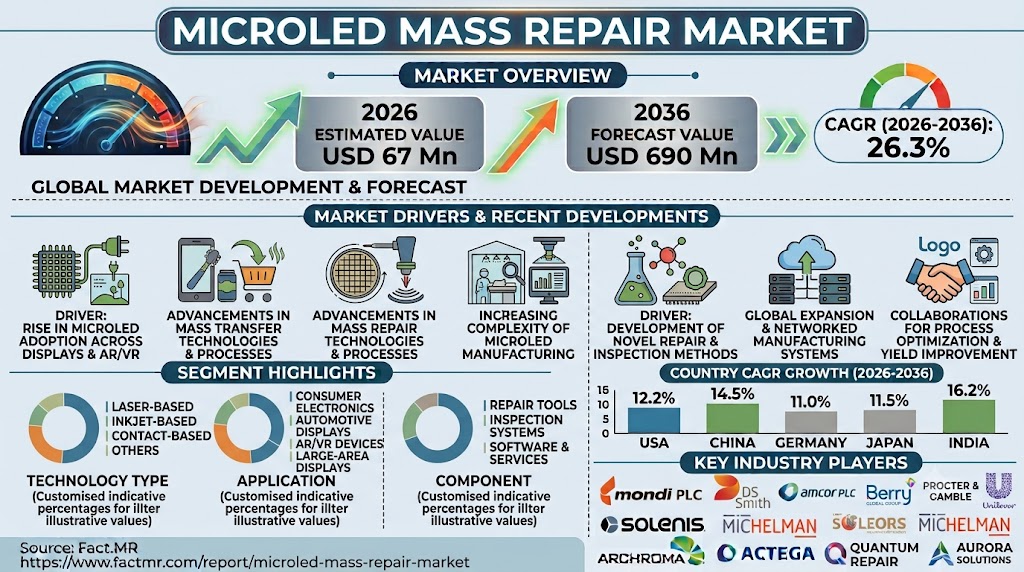
The global MicroLED Mass Repair Market is valued at USD 79 million in 2026 and is projected to reach USD 720 million by 2036, expanding at a 24.7% CAGR over the forecast period. The market was valued at USD 63.4 million in 2025, creating an absolute opportunity of USD 641 million through 2036.
MicroLED mass repair is becoming part of production yield management as display makers seek to correct defective emitters rather than discard larger panel sections. Repair workflows connect inspection coordinates with laser processing, replacement, redundancy activation, and post-repair verification. Panel OSATs and equipment OEMs are also evaluating modular repair cells for AR, automotive, and large-format display programs.
Get Detailed Market Forecasts, Competitive Benchmarking, and Pricing Trends
Global Segment Leaders
- Laser removal & replace accounts for 41.0% of the repair-method segment in 2026. The process can selectively remove failed or misplaced emitters after inspection while limiting disturbance to nearby pixels.
- Dead pixels represent 38.0% of the defect-type segment. These visible failures are a major focus during panel yield screening because they can affect the perceived quality of premium displays.
- Large-format displays hold 34.0% of the display-type segment. Tiled panels contain large numbers of emitters, creating a need for post-transfer inspection and targeted repair.
- Fully automated systems account for 52.0% of the automation segment. Automated alignment, defect-coordinate transfer, laser action, and verification can reduce operator variation across high-pixel-count panels.
- Display makers represent 47.0% of the end-user segment. In-house repair allows manufacturers to manage yield before finished modules move to downstream assembly.
Country-Level Performance
- Switzerland: The market is projected to expand at a 29.9% CAGR through 2036. Precision engineering, photonics capabilities, and an export-oriented machinery industry support demand for advanced laser and repair equipment. Swiss exports increased 1.4% to CHF 287.0 billion in 2025, according to the Federal Office for Customs and Border Security.
- Finland: A 28.1% CAGR is forecast through 2036. Microelectronics, photonics, and advanced manufacturing capabilities support potential demand for precision laser tools. Statistics Finland reported that working-day-adjusted turnover in the electronic and electrical industry increased 21.9% year over year in June 2026.
- Germany: The market is expected to advance at a 26.0% CAGR. Electronics activity and automation engineering provide an established environment for precision processing equipment. Destatis reported December 2025 monthly order growth of 5.7% for computer, electronic and optical products and 9.8% for electrical equipment.
- South Korea: A 23.9% CAGR is anticipated through 2036. The country’s established display and semiconductor manufacturing ecosystem supports demand for high-throughput laser and photonics equipment. ICT exports reached USD 264.3 billion in 2025, up 12.4% year over year, while semiconductor exports increased 22.1%.
- USA: The market is projected to grow at a 21.2% CAGR. Electronics investment and domestic laser-tool capabilities support adoption across research, prototyping, and production applications. U.S. Census Bureau data showed new orders for computers and electronic products increased 3.1% to USD 31.1 billion in June 2026.
- Japan: A 18.3% CAGR is forecast through 2036. Established electronics manufacturing and precision-equipment expertise support applications requiring tightly controlled laser processing. JEITA’s METI-sourced statistics reported electronic components and devices production of JPY 732,271 million in December 2025.
- United Kingdom: The market is expected to register a 17.5% CAGR. Compound-semiconductor, photonics, and specialist electronics capabilities provide a base for early repair validation and pilot manufacturing. The UK’s Semiconductor Sector Study 2026 reported approximately 16,350 direct employees across dedicated semiconductor companies and estimated GBP 7.5 billion in GVA in 2025.
Market Drivers and Opportunities
Defect correction for premium panels has an estimated +2.4% impact on CAGR and is the strongest listed driver. Display makers can compare the value of salvaging a module with the cost of scrapping a panel when deciding whether to deploy repair equipment.
Laser repair linked to inspection maps carries a +1.8% impact on CAGR. Production tools gain value when automated optical inspection and electrical testing can provide coordinates that directly trigger repair actions.
Automation for tiled display production contributes an estimated +1.3% impact on CAGR. Fully automated systems can reduce manual handling as large-format display production moves from pilot programs toward commercial output.
AR and automotive display validation adds an estimated +0.9% impact on CAGR, particularly where high-resolution displays require tightly controlled repair and verification.
The report identifies integrated repair and verification cells as an opportunity with a +1.5% impact on CAGR. These systems connect defect review, repair action, and post-repair validation in one workflow.
Micro-displays for AR and wearables carry a +1.2% impact on CAGR, while panel OSAT repair services contribute an estimated +0.8%. Contract repair could provide an alternative for display makers that want to validate repair economics before investing in dedicated equipment.
High qualification costs remain a key restraint, with an estimated -0.8% impact on CAGR. Each combination of pixel pitch, substrate, and bonding method can require its own process window. Slow repair cycles at fine pitch and limited common process standards also constrain adoption.
Competitive Landscape
The key companies profiled in the MicroLED Mass Repair Market include Coherent Corp., V Technology Co., Ltd., Kulicke & Soffa Industries, Inc. (LUMINEX), and PlayNitride Inc. Competition is focused on repair yield, laser-process repeatability, defect correction, and integration between inspection and repair workflows.
Coherent Corp. has direct commercial MicroLED repair activity through its UVtransfer portfolio, which includes pixel repair and trimming as well as a UVtransfer R remove-and-refill system.
V Technology markets FPD inspection and repair equipment, while Kulicke & Soffa’s LUMINEX provides a laser-based mini/microLED transfer platform with precision-correction capabilities. PlayNitride is also profiled within the competitive landscape.
Analyst Perspective
Shambhu Nath Jha, Principal Consultant at Fact.MR, states:
“MicroLED mass repair draws attention because defect correction is becoming part of yield economics, not only laboratory process learning. The market is expected to expand when inspection data, laser action and post-repair verification are linked in one production workflow. Suppliers should combine precise optics, reliable handling and repair software that gives engineers repeatable proof.”
The report covers laser removal and replacement, redundancy activation, selective re-transfer, and ink/bonding repair. It also examines dead pixels, misplaced dies, dim or color-shift defects, bonding voids, large-format displays, wearables and micro-displays, AR/VR, and automotive displays.
The analysis draws on 120+ sources, 35+ company portfolios, 25+ countries, and more than 20 industry interviews.
Other Related Reports:
Humanoid Robot Fleet Management Services Market
Human-Verified Content Certification Services Market
About Fact.MR
Fact.MR is a market research and consulting firm providing syndicated and customized research across technology, industrial goods, chemicals and materials, consumer products, and other major industries. Its research combines primary interviews, secondary research, market sizing, competitive analysis, and validation of industry developments.