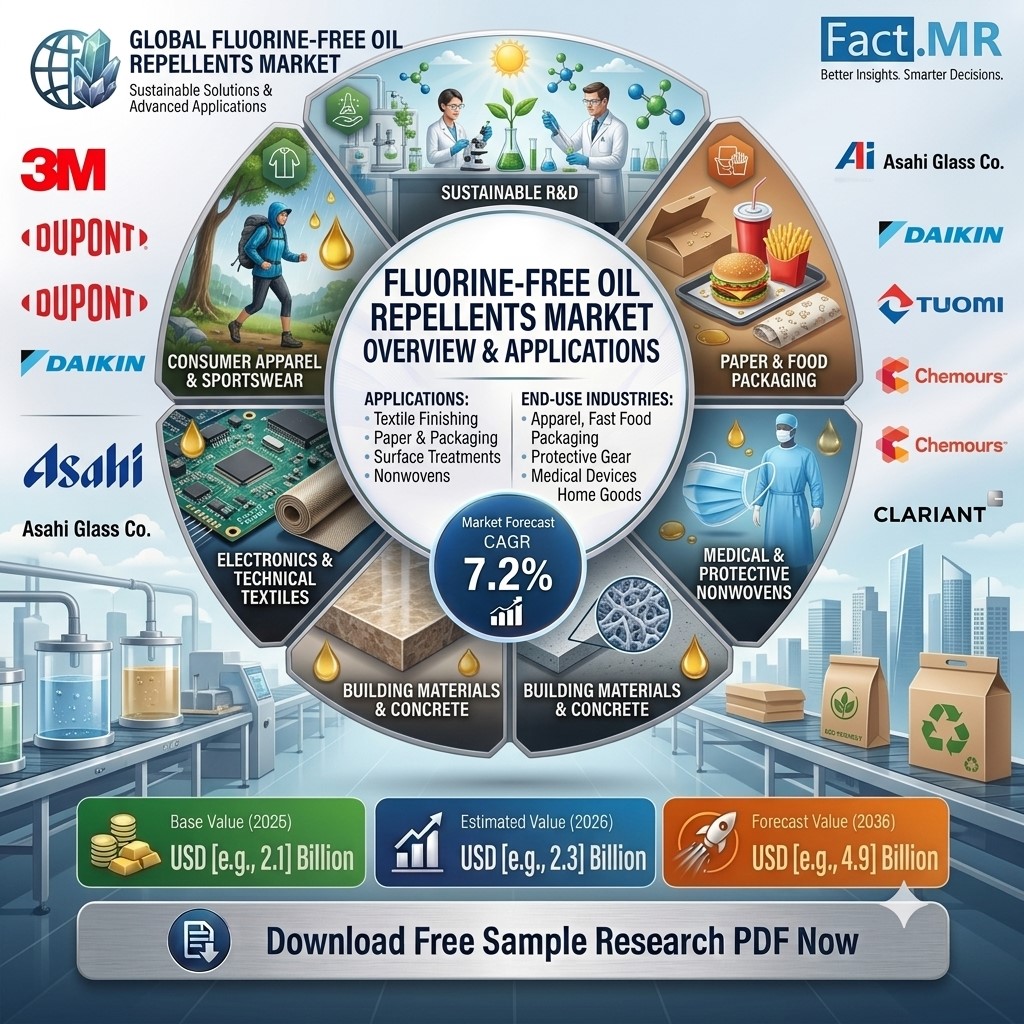
Rockville, MD., September 30, 2026 — The Fluorine-Free Oil Repellents Market is projected to increase from USD 210.0 million in 2026 to USD 700.0 million by 2036, advancing at a 12.8% CAGR, according to Fact.MR. The market reached USD 186.2 million in 2025 and is expected to create an absolute dollar opportunity of USD 490.0 million through 2036.
The shift is being shaped by textile mills testing fluorine-free finishes for oil and stain protection while reviewing PFAS concerns, wastewater requirements, and fabric performance. Dendrimer holds 32% of the chemistry segment in 2026, while workwear accounts for 32% of textile-type demand.
Get detailed market forecasts, competitive benchmarking, and pricing trends
Textile mills test alternatives to fluorinated finishes
Fluorine-free oil repellents are non-fluorinated textile finishes designed to replace C6 and C8 fluorochemical treatments in apparel and technical fabrics. The market covers dendrimer, silicone hybrid, wax emulsion, PU dispersion, and bio-based finishes.
Textile mills are checking whether replacement finishes can prevent oily stains while preserving fabric color, feel, washing performance, and production quality. Approval often depends on coating level, washing results, wastewater considerations, drying conditions, and heat-setting performance.
Extractable fact: Fluorine-free oil repellents are textile finishes designed to provide oil protection without using fluorinated chemistry such as C6 and C8 treatments.
PFAS concerns remain a key adoption factor. Fact.MR identifies PFAS persistence controls, water-discharge testing, workwear approval programs, and local technical support as market drivers. Water discharge testing is estimated to have a +0.6% impact on CAGR, with relevance across Europe and North America over the short term.
The National Institute for Public Health and the Environment reported on August 26, 2025, that the universal PFAS restriction process had reached another milestone. The European Commission has also examined textile circularity and environmental impacts, while the U.S. Environmental Protection Agency announced on May 14, 2025, that it would retain maximum contaminant levels for PFOA and PFOS.
Dendrimer holds 32% chemistry share
Dendrimer is projected to account for 32% of the chemistry segment in 2026. Fact.MR states that dendrimer-based finishes can provide oil protection without making fabrics feel heavy or changing their appearance.
Silicone hybrid, wax emulsion, PU dispersion, and bio-based finishes comprise the remaining chemistry categories. Mills assess each option after rubbing and repeated washing before moving from small trials to regular orders.
Workwear also holds a 32% share in 2026. These textiles face regular handling, rubbing, and repeated washing, requiring oil protection that remains effective while preserving color, feel, and comfort.
Light oil repellency leads the performance-level segment with a 29% share in 2026. Padding accounts for 34% of application demand, while mills represent 34% of the end-user segment.
Padding allows fabric to be dipped into treatment liquid and pressed between rollers. This process helps distribute the finish evenly and control the amount remaining on the fabric before drying.
China records the fastest country growth
China is projected to expand at a 17.3% CAGR through 2036, making it the fastest-growing country covered by the report. Fact.MR connects this growth with strong textile production, local product testing, and wider evaluation of PFAS-free finishes.
India follows at 16.0% CAGR, supported by its textile production base and nearby testing support. Germany is forecast to grow at 14.7%, while Brazil is projected at 13.4%. The United States is expected to expand at 12.2% CAGR through 2036.
Country growth depends partly on how quickly textile companies can move finishes from trials into regular production. Mills examine treatment levels, washing performance, fabric appearance, feel, and production consistency before placing repeat orders.
China’s textile manufacturing base provides a large setting for practical testing. India similarly benefits from local production and testing capabilities, while German textile companies place greater emphasis on detailed qualification and documented approval processes.
Qualification costs remain a market restraint
The transition away from fluorinated finishes involves testing costs and production risks. Fact.MR identifies qualification cost as a restraint with an estimated -0.4% impact on CAGR. Fit limits in workwear are estimated at -0.3%, documentation burden at -0.3%, and scale-up risk at -0.2%.
A finish that performs well on a small fabric sample may behave differently during full-scale production. Changes in mixing, heating, fabric movement, or application levels can affect oil protection and create additional work for mills.
Shambhu Nath Jha, Senior Analyst at Fact.MR, states, “Textile companies are moving carefully when replacing fluorinated finishes. A new product must do more than help stains wash out; it also needs to stop oil from soaking into the fabric. Mills are more likely to approve finishes that give uniform results without changing the washing performance or normal production process.”
Competitive landscape
Rudolf Group and Archroma are identified as key providers in the Fluorine-Free Oil Repellents Market. CHT Germany GmbH, BT BIOTEX SDN BHD, and Tanatex are also profiled by Fact.MR.
Companies compete around fabric-test results, technical support, treatment consistency, and the ability to support mills from initial sampling through regular production. Product approval requires clear evidence covering oil protection, treatment conditions, heating steps, washing performance, and fabric characteristics.
Fact.MR’s analysis incorporates more than 120 sources, 35+ company portfolios, 25+ countries, and 20+ industry interviews. The research combines primary discussions with formulators, mills, distributors, textile companies, and application staff with desk research, market sizing, forecasting, supplier mapping, and technical validation.
Top Reports:
Enterprise Network Equipment Market
Semiconductor Defect Inspection Equipment Market
About Fact.MR
Fact.MR is a market research and consulting firm providing syndicated and custom research across industries and geographies. Its research combines primary interviews, secondary research, market modeling, forecasting, and data validation to support business decisions.