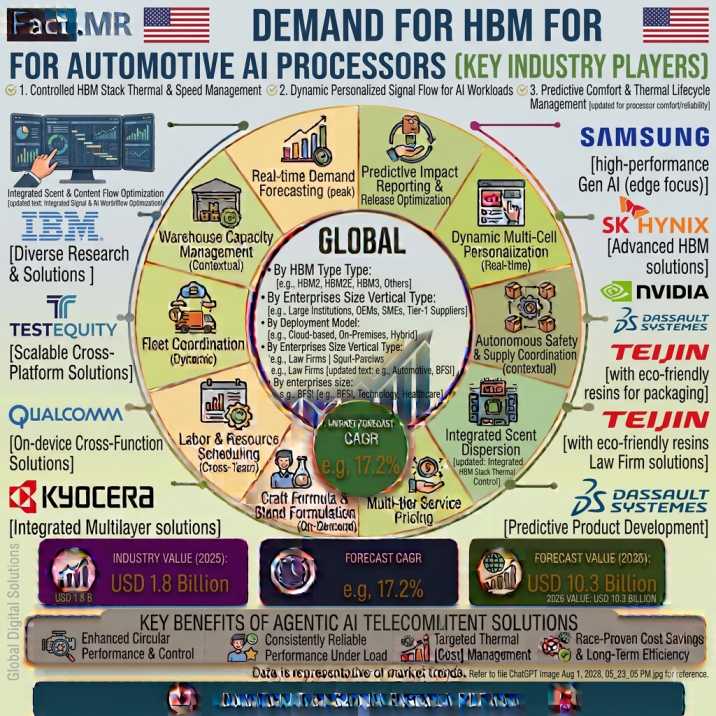
The global HBM for Automotive AI Processor Market is projected to grow from USD 2.1 billion in 2026 to USD 10.3 billion by 2036, registering a 17.2% CAGR during the forecast period, according to Fact.MR. The market was valued at USD 1.8 billion in 2025, creating an absolute opportunity of USD 8.2 billion through 2036.
High-bandwidth memory (HBM) is being evaluated for automotive AI processors that handle demanding camera, radar, sensor-fusion, autonomous driving, and centralized vehicle-computing workloads. As vehicle platforms process larger volumes of sensor data, memory bandwidth is becoming an important factor alongside processor performance, thermal management, and package reliability.
Get Detailed Market Forecasts, Competitive Benchmarking, and Pricing Trends: https://www.factmr.com/connectus/sample?flag=S&rep_id=16010
HBM3E and Autonomous Driving Processors Lead Key Segments
- HBM3E is projected to account for 54.0% of the market in 2026 by HBM memory type. Its position reflects the balance between high bandwidth and progressing qualification for automotive applications.
- Autonomous Driving Processors are expected to hold 47.0% share in 2026 by automotive application. These processors handle substantial data flows from cameras, radar, and other vehicle sensors.
- Automotive OEMs are anticipated to account for 42.0% share in 2026 by end user. Vehicle manufacturers influence memory and processor selection at the platform architecture stage.
- System-on-Chip Integration is estimated to represent 58.0% share in 2026 by integration model, supported by centralized computing architectures that keep processing and memory functions closely connected.
- Through-Silicon Via (TSV) Technology is forecast to hold 69.0% share in 2026 by packaging technology because TSVs provide dense vertical connections between stacked HBM layers.
South Korea, China and the USA Show Strong Growth
- South Korea: The market is forecast to expand at an 18.1% CAGR from 2026 to 2036. The country’s memory manufacturing depth and HBM packaging capabilities support automotive-grade qualification and supply.
- China: Demand is projected to grow at a 17.6% CAGR. Domestic semiconductor programs and processor localization are supporting interest in high-bandwidth memory for vehicle computing platforms.
- USA: The market is expected to register a 16.9% CAGR. AI infrastructure, processor design activity, and partnerships between chip vendors and automotive technology companies are supporting development.
- Japan: The market is projected to expand at a 16.3% CAGR, supported by its materials, electronics, inspection, and automotive technology capabilities.
- Germany: Demand is forecast to increase at a 15.7% CAGR. Premium vehicle platforms and automotive semiconductor development are supporting selective adoption of high-performance computing architectures.
- Taiwan: The market is expected to grow at a 15.0% CAGR, supported by foundry capacity and proximity to advanced packaging operations.
- Singapore: Demand is projected to rise at a 14.4% CAGR, with regional electronics manufacturing and engineering capabilities supporting packaging and testing activities.
Automotive AI Workloads Increase Memory Bandwidth Requirements
Automotive AI processors need to process continuous streams of information from cameras, radar, and other sensors. As driver assistance and automated driving systems become more centralized, processors require faster access to memory for perception and sensor-fusion workloads.
The growth of vehicle compute platforms is therefore creating a use case for HBM where bandwidth and response consistency are more important than the low cost of conventional memory.
The report notes that California autonomous vehicles operating under testing permits logged more than 9 million miles on public roads between December 2024 and November 2025. This growing testing activity illustrates the volume of perception and computing workloads involved in advanced vehicle systems.
Advanced Packaging Supports HBM Integration
HBM depends on advanced packaging to connect multiple memory layers with processor logic. TSV technology is particularly important because it enables dense vertical interconnections inside stacked memory packages.
System-on-Chip integration is also gaining relevance as vehicle platforms consolidate computing functions. Shorter data paths between processing and memory can help address bandwidth bottlenecks in high-performance automotive computing architectures.
The U.S. Department of Commerce finalized USD 1.4 billion in CHIPS National Advanced Packaging Manufacturing Program awards in January 2025, including USD 300 million for advanced substrates and materials research. Such investment supports the broader packaging ecosystem needed for dense memory-to-logic integration.
Automotive Qualification Creates Opportunities
Fact.MR identifies several opportunities for companies participating in the HBM automotive ecosystem:
- Automotive-grade HBM qualification can help suppliers establish access to vehicle programs before long platform-development cycles are locked in.
- HBM stack inspection and testing are becoming more relevant as memory packages become denser.
- Thermal-aware package design can help address the need to maintain memory bandwidth without requiring disproportionate increases in vehicle cooling capacity.
- Software-defined vehicle platforms can create longer-term demand for centralized computing architectures using higher-bandwidth memory.
The report identifies automotive-grade qualification as an opportunity with a +1.8% impact on CAGR, followed by HBM stack inspection and testing at +1.4%.
Package Cost and Qualification Cycles Remain Challenges
HBM remains more expensive than mainstream memory technologies. This can concentrate early automotive adoption in vehicle platforms where higher compute performance justifies additional package costs.
Thermal and reliability requirements are also important. Automotive processors must operate across strict temperature and lifetime conditions, making package validation a key step before wider vehicle-program deployment.
Long qualification cycles present another constraint. Automotive platforms move through extended validation stages, which can slow the transition from engineering samples to production use. Supply allocation pressure across South Korea, Taiwan, and China can also affect component availability.
Competitive Landscape
The market includes major HBM suppliers, semiconductor manufacturers, advanced packaging companies, and processor vendors. Key companies profiled by Fact.MR include:
- SK hynix Inc.
- Samsung Electronics Co., Ltd.
- Micron Technology, Inc.
- Taiwan Semiconductor Manufacturing Company Limited
- Advanced Micro Devices, Inc.
SK hynix contributes HBM manufacturing capabilities, while Samsung Electronics brings high-capacity HBM expertise for demanding compute applications. Micron Technology is developing HBM products for high-performance computing workloads.
TSMC strengthens the ecosystem through advanced semiconductor manufacturing and packaging capabilities. AMD contributes automotive AI processor technology, including automotive-grade embedded processors designed for AI workloads.
Recent Technology Developments
- In March 2025, Micron reported that its HBM3E 12H 36 GB product provides 50% more capacity than its HBM3E 8H 24 GB product in the same cube form factor and uses up to 20% less power than a competing HBM3E 8H 24 GB solution.
- In January 2026, AMD introduced its automotive-grade Ryzen AI Embedded P100 processor portfolio, offering up to 50 TOPS of NPU performance and AEC-Q100 support.
- In September 2025, SK hynix announced completion of HBM4 development, stating that bandwidth doubled and power efficiency improved by more than 40% compared with the previous generation.
Analyst Perspective
Shambhu Nath Jha, Principal Consultant at Fact.MR, stated:
“HBM for automotive AI processors is moving from a performance discussion into a platform-design requirement. Suppliers that can combine memory bandwidth, package reliability and automotive qualification evidence are expected to shape processor selection.”
The report also highlights the importance of automotive-grade testing, thermal validation, package reliability, and coordination between processor and memory suppliers before HBM-enabled platforms enter long vehicle production cycles.
About the HBM for Automotive AI Processor Market Report
Fact.MR’s HBM for Automotive AI Processor Market report covers the period from 2026 to 2036. The study analyzes the market by HBM memory type, automotive application, end user, integration model, packaging technology, and region.
HBM memory types covered include HBM2E, HBM3, HBM3E, HBM4, and other HBM types. Automotive applications include autonomous driving processors, ADAS processors, cockpit AI processors, sensor-fusion processors, and central vehicle compute.
The end-user analysis covers automotive OEMs, Tier 1 suppliers, semiconductor companies, autonomous vehicle developers, and mobility technology providers. Integration models include system-on-chip integration, chiplet integration, co-packaged memory, accelerator module integration, and custom board integration.
Packaging technologies covered include TSV technology, silicon interposer packaging, hybrid bonding, advanced substrate packaging, and other advanced packaging approaches. The report provides country-level analysis for South Korea, China, the USA, Japan, Germany, Taiwan, and Singapore.
The research uses a hybrid top-down and bottom-up approach incorporating memory demand, automotive AI processor adoption, packaging readiness, country growth, segment shares, and provider analysis.
Explore More Related Studies Published by Fact.MR Research:
About Fact.MR
Fact.MR is a global market research and consulting firm, trusted by Fortune 500 companies and emerging businesses for reliable insights and strategic intelligence. With a presence across the U.S., UK, India, and Dubai, we deliver data-driven research and tailored consulting solutions across 30+ industries and 1,000+ markets. Backed by deep expertise and advanced analytics, Fact.MR helps organizations uncover opportunities, reduce risks, and make informed decisions for sustainable growth.