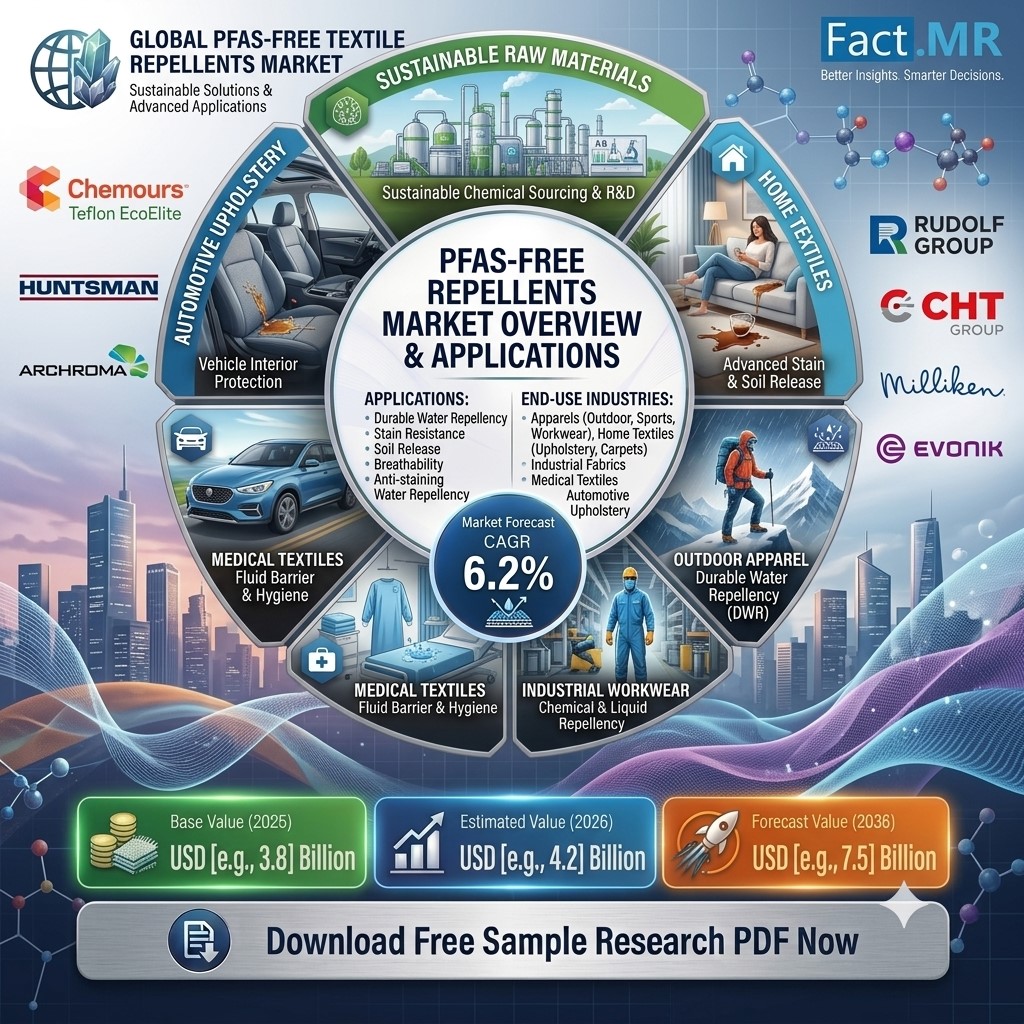
Rockville, MD., September 30, 2026 — The PFAS-Free Textile Repellents Market is projected to rise from USD 690.0 million in 2026 to USD 1.85 billion by 2036, expanding at a 10.4% CAGR, according to Fact.MR. The market was valued at USD 625.2 million in 2025 and is expected to create an absolute dollar opportunity of USD 1.16 billion through 2036. Germany is projected to record the highest country CAGR at 11.9%, while the United States is forecast to register 9.8%.
The shift toward PFAS-free textile repellents is tied to tighter PFAS controls, water-discharge testing, and growing evaluation of fluorine-free finishes. Textile mills are also testing whether alternative chemistries can maintain water resistance, fabric feel, wash durability, and production compatibility before approving them for regular use.
Get detailed market forecasts, competitive benchmarking, and pricing trends
PFAS restrictions increase demand for textile finishing alternatives
PFAS-free textile repellents are durable textile finishes formulated without PFAS or fluorinated chemistries. They are used to provide water, oil, or stain resistance across clothing, footwear, workwear, home textiles, and other fabric products.
PFAS restrictions are encouraging manufacturers to assess alternative finishes that can meet performance requirements without requiring major changes to existing production lines. Fact.MR identifies PFAS persistence control in water repellency as a driver with an estimated +0.8% impact on CAGR, while water-discharge testing carries a +0.6% impact.
Extractable fact: PFAS-free textile repellents are textile finishes that protect fabrics from water, oil, or stains without using PFAS or fluorinated chemistries.
The market’s largest function segment is water repellency, which accounts for 30% of the market in 2026. This position reflects its broad use across textile applications where manufacturers need fabrics to resist water during everyday use and maintain performance after washing.
Silicone holds 28% share in 2026
Silicone represents 28% of the PFAS-free textile repellents market by chemistry in 2026. Textile manufacturers already have experience with silicone-based finishes, supporting their use across different fabrics and end-use applications.
The report identifies outdoor apparel as the largest textile-type segment, with a 41% share in 2026. Manufacturers are evaluating finishes for jackets and other water-resistant clothing where performance after repeated washing remains an important qualification requirement.
Pad-dry-cure accounts for 35% of application methods in 2026. The method fits existing textile finishing operations, allowing manufacturers to introduce PFAS-free finishes with limited disruption to established production processes.
Textile mills represent 36% of the market by end user in 2026. Mills apply and test textile finishes directly, giving them an important role in determining whether a product can move from trials into regular production.
Germany records the fastest country growth
Germany is projected to expand at an 11.9% CAGR between 2026 and 2036. Fact.MR links this growth with local textile production and product testing, as mills assess fabric feel, water resistance, wear, and production performance before placing larger orders.
Brazil follows with a projected 10.9% CAGR through 2036. Textile companies are testing fluorine-free finishes for water resistance, fabric feel, durability, and ease of use before adopting them in regular production.
The United States is forecast to register a 9.8% CAGR. Fact.MR states that U.S. textile companies are using more fluorine-free finishes, while multiple trials may be required to confirm water resistance, fabric feel, and performance after repeated use.
The country growth figures are therefore Germany — 11.9%, Brazil — 10.9%, and United States — 9.8% CAGR for 2026–2036.
Qualification costs remain a market restraint
Testing remains a key part of the adoption process. Fact.MR identifies qualification cost as a restraint with an estimated -0.4% impact on CAGR. Silicone fit limitations, documentation requirements, and scale-up risks can also slow the movement of new finishes into high-volume production.
The report identifies a specific qualification detail: new finishes are tested on existing fabrics to determine whether they provide consistent performance under normal production conditions. Clear test records help mills and brands compare results and support approval decisions.
Shambhu Nath Jha, Senior Analyst at Fact.MR, states, “Companies want textile finishes that are easy to test and can deliver reliable results in production. Performance remains the main focus, especially in outdoor apparel applications. Suppliers that provide clear guidance and help customers during product trials are more likely to succeed in the market.”
Competitive landscape
The competitive landscape includes Archroma, Rudolf Group, HeiQ, Tanatex Chemicals, and CHT Germany GmbH. These companies are profiled for their presence across PFAS-free textile finishing applications.
Archroma and Rudolf Group provide textile finishes supporting water resistance and fabric performance. HeiQ also serves textile applications with fluorine-free products, while Tanatex Chemicals and CHT Germany GmbH are included among the key providers assessed by Fact.MR.
The report evaluates competition through product quality, performance consistency, product records, testing, and the ability to support mills during product trials and production adoption.
Fact.MR’s analysis uses more than 120 sources, 35+ company portfolios, 25+ countries, and 20+ industry interviews. Its methodology combines primary research, desk research, market sizing and forecasting, followed by data validation and updates based on production, testing, regulatory, and product-adoption trends.
Top Reports:
Waste Management Equipment Market
About Fact.MR
Fact.MR is a market research and consulting firm providing syndicated and custom research across industries and geographies. Its research combines primary interviews, secondary research, market modeling, and data validation to support business decisions.