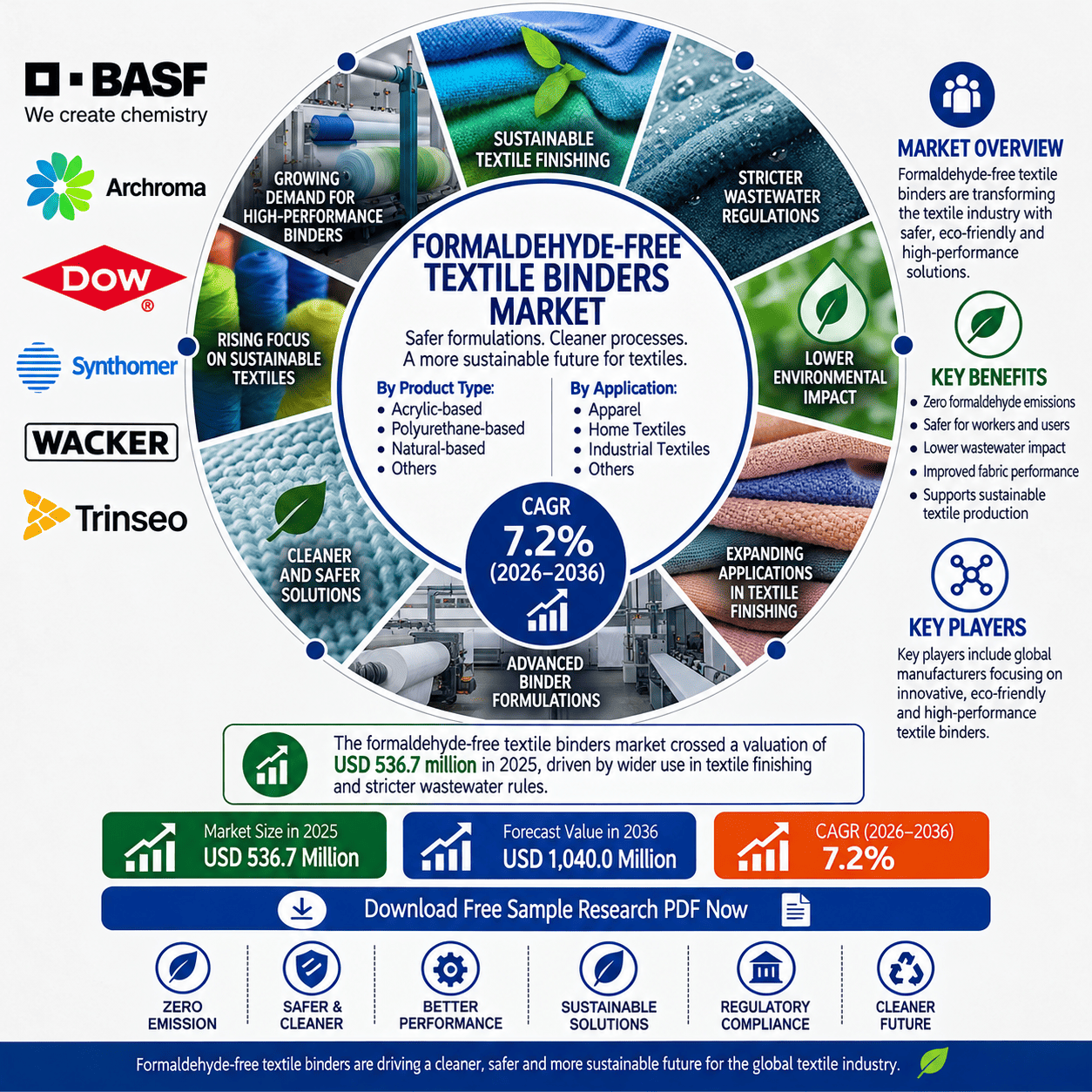
The formaldehyde-free textile binders market growing from USD 570.0 million in 2026 to USD 1.04 billion by 2036, representing a 6.2% CAGR during the forecast period. Textile mills are increasingly evaluating binders that can meet emission and wastewater requirements while preserving fabric strength, softness, appearance, and wash performance.
Stricter controls on persistent chemicals and wastewater discharge are influencing binder selection. Mills are not evaluating environmental performance alone; products must also perform under normal production conditions. Heating requirements, processing time, fabric feel, color retention, wash durability, and energy consumption are considered before a binder receives wider production approval.
Get detailed market forecasts, competitive benchmarking, and pricing trends
Nonwovens Account for 38% Market Share
Nonwovens are projected to hold 38% of the market in 2026, making them the leading application segment. Binders used in nonwovens must keep fibers firmly together during processing and use while maintaining wet strength without making the material excessively stiff. Factory trials therefore remain important before mills commit to repeat purchases.
By chemistry, acrylic binders account for 32% of the market in 2026. Their established use in textile processing allows mills to evaluate strength, softness, drying behavior, heating requirements, and wash performance under familiar production conditions. Apparel represents 32% of demand by textile type, while soft-hand performance holds 30% of the performance segment. Textile mills themselves account for 41% of buyer demand, reflecting their direct role in formulation testing, curing, and final approval.
China Leads Country-Level Growth
China is expected to record an 8.4% CAGR through 2036, the highest country-level growth rate highlighted in the report. Expanding textile production and increasing attention to wastewater and chemical requirements are encouraging mills to assess lower-emission binder alternatives. The ability to maintain fabric performance during factory-scale processing remains a key consideration.
India follows with a 7.7% CAGR, supported by textile manufacturing activity and growing demand for products that can satisfy evolving environmental and processing requirements. Local technical support and factory-level trials can help mills determine whether new binders deliver consistent results on their existing equipment.
Germany is projected to grow at a 7.1% CAGR, providing a strong European market perspective. German textile mills commonly assess binder grades through sample and production testing, checking application conditions, heating time, fabric strength, softness, appearance, and emission documentation before approving regular use. Brazil is expected to expand at 6.5%, while the United States is projected to record a 5.9% CAGR.
Low-Emission Finishing Shapes Product Development
The shift toward low-emission textile finishing is creating opportunities for binders that combine environmental compliance with reliable processing performance. Mills increasingly compare products under identical conditions so they can identify differences in softness, strength, appearance, wash life, and energy requirements.
PFAS-free textile demand is another factor influencing product development. Nonwoven producers and textile finishers are reviewing formulations that satisfy chemical restrictions without compromising the properties expected from finished materials. Local application laboratories and technical teams can support these evaluations by reproducing factory conditions before larger production trials.
Qualification costs remain a restraint. Replacing an established binder can require laboratory testing, fabric trials, production-line time, safety documentation, wastewater checks, and customer approval. A formulation that performs well in a small trial may also behave differently during full-scale production if heating, application levels, drying conditions, or fabric characteristics change.
Competitive Landscape
The competitive landscape includes BASF, Archroma, Dow, Synthomer, Wacker, and Trinseo, according to Fact.MR. Competition is shaped by binder performance, technical support, product documentation, production compatibility, and the ability to help textile mills complete qualification trials.
Shambhu Nath Jha, Senior Analyst at Fact.MR, notes that textile mills assess fabric strength, softness, wash life, appearance, heating needs, and wastewater results before moving a formaldehyde-free binder into larger-scale production.
Market Outlook
The formaldehyde-free textile binders market is expected to add USD 470.0 million in absolute opportunity between 2026 and 2036. Demand for low-emission finishing, tighter wastewater requirements, nonwoven applications, and binders capable of maintaining fabric performance is expected to shape the market through the forecast period.
To View top Reports
Blockchain Enabled PCR Material Certification Systems Market
About Fact.MR
Fact.MR is a market research and consulting company providing market intelligence, competitive analysis, and forecasting across global industries. Its research covers emerging technologies, evolving consumer trends, industrial developments, and changing business environments. Fact.MR delivers data-driven insights designed to support strategic planning, investment decisions, and market-entry initiatives.